

Editor’s note: TNGlobal is one of the media representatives from Southeast Asia invited to attend JETOUR International Press Conference at Auto China 2026. (sponsored)
As Jetour accelerates its global expansion, the Chinese SUV maker is positioning hybrid technology as the cornerstone of a pragmatic transition toward electrification.
In a recent interview with TNGlobal, Dai Lihong, President of JETOUR Auto, outlines how the brand’s “dual power” strategy — balancing internal combustion engines, plug-in hybrids, and battery-electric vehicles — is evolving to meet the realities of diverse global markets, especially in Southeast Asia.
From the rollout of its Global Architecture for Intelligent All-road (GAIA) off-road architecture and next-generation C-DM hybrid systems to its growing footprint across ASEAN, Jetour is betting that technological versatility, localized development, and rugged hybrid SUVs will give it a competitive edge in an increasingly crowded new energy vehicle landscape.
Jetour was launched by Chery Holding Group in response to market trends and consumer demand. The brand was officially created on Jan 22, 2018, and became an independent brand in 2021, with independent operations in research and development, procurement and marketing, information from its website showed. Chery Automobile Co., Ltd. was officially listed on the main board of the Hong Kong Stock Exchange in September last year.
In the interview, Dai also shared about Jetour’s plans and strategy, the impact of high fuel prices to its strategy, among others.
Below are the edited excerpts:
In our last discussion, you outlined a strategy for 2024–2025 focused on internal combustion engine (ICE) and plug-in hybrid (PHEV) models. Now that we’ve entered 2026, how is the transition toward a “balanced product portfolio” (ICE, PHEV, and BEV) progressing?
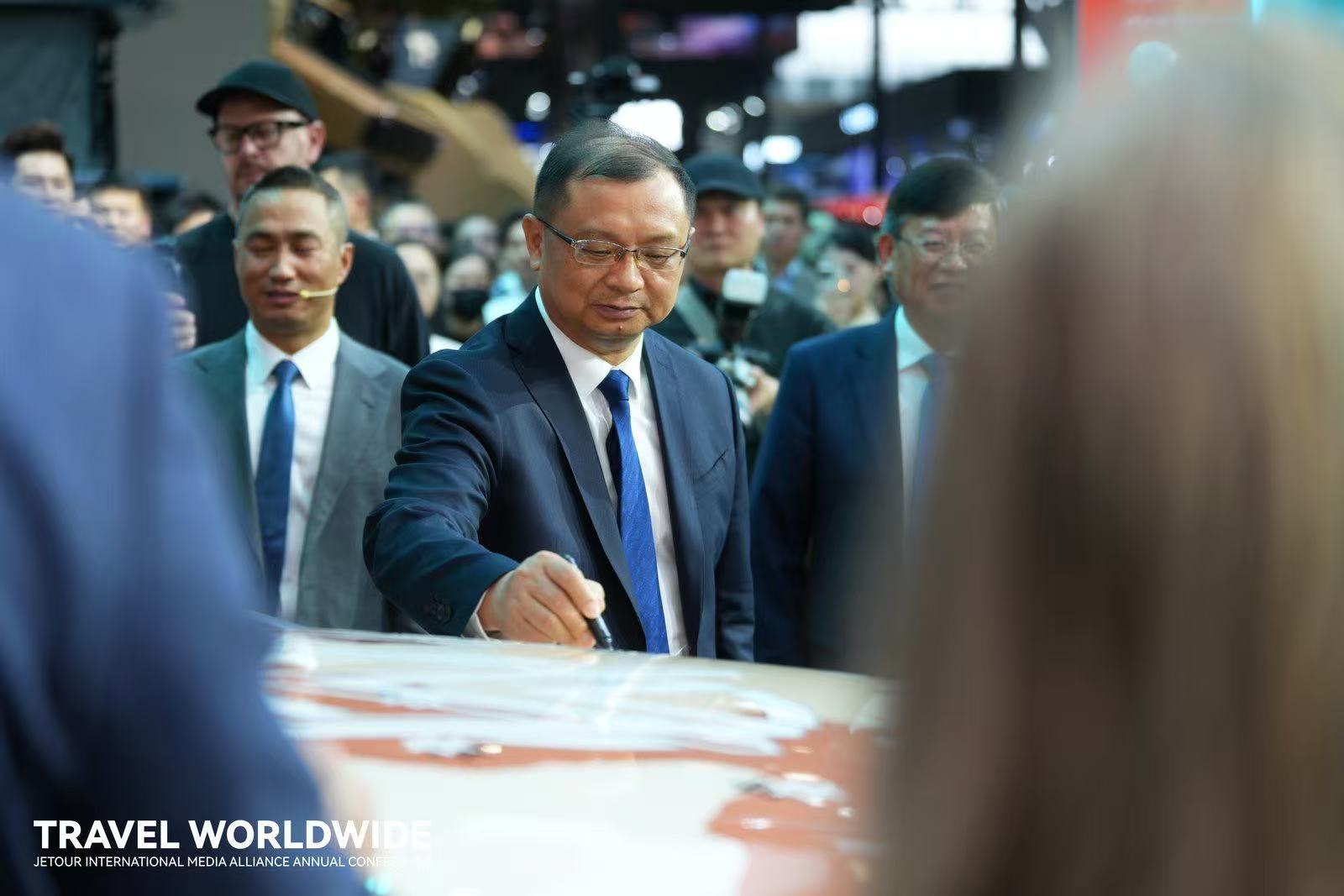
Firstly, we are committing to a dual power strategy and enriching the product experience: Hybrid technology is an essential bridge between the ICE era and the fully-electric era. Jetour remains committed to a “dual power” strategy, focusing on both efficient ICE vehicles and new energy vehicles to fully meet diverse user needs.
Global new energy vehicle penetration is rising rapidly (McKinsey forecasts it will reach 50 percent by 2030), but ICE vehicles still retain advantages in fueling convenience and maintenance accessibility in many overseas markets.
Currently, ICE vehicles contribute the majority of Jetour’s overseas sales. Going forward, we will continue to consolidate the ICE market while leveraging industry-leading hybrid technologies to achieve dual growth across different global energy structures.
Also, we are building a “technology moat” with hybrid systems as the bridge:
We have made significant R&D investments in hybrid technologies, integrating multiple technical routes including plug-in hybrid, range extender systems, and even hydrogen energy, forming a comprehensive and advanced technology matrix.
We have developed a new-generation all-terrain intelligent architecture, GAIA. Based on this platform, GAIA CDM-O Super Hybrid and GAIA CEM-O Range-Extended systems deliver both extreme off-road performance and ultra-low energy consumption.
In 2025, we launched multiple hybrid models such as T2 i-DM, G700, and S08 DM. F700 and G900 will follow in 2026 and 2027, further expanding the product lineup.
We are using the “One market, one strategy” approach to green transformation: We will advance in an orderly manner based on the maturity of each regional market. ICE and hybrid vehicles each have their own timing windows across markets; a balanced portfolio is the most pragmatic globalization path.
Southeast Asia is in a rapid energy transition phase with complex geographic conditions. We will introduce large hybrid SUVs tailored to multi-member families and evolving energy needs.
In markets with strict environmental regulations, such as Europe, we will focus on high-end hybrid models to achieve breakthroughs.
With many Chinese brands entering the ASEAN new energy vehicle market, how has this intense competition affected your pricing strategy and technology roadmap?
We believe competition as a catalyst for technological refinement. We have already entered seven ASEAN countries (Indonesia, Malaysia, the Philippines, Brunei, Laos, Myanmar, Cambodia). While competition is intense, it has helped clarify Jetour’s technological direction.
Our positioning is simple: to become a “leader in travel exploration.” The competition reinforces our commitment to refining our “golden combination” — the XWD intelligent AWD system and C-DM hybrid technology — to build differentiation in range, efficiency, and smart cockpit capabilities.
Extreme performance: XWD AWD + C-DM hybrid technology
To handle ASEAN’s rainy seasons, floods, and varied terrains, the T2 i-DM is equipped with the XWD intelligent AWD system, improving response speed by 20%, handling limits by 15%, and reducing operational steps by over 80% compared to traditional systems.
In testing, the T2 i-DM easily passed cross-axle and roller tests, demonstrating strong off-road capability and reliability.
To address range and efficiency concerns, C-DM hybrid technology delivers a balance between performance and energy savings. For example, the fifth-generation hybrid engine achieves a thermal efficiency of 45.95%, while the S08 DM offers a range of 1,300 km and fuel consumption as low as 5.18L/100 km.
Hardware foundation: GAIA architecture
ASEAN markets often have challenging road and weather conditions. The GAIA platform provides a strong mechanical foundation with high ground clearance, long suspension travel, and triple differential locks.
It also supports water wading up to 970 mm, leading its class in hardware capabilities.
Safety: ASEAN NCAP five-star rating
Jetour adheres to global standards, with over 600 rigorous testing criteria. In January, the T2 achieved a five-star ASEAN NCAP rating with a score of 86.50 and officially launched in Malaysia in March.
Confidence through mature technology
Our confidence lies in our technological foundation. Through GAIA and C-DM, we aim to define a more efficient and versatile mobility experience and popularize hybrid off-road vehicles.
Has the “next-generation hybrid engine” you mentioned last year been applied to key models in Southeast Asia?
We maintain a dual power strategy and tailor solutions for each country.
Key models in Southeast Asia: Jetour T2 and Dashing have launched in Malaysia and Indonesia. The Malaysian T2 features a 2.0T four-cylinder turbocharged engine, delivering strong power for long-distance driving.
Accelerating deployment of new hybrid technology: The latest CDM-O 2.0TD hybrid engine (45.95 percent thermal efficiency) is being introduced into Southeast Asia. The T1 i-DM launched in the Philippines in October 2025 with C-DM hybrid technology. Right-hand-drive versions of T1 i-DM and T2 i-DM will launch in Indonesia mid-2026. The GAIA architecture is already used in premium off-road models like G700, launching soon in the Philippines and entering RHD markets in 2027
Localization: Southeast Asia’s complex conditions demand strong power and reliability. Jetour has optimized systems for local conditions, including rough terrains. Cooling systems and power stability are designed to deliver a “fast, precise, and stable” driving experience. Moving forward, we will continue to iterate and upgrade technologies to better meet regional needs.
How is Jetour performing in Malaysia, Indonesia, the Philippines, and Cambodia? Are sales meeting expectations?
1. Balanced growth across Southeast Asia
We have entered 15 countries, with over 40 dealers (48 total) and Knock-Down factories in Indonesia, Malaysia, and Myanmar. In Myanmar, Jetour ranked number one in market share in 2025. The Philippines is experiencing rapid growth.
2. Localized operations
Subsidiaries in Malaysia and Indonesia enable better understanding of local needs and faster adaptation.
3. Future development
We will continue strengthening localization, improving services, and expanding across Southeast Asia.
How will oil price fluctuations due to the war in the Middle East affect Jetour’s strategy?
Oil price volatility has not changed Jetour’s core strategy. Instead, it reinforces the dual power approach. We will accelerate hybrid adoption to offset rising fuel costs while continuing to strengthen ICE vehicles.
How does Jetour deal with consumer hesitation due to fuel prices?
We address this through several ways such as efficient hybrid technology (C-DM), Full lifecycle service systems, localized R&D for extreme conditions.
Can you also share Jetour’s sub brand SOUEAST’s global expansion goals? Last year, SOUEAST Motor aimed to expand into more than 60 countries and regions by 2025. Has this goal been achieved? What is the goal for the end of 2026?
As of 2026, SOUEAST Motor has expanded its business into 48 countries and regions. Looking towards the end of 2026 and long-term development, SOUEAST has formulated clear global expansion goals: leveraging the Middle East and North Africa as strategic fulcrums to continuously radiate out to broader global markets. The long-term goal is to enter over 80 countries and regions and establish more than 2,000 service networks by 2030.
You previously mentioned about entering the Mexican and Egyptian markets. How did the brands perform in these two markets?
1. Launch Performance in the Two Major Markets:
- Mexican market: Mexico is Jetour’s core strategic market in Latin America. In 2025, Jetour officially established its Mexican subsidiary, with business operations radiating across the entire Latin American region, demonstrating the brand’s firm determination to deeply cultivate this market. At the same time, we established the Mexico-Central and South America Product Research Institute to conduct localized product R&D based on Latin America’s diverse geographic environments and user needs. Currently, 35 sales networks have been built locally, and the market layout is advancing steadily, laying a solid foundation for subsequent product introduction and sales growth.
- Egyptian market: The SOUEAST brand achieved phenomenal market performance in the Egyptian market, climbing to fourth place in Egypt’s passenger car segment and 6th place among all brands in just one year. Currently, the SOUEAST brand ranks among the top ten of all brands in the Egyptian market.
It is worth noting that the demand for leisure travel among family users far exceeded expectations: According to McKinsey research data, more than 45 percent of family car buyers in the Middle East and Latin America consider leisure travel as a core factor in their purchasing decisions, a trend that is even more prominent in the Mexican and Egyptian markets. Local users do not buy cars merely to satisfy basic commuting needs; instead, they highly value whether the vehicle can meet the needs of family weekend outings, long-distance touring, and outdoor leisure. This aligns perfectly with Jetour’s core “Travel+” strategy, further strengthening our determination to implement “Travel+” products and ecosystems in local markets.
Users have extremely high requirements for all-terrain adaptability and reliability: The Mexican market features complex terrain with a high proportion of plateaus and mountainous areas, demanding exceptional power response and all-terrain capability. The Egyptian market covers diverse road conditions including cities, deserts, and gravel plains, meaning users have stringent standards for vehicle stability, cooling performance, and power output. During the research, we found that local users prioritize “reliability and durability” far above smart features or entertainment configurations. This led us to purposefully strengthen localized product adaptation, such as optimizing power tuning for high-altitude environments and reinforcing thermal management for high-temperature climates, ensuring the products perfectly match the core needs of local users.
It is also worth noting that acceptance and demand growth rate for New Energy Vehicles (NEVs) far exceeded market expectations: In the Egyptian and Mexican markets, user acceptance and the growth rate of demand for hybrid and other NEV models far exceeded the team’s prior market forecasts. Local users care about the low fuel consumption and low operating costs of NEVs, but they also have extremely high requirements for their performance and reliability. This has prompted us to accelerate the introduction of C-DM high-efficiency hybrid technology into these two markets, offering hybrid products that balance performance and energy savings to meet local users’ rapidly growing demand for new energy.
Will Jetour enter other markets in Southeast Asia next?
In 2024, JETOUR entered right-hand-drive markets like Malaysia and Indonesia through its internal combustion engine (ICE) product portfolio. Currently, we have established KD (Knock-Down) factories in Indonesia, Malaysia, and Myanmar. Moving forward, Jetour will build upon this existing foundation to continuously and deeply cultivate the Southeast Asian market:
- Accelerating hybrid product introduction: Next, we will roll out spacious and stylish hybrid SUVs, such as the DASHING, X70, and T-series, to respond to the explosive growth of the Southeast Asian new energy market.
- Deepening localized R&D: We are currently preparing to establish overseas research institutes, including an ASEAN institute, aiming to achieve localized R&D and native product adaptation.
- Continuous full-region coverage: JETOUR will steadily expand into other mainstream automotive consumer markets in Southeast Asia. By upgrading our full-process service system, we will continuously provide local users with travel solutions that better fit their needs.
What about other markets? Which countries are you expanding into? Can you disclose the targets for 2026?
Core Expansion Market Roadmap:
- European market: With Poland as the core first stop, we will continue to deepen our layout in the EU market. Starting from the third quarter of 2027, we will successively launch brand-new models in Poland and across the wider EU market, achieving comprehensive coverage of mainstream EU countries.
- ANZ (Australia and New Zealand) market: We will officially enter the Australian market in the first quarter of 2027, followed by a gradual expansion into New Zealand to achieve full coverage of the ANZ region.
- Latin American market: Centered around Mexico, Chile, and Peru, we will continue to deepen our layout across the entire Latin American market. In 2026, we will introduce brand-new models like the G700 into the Peruvian market, gradually covering other mainstream automotive consumer countries in Latin America.
- African market: Focused on South Africa and Egypt, we will continue to expand into other African nations, deepening the layout of localized KD factories and service networks to achieve steady growth in the African market.
- Middle Eastern market: Building on our current leading position in markets like Saudi Arabia and the UAE, we will continue to deepen our footprint across the entire Middle Eastern region, refining our localized product and service systems.
In 2026, JETOUR will continue to adhere to its core “Travel+” strategy and its “dual-drive” (ICE and EV parallel) product strategy. We will deepen localized operations across all regional markets, accelerate the global rollout of new energy products, and continuously improve our global sales and service network layout. By steadily advancing our footprints in key strategic markets such as Europe, ANZ, and Brazil, and continuously consolidating our leading positions in advantageous markets like the Middle East, Latin America, Southeast Asia, and Africa, we will accelerate the brand’s global development pace.
Apart from the Chery brand itself, Chery Holding Group also owns other brands and sub-brands, such as Jetour, SOUEAST, as well as Omoda and JAECOO. Could you disclose how the overall strategy is formulated?
This Beijing Auto Show marks the first time that JETOUR and SOUEAST have appeared together on the same stage as a dual-brand line-up. Through the synergistic efforts of the JETOUR and SOUEAST dual-brand matrix, we achieve precise coverage of all user travel scenarios.
In terms of brand positioning:
- JETOUR focuses on professional off-roading, covering all-scenario needs from light off-roading to luxury off-roading.
- SOUEAST is positioned as an urban leisure travel companion, catering to the commuting and leisure needs of global urban users.
The two brands share a deep foundation in core technology and supply chain systems, both enjoying the Group’s globalized R&D resources and supply chain support. SOUEAST is equipped with the C-DM high-efficiency hybrid technology derived from JETOUR’s off-road standards, bringing users a next-level product performance experience through shared technology.
Currently, JETOUR has entered 100 countries and ranks first in the boxy SUV segment across multiple markets. SOUEAST has also expanded to 48 countries, breaking into the top ten of all brands in markets such as Egypt and Uzbekistan. Together, both sides are accelerating the brand’s upward breakthrough in the global market.
China’s JETOUR unveils “Travel+” strategy at Auto China 2026