

As we usher into the new year, we sought insights from prominent figures across the Southeast Asian tech landscape. These leaders reflected on their triumphs in 2025, sharing valuable perspectives on their achievements and the challenges they overcame.
They also unveiled their ambitious aspirations, meticulously outlined their strategic plans for 2026, and offered insightful predictions on the trajectory of the tech industry in the new year.
We talked to Roderick Purwana, Managing Partner at East Ventures to learn more about the firm’s development in 2025 and its plans and aspirations for 2026. He also shared his views on the outlook of tech ecosystem in Southeast Asia in 2026.
Founded in 2009, East Ventures said it has transformed into a holistic platform that provides multi-stage investment, from Seed to Growth stage investments, for over 300 tech companies across Southeast Asia. The sector-agnostic VC firm also have business operations in Japan.
East Ventures is committed to achieving sustainable development and bringing positive impacts to society through its initiatives and ESG-embedded practices. East Ventures is an active member of Global Private Capital Association (GPCA) Leadership Circle, Singapore Venture and Private Capital Association and Indonesia Venture Capital Association for Startups (Amvesindo), information from its website showed.
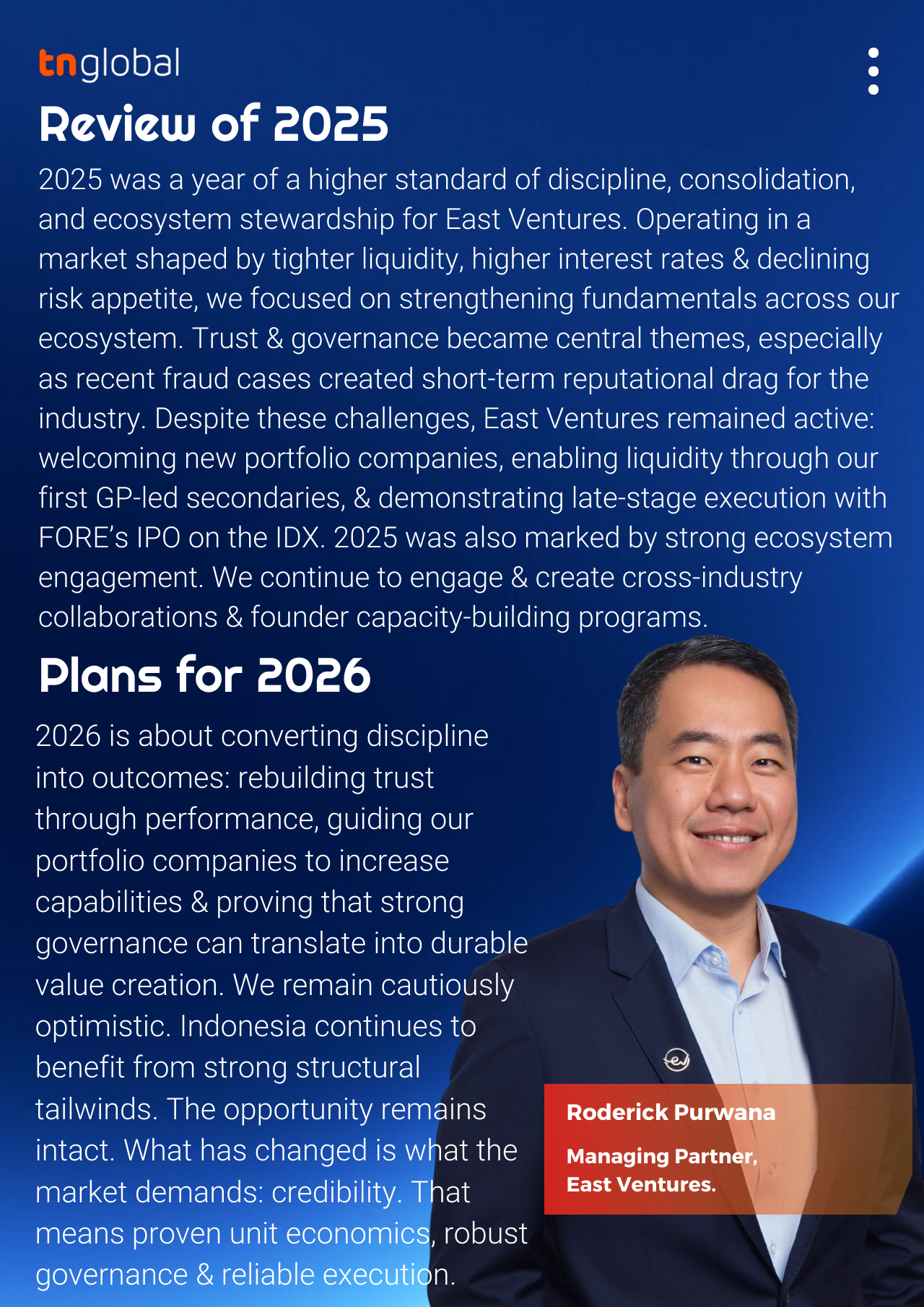
How was East Ventures’ 2025?
2025 was a year of a higher standard of discipline, consolidation, and ecosystem stewardship for East Ventures.
Operating in a market shaped by tighter liquidity, higher interest rates, and declining risk appetite, we focused on strengthening fundamentals across our ecosystem. Trust and governance became central themes, especially as recent fraud cases created short-term reputational drag for the industry.
Despite these challenges, East Ventures remained active: welcoming new portfolio companies, enabling liquidity through our first GP-led secondaries, and demonstrating late-stage execution with FORE’s IPO on the Indonesia Stock Exchange (IDX). Beyond investments, 2025 was also marked by strong ecosystem engagement. We continue to engage and create cross-industry collaborations and founder capacity-building programs. – In short, 2025 was about resilience and maturity: tightening standards, reinforcing credibility, and laying the groundwork for the next phase of growth.
What’s your expectation/aspirations for 2026?
For East Ventures, 2026 is about converting discipline into outcomes: rebuilding trust through performance, guiding our portfolio companies to increase capabilities, and proving that strong governance can translate into durable value creation.
We remain cautiously optimistic, and that is the appropriate stance. Indonesia continues to benefit from strong structural tailwinds—large domestic demand, accelerating digital adoption, and real, unresolved problems that technology can meaningfully address. The opportunity remains intact. What has changed is what the market demands: credibility. That means proven unit economics, robust governance, and reliable execution.
In a period like this, trust is rebuilt through outcomes. That’s why we focus on helping create a consistent pipeline of “good stories”—companies that execute well, govern well, and deliver results.
What are East Ventures’ plans in 2026? What is the focus in the new year?
As investors, we will continue to invest, supporting founders who are building with discipline and long-term intent, and work with stakeholders in the ecosystem building. In terms of sectors, we will remain sector-agnostic, with a focus on four areas: AI-first, healthtech, consumer tech, and climate tech.
Beyond capital, capacity building is a core priority. We work closely with our companies to strengthen execution, governance, and talent, ensuring they are built to scale sustainably. At the late stage, our focus is on deliberately developing credible liquidity pathways across public markets and strategic consolidation. We view liquidity not as a single event, but as the outcome of sustained discipline—anchored in governance, operational maturity, and founder alignment. Our role is to institutionalize optionality, so companies are prepared to engage with liquidity opportunities when market conditions allow.
In a period like this, trust is rebuilt through outcomes. That’s why we focus on helping create a consistent pipeline of “good stories”—companies that execute well, govern well, and deliver results.
How is the outlook for 2026 for the tech ecosystem in Southeast Asia or the market(s) in focus?
We’re in a very different phase versus the peak. The market has been in a down-cycle for roughly 24–30 months, and instead of freezing, it’s becoming more rational: fundamentals matter again, business models need to be clear, and governance is no longer optional. There are signs the worst part of the cycle may be behind us, but the pace of recovery will still depend on global conditions—rates, geopolitics, and liquidity.
We remain cautiously optimistic, and that is the appropriate stance. Indonesia continues to benefit from strong structural tailwinds—large domestic demand, accelerating digital adoption, and real, unresolved problems that technology can meaningfully address. The opportunity remains intact. What has changed is what the market demands: credibility. That means proven unit economics, robust governance, and reliable execution.
Gobi Partners to double-down on “uni-tech”, expects close of 2nd Pakistan fund in 2026 [Q&A]