

Editor’s note: For this special report series, TNGlobal spoke with investors, ecosystem builders, capital-market leaders and founders to examine the opportunities and challenges shaping Hong Kong’s next chapter in technology.
For robotics companies, the challenge is no longer demonstrating what a machine can do, but proving that it can deliver measurable returns in the workplace. Robocore Technology Ltd., the Hong Kong-founded service robotics company, is betting that the next phase of growth will come from making robots easier to deploy, integrate and operate at scale.
With applications spanning healthcare, eldercare, hospitality and retail, the company is moving beyond hardware sales towards a broader platform combining software, artificial intelligence and services.
The shift comes as Robocore seeks to build on a global footprint spanning nearly 20,000 client sites. A strategic investment from Foxconn, potentially worth up to $30 million, is expected to strengthen its manufacturing capabilities and support expansion in telemedicine and international markets. The company has set ambitious revenue growth targets and aims to begin preparing for a potential initial public offering within five years, with a pre-2030 listing as its goal.
In an interview with TNGlobal, Robocore Founder and CEO Roy Lim discussed the economics of scaling service robotics, the case for Robot-as-a-Service, and how Foxconn’s manufacturing expertise could help turn deployments into a repeatable global business. He also assessed Hong Kong’s strengths and shortcomings as a technology hub, including the need to bridge the gap between pilot projects and large-scale commercial adoption.
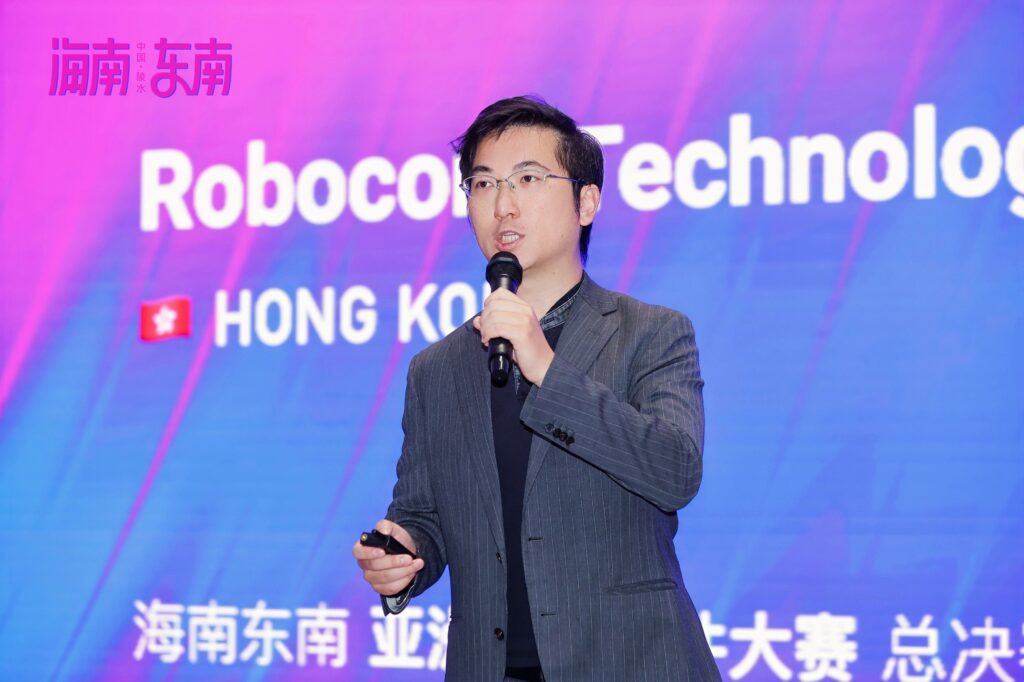
Below are the edited excerpts:
How Robocore has evolved since you founded the company in Hong Kong? What has changed most significantly in the business?
Robocore began with a simple conviction: service robots should not be closed, single-purpose machines. They should be open, adaptable platforms that businesses, developers and partners can configure for real-world needs.
In the early days, much of our effort went into proving that robots could operate reliably outside a laboratory—in hospitals, elderly-care facilities, schools, hotels, retail stores, offices and homes. We were selling both the technology and the vision. Today, the conversation has changed. Customers are no longer asking whether robots can be useful; they are asking how quickly they can deploy them, how they integrate with existing workflows, and what measurable return they can generate.
The biggest evolution has been from selling devices to building an ecosystem. That includes the robot platform, AI and telepresence capabilities, software, application partners, system integrators, fleet-management tools and vertical solutions. We have also grown from a Hong Kong-founded company with a global ambition into a company with robots deployed at nearly 20,000 client sites worldwide.
Our focus has become much more disciplined as well. We see particularly strong opportunities where robots solve persistent operational problems: healthcare access, eldercare, workforce shortages, smart facilities, education and customer-facing services. The question is no longer simply, “Can a robot move around and interact with people?” It is, “Can it help an organisation deliver better outcomes at a scalable cost?”
What is the biggest challenge in moving robotics from a technology demonstration into something that businesses and consumers are willing to deploy at scale?
The hardest part is not building an impressive robot demonstration. The hardest part is making the robot useful, reliable and economically justifiable every day.
A successful deployment must fit into a customer’s existing operations. In healthcare, for example, a robot cannot become an extra task for nurses or clinicians. It has to reduce friction—perhaps by enabling telemedicine, improving access to specialists, supporting patient communication or reducing unnecessary travel. In hospitality or retail, it needs to improve service consistency, productivity or customer experience without creating operational complexity.
There are four things that matter:
– Reliability in real environments, not controlled demonstrations.
– A clear workflow and measurable return on investment.
– Integration with people, systems and operating procedures.
– A commercial model that reduces the risk of adoption.
The human side is equally important. Robots must earn trust from employees, customers, patients and families. Technology adoption happens fastest when people see the robot as a practical tool that helps them do their work better, rather than as something imposed on them.
In our experience, the most scalable use cases are not necessarily the most futuristic. They are the ones where a robot solves a clear, repeated and costly problem. Telemedicine in eldercare is a good example: in New York State, temi robots have been used in more than 200 elderly-care homes to help doctors conduct remote consultations quickly. That is a practical deployment model with a direct impact on access and operating efficiency.
You have been talking about moving from one-off hardware sales toward a Robot-as-a-Service model. Why is this transition important for Robocore and for the wider robotics industry?
Robot-as-a-Service, or RaaS, is important because it aligns the economics of robotics with the way customers actually want to buy outcomes.
For many organizations, buying a robot outright can feel like a capital-expenditure decision with uncertainty around utilisation, maintenance, upgrades, software and long-term support. A RaaS model can make adoption more manageable by shifting the discussion toward a predictable operating cost and a defined service outcome.
For Robocore, it also changes our relationship with customers. We are not simply delivering hardware and walking away. We have an incentive to ensure the robot remains connected, supported, updated, utilised and valuable throughout its lifecycle. That creates recurring revenue, but more importantly, it creates a much stronger feedback loop. We learn continuously from deployment data, customer workflows and user behaviour, then improve the product and service.
For the wider industry, RaaS is likely to be a major enabler of mass adoption. Robotics should increasingly be sold as a service layer that delivers outcomes—remote consultations completed, staff time saved, customer interactions improved or facilities managed more efficiently—not just as a machine with a one-time purchase price.
The industry still needs flexibility. Some customers will prefer to purchase robots directly, particularly large enterprises or system integrators. But RaaS gives many customers a lower-risk route to start, test, scale and upgrade their robotic operations.
In 2025, Foxconn Technology made a strategic investment in Robocore, with a potential total investment of $30 million. What does having a global manufacturing and technology partner like Foxconn enable Robocore to do that it could not do as easily on its own?
Foxconn’s strategic investment is important not only because of the capital, but because it brings deep manufacturing, supply-chain and technology capabilities to our growth journey.
Building robotics at scale is different from producing a small number of prototypes. It requires disciplined product engineering, quality systems, component sourcing, cost control, manufacturing scalability and the ability to respond quickly to demand across different markets. Foxconn has extensive experience in those areas, and that can help us accelerate the transition from a successful robotics company to a globally scaled robotics platform business.
The partnership also reflects a shared view that robotics is becoming an increasingly important part of the next generation of AI-enabled technology. Robots are where AI meets the physical world. To succeed, companies need strong capabilities in hardware, software, manufacturing, data, distribution and vertical-market deployment. No single company can do all of that alone at global scale.
The announced transaction involves a potential total investment of up to $30 million, beginning with $10 million for a 6.6 percent stake in RoboTemi Global, with potential additional tranches over the following two years. We intend to use this support to strengthen our telemedicine activities in the United States, Europe and Japan, introduce new consumer products in mainland China, and expand our global sales and marketing capabilities.
For us, Foxconn is a strategic partner that can help improve speed, scale and resilience while we remain focused on what Robocore does best: developing open-platform service robotics and building practical applications around them.
You have set ambitious growth targets and are looking toward a potential IPO. What needs to happen operationally and commercially for Robocore to reach the next stage of growth?
An IPO should be the result of building a durable, globally scalable business—not the objective by itself. Our priority is to strengthen the fundamentals that would make Robocore IPO-ready.
Commercially, that means growing recurring and predictable revenue, increasing the proportion of customers that deploy robots across multiple sites, building stronger vertical solutions in healthcare and eldercare, and expanding our international distribution and system-integrator network. We need to demonstrate that deployments can be repeated efficiently, not just won one customer at a time.
Operationally, we need to keep improving product reliability, serviceability, fleet management, data security, compliance and unit economics. As deployments grow, our ability to support customers at scale becomes just as important as our ability to develop new features. A robot deployed in one location is a product; thousands of robots deployed across countries require a robust operating platform.
We also need the right governance, financial discipline and organisational depth. A public-market company must be transparent, resilient and capable of delivering consistently through different market cycles.
We have stated an ambition to grow revenue threefold over the next three years and fivefold by 2028, supported by expansion in telemedicine, consumer robotics and global sales. The plan is to initiate IPO preparation within five years, with the aim of being ready for a potential pre-2030 listing. Those are ambitious targets, but they give the organisation a clear operating direction.
For Hong Kong’s tech ecosystem:
Robocore is a good example of a company that was built in Hong Kong but has ambitions far beyond Hong Kong. Do you think Hong Kong is best understood as a market for technology companies, or as a launchpad for companies that want to compete globally?
Hong Kong is both, but for a company like Robocore, its greatest value is as a launchpad.
It is a demanding and highly connected market where companies can validate products with sophisticated customers in healthcare, property, hospitality, retail, education and financial services. At the same time, Hong Kong sits at a unique intersection: it has international capital markets, global business practices, strong legal and financial infrastructure, close links with mainland China and direct connectivity to Asia and the rest of the world.
For robotics, this combination is meaningful. You need customers willing to adopt technology, partners who understand international business, access to capital, proximity to advanced manufacturing, and the ability to build for multiple markets rather than just one. Hong Kong gives companies a base from which to think internationally from day one.
The important mindset is that Hong Kong companies should not treat the local market as the limit of their ambition. It can be an excellent proving ground, but the opportunity is global. We have always viewed Hong Kong as the place where we build our company, connect capabilities and launch into international markets.
For a robotics company, access to engineering talent, manufacturing capabilities and capital are all important. Which of these does Hong Kong do particularly well, and where are the gaps?
Hong Kong’s strongest advantages are its ability to connect different parts of the innovation ecosystem.
It does particularly well in several areas:
– Access to international business networks, investors, customers and professional services.
– A strong financial and legal environment for fundraising, partnerships and cross-border business.
– A high concentration of potential early adopters in healthcare, real estate, hospitality, retail, education and smart-city applications.
– Proximity to the Greater Bay Area and one of the world’s deepest electronics and manufacturing ecosystems.
– International talent and a business culture that helps companies build for global markets.
For a robotics company, Hong Kong Science Park and the broader ecosystem can also provide meaningful support through infrastructure, networks and access to innovation partners. Robocore’s headquarters at Hong Kong Science Park reflects that advantage.
The gaps are also clear. Hong Kong has strong talent, but the global competition for deep robotics, AI, embedded-systems and commercialisation talent is intense. We need to continue attracting specialised engineers, product leaders and experienced operators from around the world, while developing more local talent with experience in turning research into scalable commercial products.
There is also a gap between pilot projects and scaled procurement. Hong Kong is very good at innovation discussions and proof-of-concept projects, but more large organisations need clear pathways to scale successful solutions across multiple sites. Start-ups do not only need opportunities to demonstrate technology; they need reference customers prepared to deploy it repeatedly and at meaningful scale.
After building Robocore from Hong Kong into an international robotics company, what is the one piece of advice you would give to your younger self?
I would tell myself to focus earlier on the problem, the customer and the distribution model—not only the technology.
In robotics, it is easy to become absorbed by the machine: the sensors, movement, AI, interaction design and engineering. All of that matters. But technology alone does not create a successful robotics company. You have to identify a painful customer problem, understand who makes the buying decision, prove the return on investment, build the right channel partners and make deployment simple enough to repeat.
I would also say: build globally from the beginning, but stay focused. A Hong Kong company has the advantage of being naturally international, yet that can lead to trying to serve too many markets and use cases at once. The better approach is to establish a few high-value applications, make them work exceptionally well, build strong reference customers, and then expand systematically.
Finally, be patient about trust. In robotics, every successful deployment becomes a proof point. It builds confidence with customers, partners, investors and regulators. There are no shortcuts to real-world reliability, but over time, those deployments become one of the strongest competitive advantages a company can have.