

Editor’s note: For this special report series, TNGlobal spoke with investors, ecosystem builders, capital-market leaders and founders to examine the opportunities and challenges shaping Hong Kong’s next chapter in technology.
Hong Kong has spent the past decade building the foundations of a technology and innovation ecosystem. Today, the city has moved beyond the question of whether it can become a technology hub. The bigger challenge is whether it can scale its companies, commercialize more research and turn its position between China and global markets into a sustained competitive advantage.
For Hong Kong Science and Technology Parks Corporation (HKSTP), the ecosystem has reached the quality and maturity needed to compete with leading innovation hubs, but scale remains the next frontier. The organization now counts more than 2,600 technology companies and over 17,000 R&D professionals across its ecosystem, while its portfolio includes 14 unicorns.
In an interview with TNGlobal, HKSTP CEO Terry Wong discussed Hong Kong’s evolution as an innovation hub, its role within the Greater Bay Area, and where the city can carve out an advantage in AI and deep technology. He also told TNGlobal what needs to change in funding and commercialization to help more startups move from laboratory breakthroughs to global businesses.
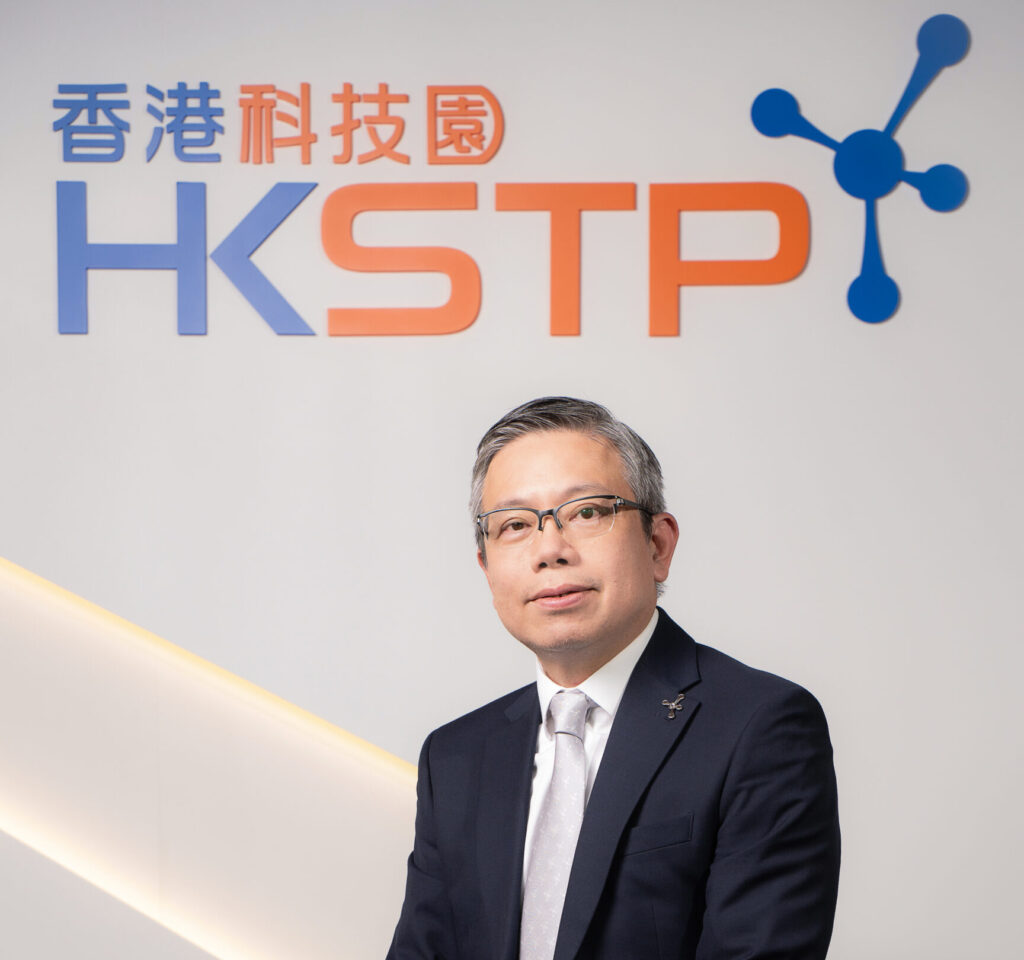
Below are the edited excerpts:
Hong Kong has invested heavily in building a technology and innovation ecosystem over the past decade. How would you assess Hong Kong’s progress today? Has the city reached the scale and maturity needed to compete with leading global innovation hubs?
Hong Kong’s I&T ecosystem has made remarkable progress over the past decade, with the entire innovation value chain becoming increasingly mature. In my view, Hong Kong has already achieved the quality and maturity needed to compete with leading innovation hubs globally. The next challenge is scale.
This progress is reflected in two international benchmarks. Our white paper with CB Insights awarded Hong Kong a Mosaic Score of 370, ranking first in Asia and fifth globally.
Meanwhile, the Shenzhen-Hong Kong-Guangzhou innovation cluster has ranked first in the Global Innovation Index for the second consecutive year. On quality, Hong Kong is already among Asia’s leading innovation hubs.
At HKSTP, we see this momentum firsthand. Our I&T ecosystem brings together more than 2,600 technology companies and over 17,000 R&D professionals, and has nurtured 14 unicorns, including SenseTime and Lalamove, demonstrating Hong Kong’s ability to build globally competitive technology companies.
Through HKSTP’s investment and partnership platform, portfolio companies have attracted significant follow-on private investment. Our Corporate Venture Fund has facilitated over HK$170 billion ($21.7 billion) in fundraising, with every HK$1 invested attracting HK$13 from private capital. This reflects strong market confidence in Hong Kong’s I&T ecosystem.
Hong Kong has been making great progress in its I&T development. The next focus should be on creating more large-scale technology enterprises, accelerating commercialization, and strengthening access to global markets.
That’s why the government’s first Five-Year Plan is so important. It sets clear targets, including raising R&D expenditure to 3 percent of GDP after 2030 and accelerating new industrialisation.
Combined with the rapid development of AI and life and healt technology, as well as the opportunities presented by the Greater Bay Area, these initiatives give us confidence that the next decade will be a golden era for Hong Kong innovation.
Hong Kong is competing with established technology hubs such as Shenzhen, Singapore, Seoul and Silicon Valley. What is Hong Kong’s distinctive advantage when it comes to building and attracting technology companies?
Hong Kong’s distinctive advantage is that we are the gateway between China and the world, while HKSTP helps companies translate that advantage into growth. While the Chinese Mainland leads in areas such as AI, advanced manufacturing and industrial scale, Hong Kong plays a unique role as a super-connector. We bring together international capital, talent, legal and regulatory standards, and global market access with the innovation, research and manufacturing strengths of the Mainland.
Hong Kong is also one of the world’s most research-intensive cities, with five universities ranked among the global top 100. Combined with our deep capital markets, common law system and trusted business environment, this gives technology companies a strong foundation to start, grow and expand internationally.
Hong Kong provides dedicated fundraising pathways for pre-revenue biotech and specialist technology companies through Chapter 18A and Chapter 18C of the HKEX Listing Rules. Since Chapter 18A was introduced in April 2018, it has transformed Hong Kong into a global powerhouse for healthcare listings. By removing traditional revenue and profit requirements for qualifying pre-revenue biotech firms, the framework created a vital bridge to international capital.
As of July 2026, 94 pre-revenue biotechnology companies have listed on the HKEX Main Board under Chapter 18A. Thanks primarily to Chapter 18A, Hong Kong firmly ranks as the second-largest biotech fundraising platform in the world and the largest in Asia.
At HKSTP, we support companies across the entire innovation journey, from ideation and incubation to fundraising, business matching, talent development and global expansion.
Through platforms such as our “Global Connect – Global Innovation Exchange” and the dual-park linkage between Hong Kong Science Park and our Shenzhen branch, companies can conduct R&D in Hong Kong while leveraging the manufacturing capabilities, supply chains and market opportunities of the Greater Bay Area.
Hong Kong is the only place in Asia that combines world-class research, international legal and financial infrastructure, a trusted bridge between the Chinese Mainland and global markets, and concrete government backing. We offer more than capital or space for innovation. We are a deal-making ground, a launchpad to Asia and the world.
How do you see HKSTP’s role within the Greater Bay Area evolving? Is Hong Kong primarily a gateway for international companies into the GBA, or can it become a technology hub in its own right?
Both — and they reinforce each other. Hong Kong is the international gateway into the Greater Bay Area — and also an
integral part of it. At HKSTP, we are building a two-way gateway that enables overseas innovators to use Hong Kong as a springboard into the GBA, while supporting Mainland companies in expanding to international markets.
Through platforms such as “Global Connect – Global Innovation Exchange”, we bring together international networks, delegations and I&T communities under one platform, allowing them to connect more effectively and access broader
opportunities, partnerships and resources.
But Hong Kong is also becoming a technology hub in its own right. Beyond research and entrepreneurship, the next phase of Hong Kong’s I&T development is about accelerating technology adoption and commercialization.
Through initiatives such as the Channel for Data-Driven Innovation and Commercialization (CDIC), we are connecting innovators with industry partners and real-world application scenarios, helping promising technologies move more quickly from the laboratory into the market and creating greater impact for the economy and society.
We are further advancing this vision through our “One Ecosystem, Two Cities” strategy. By connecting Hong Kong Science Park with our Shenzhen branch in Futian, we are creating a more integrated innovation platform where companies can leverage Hong Kong’s strengths in research, international talent and fundraising, while tapping into the Greater Bay Area’s manufacturing capabilities, supply chains and vast market opportunities.
This creates a powerful pathway for technology companies to move seamlessly from innovation and R&D, to product development, pilot testing, advanced manufacturing and large-scale market deployment.
So Hong Kong is not choosing between being a gateway and being a hub. Our role as a gateway strengthens our position as a technology hub, while our growing innovation and commercialization capabilities make us an even stronger gateway.
The two are inseparable.
AI is reshaping almost every technology sector. What areas of AI does HKSTP believe Hong Kong can realistically lead in, rather than simply follow larger markets such as the US and Mainland China?
AI is undoubtedly one of the defining technologies of our time and a new frontier of global competition. Hong Kong’s edge is not competing on scale with the US or the Chinese Mainland.
Our opportunity is to lead in AI industrialisation by turning AI breakthroughs into real-world applications and productivity gains across industries.
We are committed to advancing “AI+”, moving innovation from research and development to deployment, from technological breakthroughs to commercialization, and ultimately into economic value and societal impact.
First, AI-powered life and health technology is an area where Hong Kong is exceptionally well positioned to lead. Hong Kong combines world-class research, leading schools, strong clinical capabilities and deep AI expertise. A good example is Insilico Medicine, which used generative AI to develop the world’s first AI-generated drug candidate and has since partnered with many of the world’s leading pharmaceutical companies. This demonstrates how Hong Kong can apply AI to solve global healthcare challenges.
Second, we are building a complete AI innovation and commercialisation ecosystem. HKSTP hosts around 500 AI-focused firms and over 5,000 AI professionals. We have technologies spanning upstream R&D, midstream pilots, and downstream mass production — a complete chain that can scale innovation from 1 to 100. This is what allows AI research to become real products, from lab to market.
Third, we are investing in the infrastructure needed to support long-term AI development. Together with SenseTime, we are developing Hong Kong’s largest domestic AI Data Center, targeting more than 40,000P computing capacity by 2030.
This will strengthen Hong Kong’s AI capabilities while supporting the broader development of the “AI+” ecosystem.
Finally, talent remains fundamental. Through initiatives such as our “AI for All” Inclusive Program, we aim to benefit over 20,000 university students, early-career researchers, and professionals, helping build the talent pipeline needed to support Hong Kong’s long-term AI ambitions.
So where can Hong Kong realistically lead? Not necessarily in building the largest AI models, but in becoming one of the world’s leading hubs for AI commercialisation, AI-enabled healthcare innovation, and cross-industry AI adoption. That is where Hong Kong has a unique combination of research excellence, international connectivity and real-world application opportunities.
Deep-tech startups typically require much more capital, time and infrastructure than software startups. What needs to change in Hong Kong’s funding ecosystem to help more deep-tech companies make it from laboratory to global business?
A great idea is only the beginning. For deep-tech startups, the challenge is not just funding. It is navigating the long journey from research and development to commercialization and global expansion.
What Hong Kong needs is not simply more capital. We need an ecosystem that is aligned with deep-tech realities, where investors understand longer development cycles, higher technical risks and the time required to bring breakthrough innovations to market.
At HKSTP, we are working to bridge that gap. Through the Co-Acceleration Fund, and our Co-Acceleration Programme — Hong Kong’s first public-private partnership (PPP) private fund managed by a statutory body of the HKSAR Government, dedicated to the I&T sector.
The program combines HKSTP’s extensive experience in accelerating the growth of tech ventures with the industry resources, investment expertise and market channels of its LPs.
It brings technology ventures, investors and industry partners under one platform — providing not only funding, but also helping companies validate technologies, access customers, attract strategic partners and expand internationally. Examples include FluviusH2 and e-SENSOR.
We are leveraging Hong Kong’s unique strengths. Companies can access international capital markets, while benefiting from the manufacturing capabilities, supply chains and market opportunities of the Greater Bay Area. Through our partnerships and cross-boundary ecosystem, we help startups move more efficiently from laboratory research to large-scale deployment.
So the future of deep-tech is not just about more funding. It is about connecting capital, industry and markets. That’s the role HKSTP is playing. We are Hong Kong’s I&T ecosystem orchestrator, bringing together innovators, investors and industry partners to accelerate commercialization and growth.
Is Hong Kong moving fast enough? There is a lot of policy support and investment behind Hong Kong’s innovation ambitions. But compared with Shenzhen and other fast-moving technology hubs, do you think Hong Kong is moving quickly enough?
Hong Kong is moving deliberately and moving on the right things. When people compare Hong Kong with Shenzhen, they often focus on speed alone. But Hong Kong does not need to replicate Shenzhen’s model. Our goal is to build a world-class innovation ecosystem that combines research excellence, international capital, technology commercialisation and global market access.
At HKSTP, our focus is not simply on growing faster. It is on helping innovation move faster from the laboratory to the market. Whether through AI commercialization, cross-boundary collaboration in the Greater Bay Area, or programs that connect startups with investors and industry partners, we are shortening the journey from innovation to impact.
So when people ask whether Hong Kong is moving fast enough, my answer is yes. The speed that matters is not how quickly we build projects. It is how quickly we turn research into products, products into businesses and businesses into global success stories.
On that front, Hong Kong is accelerating.
Featured photo credits: HKSTP