

New U.S. Section 301 tariffs took effect on Friday (July 24) across 60 economies, hitting seven Southeast Asian nations: Malaysia, Cambodia, and Indonesia with a 10 percent additional duty, while Vietnam, Thailand, the Philippines, and Singapore face the higher rate of 12.5 percent.
The Office of the United States Trade Representative (USTR) published the final action on July 23 (US time), following a public comment period that drew more than 1,600 written submissions and a three-day public hearing.
Technology products, such as smartphones, laptops, semiconductors, and computers, are exempt from the new tariffs across all 60 economies.
Southeast Asia Split by Cooperation
Among Southeast Asian economies, Malaysia, Cambodia, and Indonesia entered into bilateral Agreements on Reciprocal Trade with the United States and are subject to a 10 percent additional duty.
Vietnam, Thailand, the Philippines, and Singapore did not adopt forced labor import prohibitions or enter into agreements with the United States. All four are subject to a 12.5 percent additional duty on top of existing most-favored-nation (MFN) rates, with no country-specific exemptions.
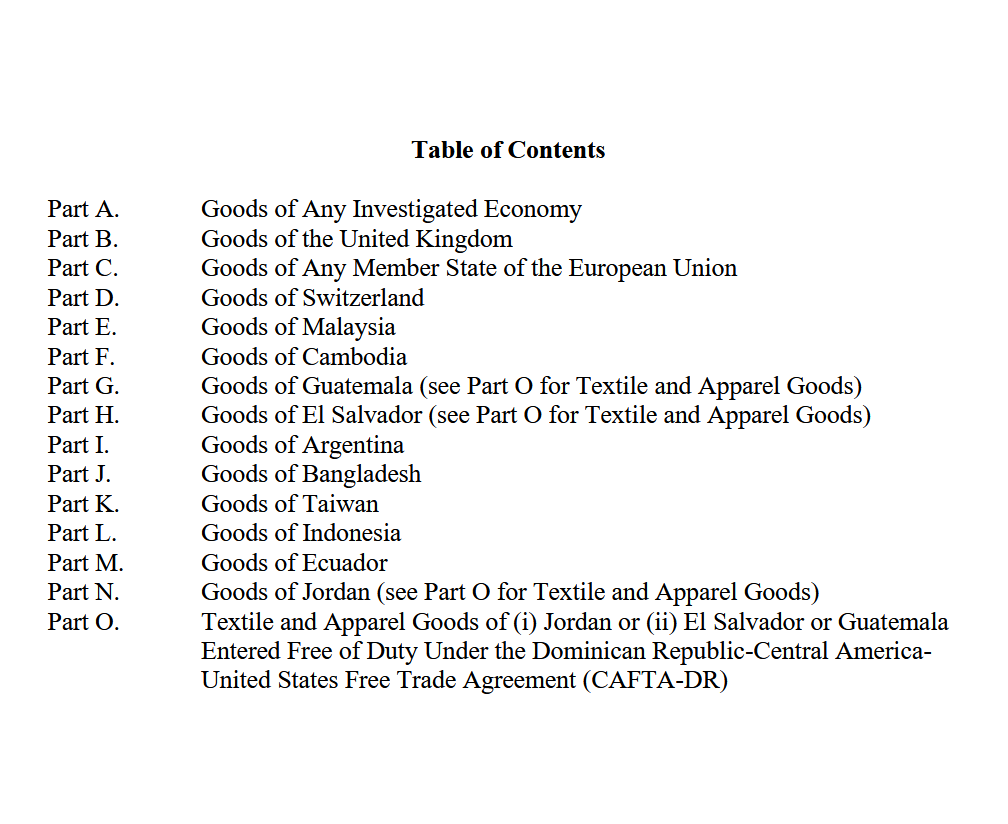
Annex II of the document provides product exemption table, listing every HTS subheading whose goods are not subject to the Section 301 tariff actions. Malaysia, Cambodia, and Indonesia each carry a dedicated section, namely Parts E, F, and L respectively of Annex II.
They listed products from those countries that are exempt from the Section 301 tariff beyond what already covers for all 60 economies. Most of the entries are agricultural products.
Technology Products Exempt Across All 60 Economies
Smartphones, laptops, desktop computers, hard drives, keyboards, and all other automatic data processing machines and their parts and accessories are exempt from the Section 301 tariffs across all 60 economies, including Vietnam, Thailand, the Philippines, and Singapore. The exemption covers HTS headings 8471.30 through 8471.90 for computers and 8473.30 for computer parts and accessories.
Smartphones and other cellular and wireless telephone handsets under HTS headings 8517.13 and 8517.14 are exempt.
Base stations, transmission and reception apparatus, and antenna equipment under headings 8517.61 through 8517.71 are also exempt.
Electronic integrated circuits, including processors and controllers, memory chips, and amplifiers, under HTS headings 8542.31 through 8542.90 are exempt across all investigated economies. Semiconductor manufacturing equipment is also exempt.
The USTR cited a ground for the technology exemptions, as the products could cause economy-wide disruptions if subjected to additional tariffs. Another reason is tariffs on these products may not contribute substantially to the elimination of the acts, policies, and practices found actionable in the investigations.
Critical Minerals and AI Infrastructure
Vanadium oxides and hydroxides, identified in public comments as essential inputs for energy storage systems used in AI data centers and electric grid applications, are exempt from the tariffs. Battery waste and scrap used in communications and safety technologies are also exempt.
Other Notable Universal Exemptions
Civil aircraft, engines, and parts; pharmaceutical articles; steel and aluminum derivative products already subject to Section 232 tariffs; passenger vehicles and light trucks subject to existing Section 232 tariffs; and wood products subject to existing tariff actions are exempt across all investigated economies. Humanitarian donations, informational materials, and accompanied personal baggage are also exempt.
In an era when tariffs have become the “global language,” how should companies respond?