

As Southeast Asian governments move nuclear onto their power roadmaps, it is worth being precise about what is actually holding the region back. It is not the reactors. The decisive obstacle to powering the region’s AI buildout with nuclear power is the absence of a financing structure capable of funding the first plants.
This is the central reframing of our report, “Nuclear Energy Fuels AI Boom in Southeast Asia Data Centers,” and it was reinforced repeatedly across our 2026 expert webinar series. The reactors are ready; the institutions that make first-of-a-kind (FOAK) projects bankable are still being built. The regional power system is fundamentally sound. What is missing is how FOAK risk gets allocated against a financing apparatus designed for low-risk, long-duration assets.
The economics are demanding
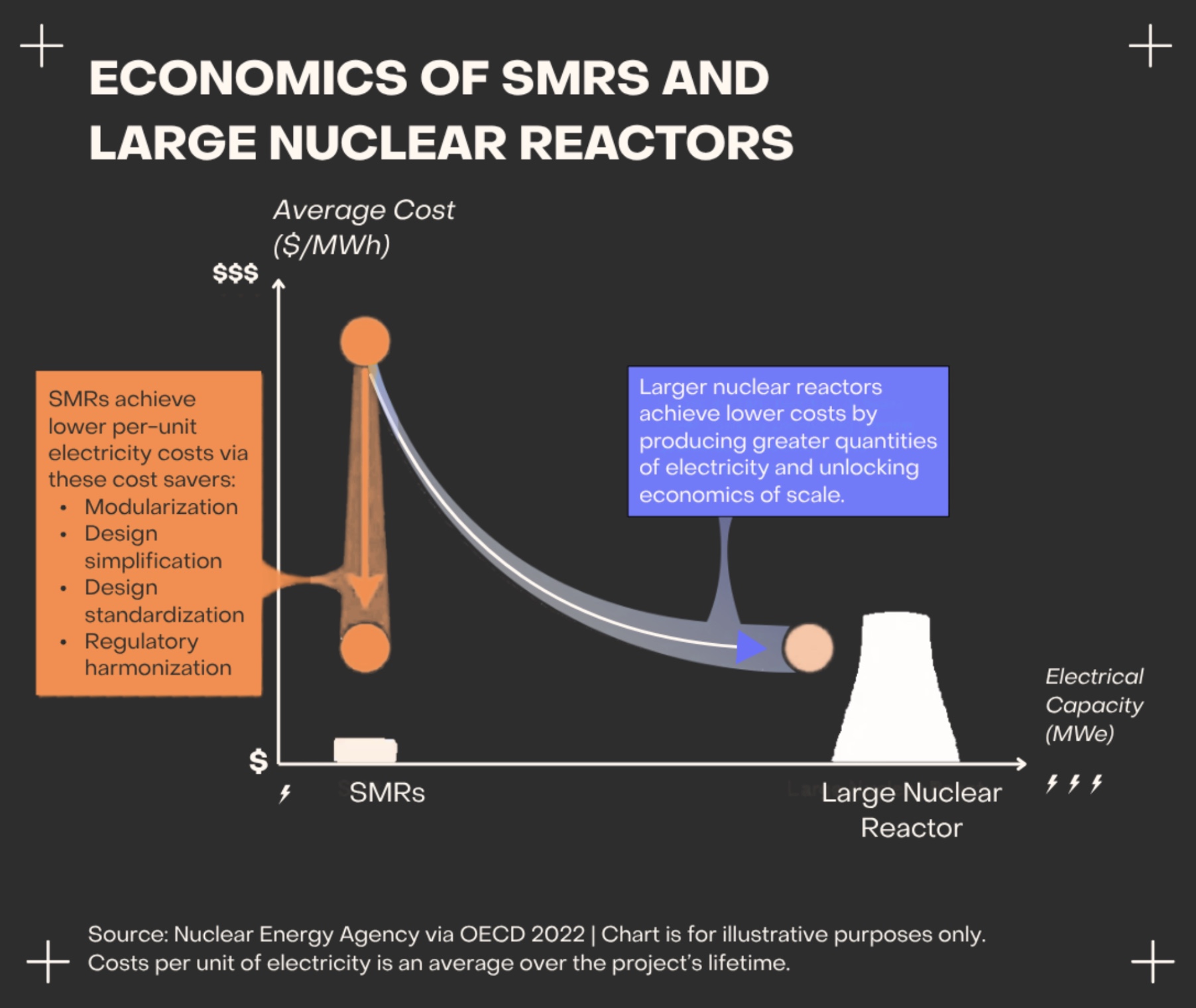
The numbers explain the urgency. Wood Mackenzie projects the region’s preferred SMRs will carry a generation cost of around US$220/MWh by 2050 — more than double the US$101/MWh estimated for conventional large-scale nuclear. Regional governments appear willing to pay that premium for factory-built quality, deployment speed, and siting flexibility. Yet data-center power-purchase agreements (PPAs) benchmark competitiveness at below USD 60/MWh. That gap puts the burden squarely on capital structuring, not on the technology.
The emerging playbook
Speakers at our intelligence webinars sketched what the solution looks like in practice.
TRIREC argued that nuclear investing should be valued biotech-style — through milestones such as design validation, anchor offtake, and final investment decision that lift net asset value long before first revenue, rather than through conventional revenue-timing models.
SGInnovate framed the regional thesis bluntly: build plants in low-cost jurisdictions and sell power to high-value customers — the logic underpinning the Singapore–Johor–Riau (SIJORI) corridor.
And the chief executive of SMR developer ThorCon International reset expectations on the first plant: its purpose is not to maximize returns, but to get built, operate, and establish the track record that makes every subsequent plant financeable.
A working template exists
We point to Sweden — where our portfolio company Blykalla secured backing for a six-reactor program supported by sovereign-rate debt and a long-term contract-for-difference — as a working template, and to Singapore’s blended-finance programs and its USD 35 billion green-bond pipeline as the most likely engine for an ASEAN equivalent.
The capital is arriving. According to PitchBook, nuclear-fission startups raised a record US$3.6 billion across 44 deals in 2025, more than double the prior peak.
As Linh & Tien, Earth VC’s Founding Partners, said, “No other clean energy source can fulfil the long-term developmental needs of human civilization the way nuclear energy can.”
The real question
The question is no longer whether nuclear has a role in Southeast Asia. The arithmetic of AI-era power demand settles that. The question is which market builds the financing architecture, the blended-finance layers, the offtake frameworks, the risk-sharing structures, to get the first plant in the ground. The first to do so will not just host a reactor. It will capture the regional pipeline that follows.
 Tam To is the Head of Marketing and Communications at Earth Venture Capital, a global deep tech venture capital firm based in Asia, investing in earth-changing startups that enable Earth efficiency. The firm manages multiple portfolio companies spanning advanced nuclear energy, green hydrogen, clean manufacturing, and frontier climate technologies. This article draws on findings from Earth VC’s report Nuclear Energy Fuels AI Boom in Southeast Asia Data Centers.
TNGlobal INSIDER publishes contributions relevant to entrepreneurship and innovation. You may submit your own original or published contributions subject to editorial discretion.
Southeast Asia’s $30 billion data center boom is racing into a power wall