

Southeast Asia is in the middle of one of the most significant infrastructure buildouts in its history. Hyperscalers, cloud providers, and sovereign AI initiatives are pouring capital into data centers at a pace the region has never seen. The Southeast Asian data center market is on track to reach US$30.47 billion by 2030, growing at a compound annual rate of 14.24 percent.
It is, by any measure, a remarkable story of regional ambition. There is just one problem: the power is not there.
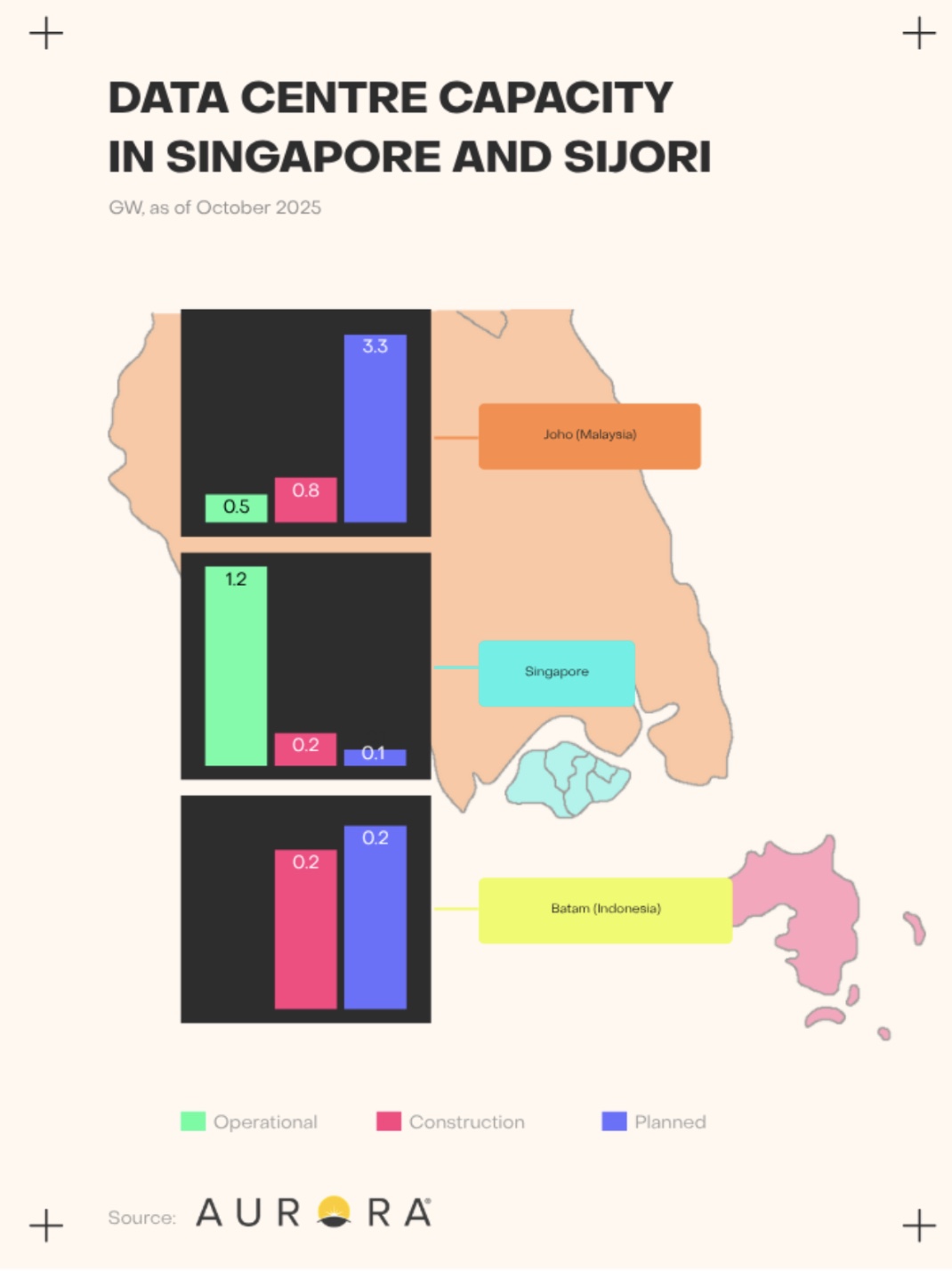
The math does not work
Power generation across Southeast Asia is growing at less than 7 percent a year. Data-center demand is growing at more than double that rate. That gap does not close on its own — and the longer it persists, the more it becomes a hard ceiling on the AI ambitions of every government and hyperscaler in the region. This is not a future risk. It is a present constraint already shaping investment decisions, deal timelines, and site-selection conversations in Singapore, Malaysia, Indonesia, the Philippines, and Vietnam.
Consider Malaysia. Its data centers consumed 8.5 TWh of electricity in 2024. By 2030, that figure is projected to reach 68 TWh — an eightfold increase in six years, at which point data centers would account for up to 30 percent of the country’s entire national power supply. Indonesia tells a similar story: demand is set to nearly quadruple from 6.7 TWh to 26 TWh. In the Philippines, the trajectory runs from 1.1 TWh today to 20 TWh by 2030. These are the three largest emerging data-center markets in the region, and all three face the same structural problem.
The demand shock is no longer theoretical. At a recent Earth VC intelligence webinar on Indonesia, Cushman & Wakefield, which advises hyperscalers on their Indonesian builds, put the scale in plain terms: one hyperscaler entering Indonesia this year is adding 300 MW of capacity, equivalent to all of Jakarta’s current live data-center capacity, from a single customer.
Why renewables alone cannot close the gap
The obvious response is to build more solar and wind, and Southeast Asia has abundant solar resources. But there is a ceiling here too. Our research suggests intermittent renewables can realistically meet roughly 30 percent of projected data-center demand by 2030 before hitting what we call the “solar plateau,” the point at which adding more panels stops solving the reliability problem and simply adds capacity that cannot be used when the sun is not shining. The rest requires firm, dispatchable baseload power, available 24 hours a day, 365 days a year, regardless of weather.
The uncomfortable reality is that approximately 70 percent of the ASEAN grid currently runs on coal and gas. If the AI buildout continues at its current pace without a clean baseload solution, the region’s data centers will be powered largely by fossil fuels.
The case for nuclear baseload
At Earth VC, we have watched this dynamic closely — not as observers, but as investors. We backed Aalo Atomics, a US-based developer building small modular reactors (SMRs) for data-center applications, and Blykalla, the Swedish SMR developer. We made these bets because the data pointed in one direction: the technology best suited to delivering firm, zero-carbon, scalable baseload at the speed and density data centers require is the new generation of SMRs.
SMRs can generate up to 300 MWe per unit, operate at capacity factors near 90 percent, and are designed for factory production and modular deployment. They are not the decade-long megaprojects of the previous nuclear era. Yet the most striking data point in our research is this: Southeast Asia currently operates zero commercial nuclear reactors.
As we write in the foreword to our report, “A civilization that digitizes without securing its power supply is building a cathedral on sand.”
The window is narrow
A region accounting for one of the world’s fastest-growing data-center markets, already straining its grid to meet current demand, has no nuclear capacity at all. SMR projects that are commercially viable in 2030 need capital allocation and regulatory groundwork today. The question is no longer whether nuclear has a role in Southeast Asia’s energy future — the arithmetic settles that. The question is which markets move fast enough to have clean baseload in place when their data-center pipelines demand it, and which discover, too late, that they built the infrastructure without securing the power.
Southeast Asia’s governments have made bold commitments on AI sovereignty and digital competitiveness. Those commitments are only as credible as the power infrastructure behind them.
 Tam To is the Head of Marketing and Communications at Earth Venture Capital, a global deep tech venture capital firm based in Asia, investing in earth-changing startups that enable Earth efficiency. The firm manages multiple portfolio companies spanning advanced nuclear energy, green hydrogen, clean manufacturing, and frontier climate technologies. This article draws on findings from Earth VC’s report Nuclear Energy Fuels AI Boom in Southeast Asia Data Centers.
TNGlobal INSIDER publishes contributions relevant to entrepreneurship and innovation. You may submit your own original or published contributions subject to editorial discretion.
Featured image: Yamu_Jay on Pixabay
The climate tech paradox: Why Asia’s biggest market gets the least capital