

As many as 73 percent of employees across Southeast Asia feel that leadership is disconnected from their digital needs, as digital transformation is being done to employees rather than with them.
The misled progress can turn the advantages of AI into a threat and stoking fears about job security among employees, rather than excitement for partnership, according to a “The Paradox of Progress” report conducted by workspace platform Lark.
The report featured a double-blind survey of 900 employers and over 5,000 employees across Singapore, Malaysia, Indonesia, Thailand, the Philippines, and Vietnam. It showed that by focusing on system upgrades rather than the human touchpoints within them, organizations have inadvertently created a “Digital Tax” that erodes their targeted productivity.
The report identified four key problems. On efficiency bias, investment is heavily skewed toward IT departments at 69 percent and Finance at 60 percent for full digitalization, while Employee Experience at 48 percent and Human Resources at 47 percent.
Regarding complexity, 55 percent of employees lose three or more hours every week to digital collaboration inefficiencies, with 71 percent feeling overwhelmed by the volume of tools, and 54 percent forced to check multiple platforms every hour just to stay in sync.
For innovation, while 80 percent of employers claim to support workforce empowerment, only 28 percent of employees feel they have high autonomy to introduce new ideas.
About training, employers are 17 percentage points more likely to feel very comfortable with AI-enabled tools and 8 percentage points more likely to have received formal AI training. Besides, 80 percent of employees say they need more support in cybersecurity and AI productivity, yet only 28 percent feel trained to innovate with confidence.
Trust is also a deepening concern. About 62 percent believe AI could eventually make their roles obsolete, and 76 percent have significant security reservations about expanded AI use.
Despite these anxieties, 88 percent of respondents are eager for AI to take over routine tasks. Employees identified their top training needs as cybersecurity awareness at 84 percent, cross-team collaboration training and automation and AI productivity both at 82 percent, and documentation and standard operating procedure discipline also at 82 percent.
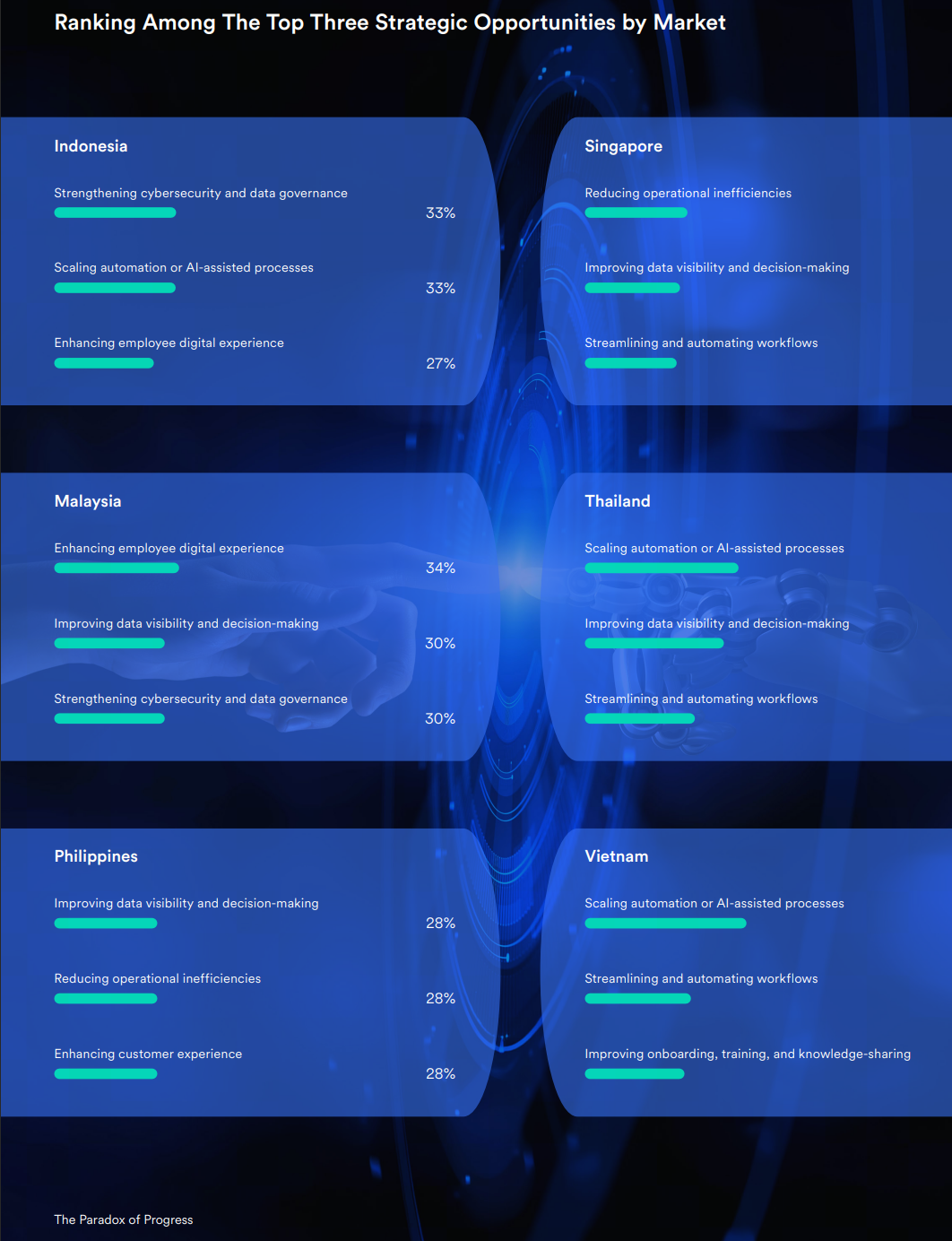
Among organizations that have consolidated onto unified platforms, 89 percent saw an immediate boost in efficiency, 87 percent reported a significant reduction in communication friction, and 82 percent realized substantial cost savings.
Olivier Adam, General Manager for Asia Pacific at Lark, said organizations are at a pivotal moment for AI adoption across Southeast Asia. But the research shows the foundation is not as solid as leadership believes, the executive added.