

Your next holiday gift could be ordered through an AI agent – according to Snowflake, more than four in 10 consumers used AI tools for their holiday shopping in 2025. As what businesses need to engage and protect customers changes, platforms are reacting accordingly. Google launched the Agent Payments Protocol (AP2) in 2025, an open protocol that allows AI agents to securely execute financial transactions on behalf of users, while Alibaba kicked off 2026 with test features enabling users to order food and complete in-chat payments directly through the Qwen app.
Behind the scenes, the technology infrastructure landscape is also rapidly shifting. Digital wallets are gaining share across online and offline transactions. Card tokenisation is scaling. Open banking is expanding. Could payment technologies – as the common layer underpinning all commerce – provide a growth catalyst for businesses to evolve and succeed in the world of AI-native commerce?
Global trends drive diversification towards emerging markets
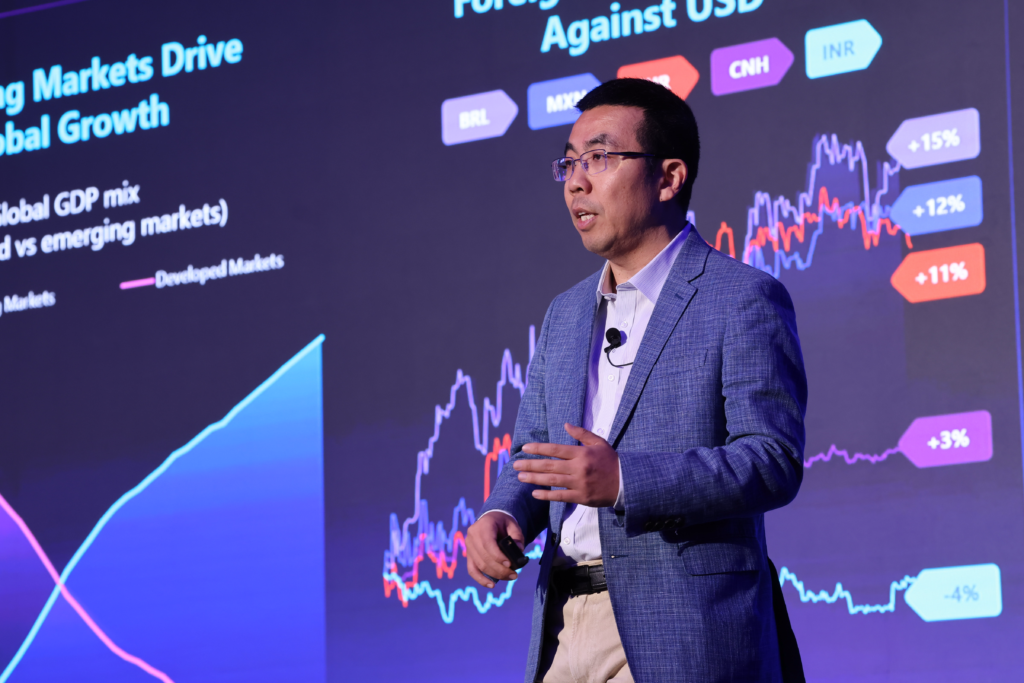
Speaking at The Economist’s Technology for Change conference, Jiang-Ming Yang, Chief Innovation Officer of Ant International, noted that increased uncertainty in global markets is driving appetite for opportunities in emerging markets.
Complexities, however, persist. Citing the example of a large e-commerce client embarking on expansion plans in Brazil, he noted that the company spent almost five months navigating a broad operational exercise involving more than 50 checklist items, over five months of payment integration work, and an estimated 800 man-days of investment before the business could be fully operational.
Yang highlighted the role that payments providers can play to simplify this landscape, especially through infrastructure. With AI, know-how in technology and local requirements can be distilled into a single AI agent, enabling businesses to conduct end-to-end operations from onboarding and integration, to optimising payment success rates and chargebacks, through one agent partner, available 24/7. This vastly expands access to expansion opportunities, in particular for smaller businesses and merchants.
Ant International also points to a model built around interoperability as the blueprint for the future. One-click card checkout, protection for alternative payment method accounts, and deep-link solutions tied to open banking are designed not only to make checkout faster, but also make operations more consistent across channels, devices, and payment methods.
Engaging the AI-native consumer through payment innovation
Consumer behaviour is another area where AI has become a mainstay. Search, recommendation, decision-making, and execution are all becoming more intelligent. That means payment systems also need to support interactions that are less predictable and less sequential than before. Yang describes this direction as part of a broader move toward agentic commerce – a future-facing layer that Ant International is developing alongside other major players in the industry.
Beyond agentic commerce, Ant International is also focusing on engaging the AI-native buyer through consumer devices – specifically AR glasses. The company sees opportunities in sectors such as e-commerce, food and beverage, and ride hailing, where payments can be woven directly into the service flow.
“Because they can see what you see and hear what you hear, AR glasses can create a very immersive user experience. We expect to see a significant shift towards these devices in the next few years, and we are ensuring that the ecosystem is ready to provide the safe, seamless payment experiences that consumers have come to know and expect,” noted Yang.
Trust as the underlying enabler for AI-driven commerce
While it offers businesses new channels to deepen engagement with consumers, AI also creates a range of new threats and vulnerabilities, such as deepfakes. Ant International opts for a pragmatic approach to AI, recognising that the technology is here to stay, and ensuring that it steps up defenses against emerging threats.
Its investments in research to strengthen trust in FinAI highlight the company’s commitment to this. The SHIELD 3-in-1 transformer model forms a foundational risk assessment layer across its services, and is able to identify high-risk transactions with more than 95% precision. To guard against AI-generated threats across a variety of scenarios, it deploys advanced anti-deepfake technologies which have demonstrated detection rates of over 99 percent.
A more connected model for commerce
Ant International highlighted five key technology priorities for the company – seamless checkout for cross-channel payments, a central agent partner to resolve global payment, customisable solutions for agentic payments, embedded payments in new experiences and AI-powered security foundation.
Taken together, these factors pave the path for Ant International to play a role as a cornerstone of the global commerce ecosystem, leveraging trusted FinAI to catalyse its inclusive vision of the future.
Ant International becomes official sponsor of Argentine national football team in Asia region