

As we usher into the new year, we sought insights from prominent figures across the Southeast Asian tech landscape. These leaders reflected on their triumphs in 2025, sharing valuable perspectives on their achievements and the challenges they overcame.
They also unveiled their ambitious aspirations, meticulously outlined their strategic plans for 2026, and offered insightful predictions on the trajectory of the tech industry in the new year.
We talked to Joan Yao, General Partner at Kickstart Ventures, to learn more about the CVC firm’s achievements in 2025 and its plans and aspirations for 2026. She also shared her views on the outlook of tech ecosystem in the Philippines and Southeast Asia for 2026.
Kickstart Ventures manages the Philippines’ largest technology venture capital funds, investing globally in early-to growth-stage tech startups via three funds, including the Ayala Corporation Technology Innovation Venture Fund (ACTIVE Fund). Kickstart is a wholly-owned corporate venture capital firm of Globe Telecom, the Philippines’ leading mobile operator.
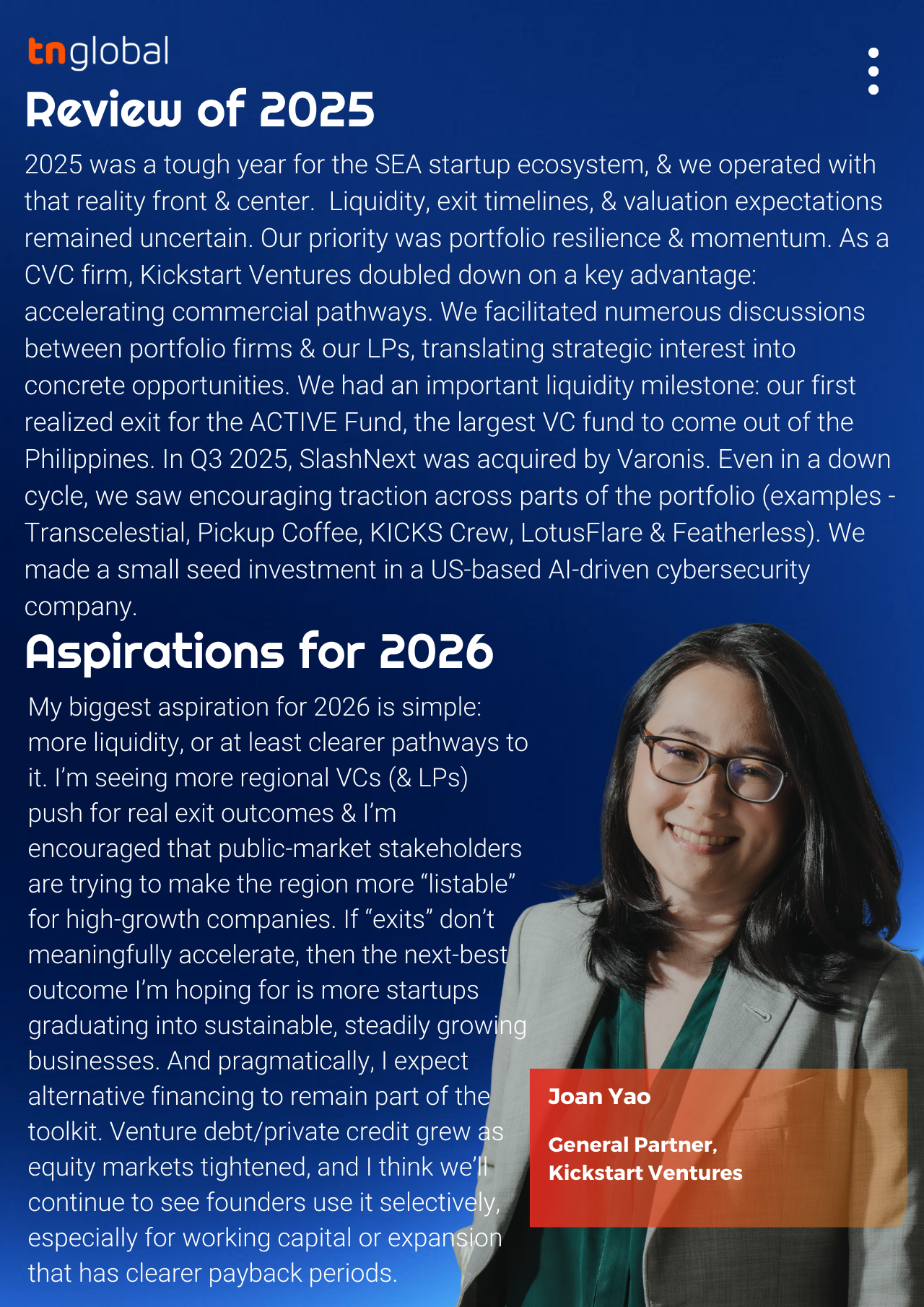
How was Kickstart Ventures’ 2025?
2025 was a tough year for the SEA startup ecosystem, and we operated with that reality front and center. Southeast Asia venture funding in H1 2025 fell to $1.85 billion across 229 equity deals, the region’s weakest level in over six years, reflecting sustained investor caution and a higher bar for deployable opportunities.
In the Philippines, equity funding in H1 2025 was $86.4 million (down 55 percent YoY): a reminder that liquidity, exit timelines, and valuation expectations remained uncertain.
Given that backdrop, our priority was portfolio resilience and momentum. We leaned into hands-on support – staying close to founders, helping them navigate the trade-offs between growth and profitability, and providing follow-on capital selectively when it was clearly warranted.
As a corporate venture capital firm, we at Kickstart Ventures also doubled down on a key advantage:accelerating commercial pathways. We facilitated numerous discussions between portfolio companies and our LPs, translating strategic interest into concrete opportunities that helped companies keep moving despite the market.
We also had an important liquidity milestone: our first realized exit for the ACTIVE Fund, the larges venture capital fund to come out of the Philippines. In Q3 2025, SlashNext was acquired by Varonis, as Varonis expanded into “AI-native” email security to address increasingly AI-driven phishing and social engineering threats.
And importantly, there were bright spots. Even in a down cycle, we saw encouraging traction across parts of the portfolio (examples include Transcelestial, Pickup Coffee, KICKS Crew, LotusFlare, and Featherless) and we also made a small seed investment in a US-based AI-driven cybersecurity company that we hope to share more about in 2026.
What’s your expectation/aspirations for 2026?
I’m going into 2026 assuming the environment stays challenging, but with a healthier “survivor set” of startups than we had going into the past two years. A lot of the uncertainty that weighed on 2025 (cost of capital, geopolitics, valuation and exit expectations) hasn’t fully cleared, so I don’t expect an easy snapback.
The upside is that the companies that made it through 2024–2025 are often simply better-run. They’ve been forced to internalize efficiency: tighter unit economics, more disciplined burn, and the ability to keep growing with less capital. That grit tends to compound, and I think it’s what will separate durable companies from the rest in 2026.
My biggest aspiration for 2026 is simple: more liquidity, or at least clearer pathways to it. I’m seeing more regional VCs (and LPs) push for real exit outcomes, and I’m encouraged that public-market stakeholders are trying to make the region more “listable” for high-growth companies.
For example, Singapore is moving toward a fast-track SGX-Nasdaq dual-listing framework (the planned “Global Listing Board,” targeted for mid-2026), alongside legal/regulatory changes meant to streamline the process. Singapore has also rolled out liquidity- and listing-support measures, including a S$5 billion Equity Market Development Program, which is directionally positive even if it won’t solve everything overnight.
If “exits” don’t meaningfully accelerate, then the next-best outcome I’m hoping for is more startups graduating into sustainable, steadily growing businesses. In other words: fewer companies living quarter-to-quarter on fundraising, and more that can fund growth through gross margin and operating discipline.
And pragmatically, I expect alternative financing to remain part of the toolkit. Venture debt/private credit grew as equity markets tightened, and I think we’ll continue to see founders use it selectively, especially for working capital or expansion that has clearer payback periods.
What are the plans of Kickstart Ventures in 2026? What is the focus in the new year? How is the outlook for 2026 for the tech ecosystem in the Philippines and Southeast Asia?
In 2026, our plan has three parts: strengthen the portfolio, stay active in selective early-stage investing, and double down on our partnership engine with our corporate LPs.
1) Portfolio-first: help companies grow strongly and get to real outcomes.
This continues to be the core of our work. We stay close to founders – sometimes meeting as frequently as weekly – to keep a clear read on the business and to be useful on the problems that matter most, whether it be go-to-market, hiring, unit economics, fundraising strategy, or partnerships. The goal is straightforward: help companies compound through a tough market and ultimately deliver positive outcomes for founders and our LPs.
2) Selective early-stage investing, with a focus on AI beyond Southeast Asia
We think this is still a good vintage to back exceptional teams early, especially in AI where the pace of iteration is fast and category leadership can form quickly. At the same time, we’ll take right-sized, risk-adjusted bets – particularly in areas where we see strong potential synergies between a startup’s technology and our corporate LPs’ business needs, and where AI enables step-function improvements, not just incremental automation.
3) Double down on our CVC advantage: building partnerships that create measurable business value for startups and LPs.
This has long been part of how we support companies, and we’ll keep strengthening it in 2026. Practically, that means continuing to facilitate commercial conversations: helping portfolio companies access pilots, customers, distribution, or capability partnerships with our corporate LPs, while also helping our LPs engage with innovation that’s relevant to their priorities. In a capital-constrained environment, these partnerships can be one of the most tangible ways we help startups keep growing.
East Ventures stays “cautiously optimistic” on Southeast Asia tech ecosystem in 2026