

Gprnt (Greenprint), an integrated digital platform that provides ESG reporting solutions, began as a project incubated by the Monetary Authority of Singapore (MAS) to bridge system-wide gaps in sustainability data. It has grown into a spun-out company that now supports more than 1,300 SMEs, works with enterprises and financial institutions, and powers the disclosure infrastructure behind SGX’s ESGenome.
Having raised $4.62 million in seed funding from Ant International and MUFG Bank, and proven that national-scale digital infrastructure can be commercially viable, Gprnt is now preparing for its next stage of funding. The target is to take the model it has built in Singapore into new markets.
In an interview, Gprnt CEO Lionel Wong told TNGlobal about graduating from a central bank, scaling without ready-made data infrastructure, and where ESG reporting goes next, among others.
Below are the edited excerpts:
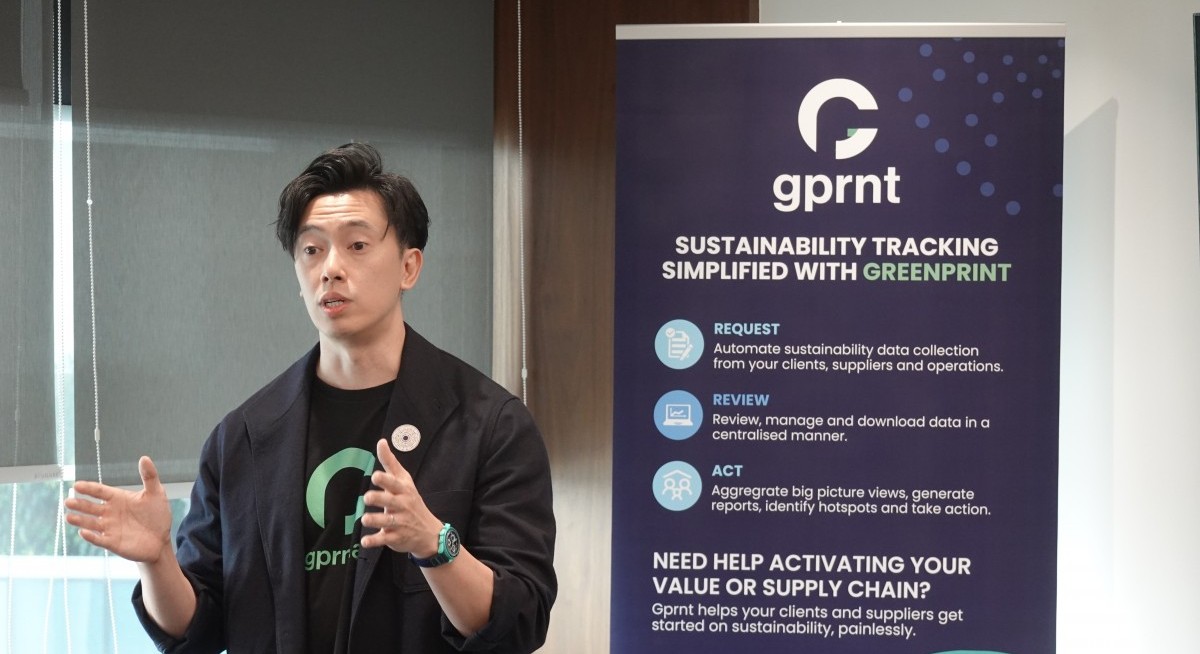
Gprnt was incubated by MAS before spinning out as a funded company under Global Finance & Technology Network (GFTN). What advantages did growing up in a central bank give you that a normal startup never gets?
Growing up within MAS gave us a very different starting point from a typical startup. MAS does not initiate spinoffs to compete with the private sector. The role of MAS’s projects lies in identifying and bridging system-wide gaps that private markets haven’t been able to address on their own, mainly due to perfectly rational commercial reasons.
As an MAS spinoff, we inherited much of that same lens. A typical startup might begin with a product vision, then validate and iterate it against a particular market challenge or inefficiency. We started from the other end: with a whole-of-ecosystem problem around the availability, trust, and usability of sustainability data. The difference, in many ways, is one of size and scope as we aren’t trying to solve for any one single gap, but to connect different pieces across financial institutions, corporatex, government agencies, and technology providers.
Gprnt operates as a startup nonetheless, and that creates its own unique set of challenges and dynamics. We have to deliver solutions across multiple fronts because the underlying problem is inherently inter-connected. At the same time, we contend with the same constraints any young startup faces: finite resources, and the need to generate commercial traction quickly. We see how all the pieces need to interact and fit together, but we can’t afford to build everything at once.
I think that tension has ultimately become one of our strengths. We have retained the system-level ambition and infrastructure mindset we developed at MAS, while adding the commercial discipline, speed, and accountability of a startup.
You’ve raised $4.62 million with ambitions to serve governments, banks, and SMEs across markets. How far does this round take you, and what do you most want to achieve before you’d think about raising again?
Over the past year, we’ve moved from building infrastructure to demonstrating its applicability across SMEs, enterprises, financial institutions, and capital markets. We now support over 1,300 SMEs and power the disclosure infrastructure for SGX’s ESGenome.
The next frontier is unlocking the value of SMEs’ sustainability data for the buyers and financial institutions. Today, larger “Queen Bees” solicit their suppliers for better data to compute their Scope 3 emissions. Those suppliers, in turn, are repeatedly asked by different Queen Bees to provide similar information through different spreadsheet templates, questionnaires, and reporting platforms.
Our aim is for an SME to generate trusted sustainability data once and that data to flow directly into the systems and calculations of its Queen Bee partners. We’re building this out in a phased manner, and are already piloting an allocation module for Scope 3 Category 1 (upstream Purchased Goods & Services) under Green 100, a national sustainability movement launched by Singapore’s Council for a Competitive Climate Transition (C3T) in May.
We’ve publicly shared that we’re preparing for our next stage of funding. That round is less about proving the original proposition and more about scaling what we’ve established. Gprnt aims to take the model in Singapore into other markets, continue to invest in our SME-focused products and engineering, and deepen our connections with the regional ecosystem.
Your free tool works because it plugs into Singapore’s trusted government data. As you expand across the region, how do you recreate the success where the data infrastructure isn’t there yet?
In Singapore, Gprnt has leveraged the country’s existing digital infrastructure to build a national layer for generating baseline sustainability data. This has enabled every business in Singapore to retrieve trusted utilities data directly from government sources, and transform it into sustainability output with minimal time and manual intervention, all without having to spend a single dollar.
That said, Singapore is unique in having spent the past decade building out underlying digital systems such as CorpPass and MyInfo Business. Gprnt cannot, and does not, assume that what we’ve built in Singapore can be replicated elsewhere.
Our expansion plans don’t hinge on negotiating direct access to data across different national authorities. Rather, we focus on ensuring that user journeys remain simplified, streamlined, and delightful. We do so by maximising users’ own data assets and pursuing direct integrations suitably.
On the first, businesses already possess much of the information needed to generate baseline sustainability data, such as their utility bills, invoices, accounting records, and other documents. We’ve invested heavily to make it as easy as possible for Gprnt users to bring those existing assets onto the platform, and to leverage AI to extract, structure, and transform them into verifiable sustainability output.
The second is to pursue integrations pragmatically. Depending on the market, the most useful data may sit with utilities providers, ERP and accounting platforms, banks, industry associations, or other technology providers. Gprnt strives to connect directly to these sources in order to automate more of the reporting process.
The infrastructure beneath Gprnt may therefore look different from market to market, but the proposition above it remains highly replicable.
Your whole value rests on trusted data. So how do you use AI to fill gaps or draft narratives without undermining the credibility?
We believe in maintaining a clear distinction between the source of truth and the intelligence layer. AI should not turn an uncertain number into a trusted number simply because it is capable of generating one.
Where we have primary data, whether from a government source, utility bill, fuel invoice, or another trusted system. Our priority is to preserve its provenance. A user should always be able to understand where a number came from, what happened to it along the way, and how it was ultimately calculated. That traceability is fundamental to the role we play as infrastructure.
Where AI becomes extremely powerful is in making that trusted data more usable. It can extract and map information from different documents, identify gaps and anomalies, explain changes, and help draft disclosure narratives based on the underlying data.
But greater automation also creates a corresponding need for greater trust. As more of the reporting process becomes machine-assisted, assurance cannot remain something that happens only at the end, after a report has been produced. It’s why Gprnt is partnering with selected assurance providers to launch on-platform digital assurance capabilities in Q4, with the aim of bringing verification progressively closer to the underlying data and workflows through which sustainability information is generated.
We see these developments as complementary. AI will dramatically reduce the time, cost, and expertise required to produce and make sense of sustainability information. Digital assurance should provide confidence that the underlying data, methodologies, and resultant outputs remain credible.
Ultimately, our goal isn’t just to automate sustainability reporting. It’s to automate it without sacrificing trust — and over time, to make trusted sustainability data more useful to the businesses generating it.
Five years ago, most companies treated ESG as a manual, once-a-year chore. What’s changed since, and where is reporting going next? Is fully automated disclosure, or ESG data feeding straight into financing, realistic in the next few years?
I don’t think we’ve fully moved past that world yet. For many companies, sustainability reporting remains fragmented, manual, and heavily dependent on spreadsheets. What has changed is the expectation around what the data should do. Five years ago, a company thought about sustainability largely in terms of producing an annual report. Today, the same information is increasingly relevant to procurement, supply-chain management, financing, investment, and risk.
What I’d wish for is that companies had started building toward the data infrastructure needed to generate reports efficiently. If every reporting cycle begins with somebody emailing a thousand suppliers to fill in another spreadsheet, we haven’t digitized sustainability. A better model collects information close to its source, structures it consistently, preserves its provenance, and makes it reusable. Building this “generate-once, use-many” infrastructure is far more scalable than pushing bilateral data collections between every stakeholder in the network.
Looking ahead, the biggest change will be that we stop thinking about sustainability information primarily as a report. It should work more like financial data does today: sitting within digital infrastructure and, with the right permissions, flowing wherever it’s needed. The same emissions data a supplier generates could feed an enterprise’s Scope 3 calculations, establish its credentials for a procurement opportunity, and let a financial institution determine eligibility for preferential financing. Today, sustainability data and financial decision-making run in parallel; I think we’ll see them converge around common sets of trusted data.
AI will accelerate this considerably. Much of the collection, processing, and preparation of sustainability information can be progressively automated, and combined with digital assurance, this makes it possible to generate, verify, and consume sustainability information much closer to real time. Disclosures can form part of transactions themselves rather than sitting as separate processes.
Singapore, Lao PDR sign implementation agreement on carbon credits collaboration