

As we usher into the new year, we sought insights from prominent figures across the Southeast Asian tech landscape. These leaders reflected on their triumphs in 2025, sharing valuable perspectives on their achievements and the challenges they overcame.
They also unveiled their ambitious aspirations, meticulously outlined their strategic plans for 2026, and offered insightful predictions on the trajectory of the tech industry in the new year.
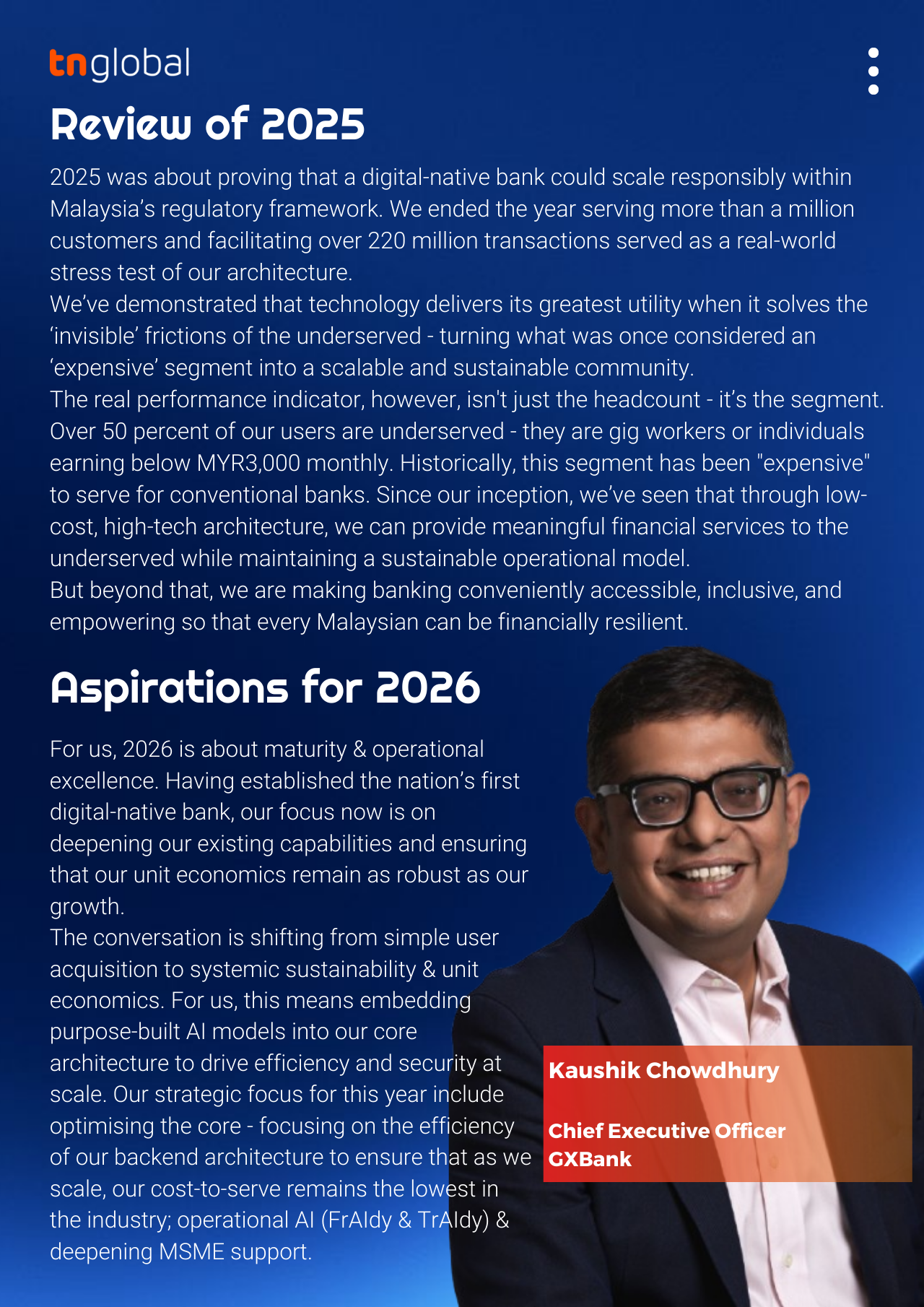
We talked to Kaushik Chowdhury, Chief Executive Officer of GXBank, to learn more about GXBank’s achievements in 2025 and its plans and aspirations for 2026. He also shared his views on the outlook of the digital banking industry in Malaysia.
GXBank was one of five digital banks licenced by Bank Negara Malaysia, the central bank of Malaysia, to cater to those unserved or underserved by the banking system. GXbank is a subsidiary of GXS Bank Pte Ltd — the 60:40 joint venture between Grab Holdings Ltd and Singapore Telecommunications Ltd — and is also owned by a consortium of other Malaysian investors, including Kuok Group, earlier media reports showed.
How was GXBank’s performance in 2025?
2025 was about proving that a digital-native bank could scale responsibly within Malaysia’s regulatory framework. We ended the year serving more than a million customers and facilitating over 220 million transactions served as a real-world stress test of our architecture.
We’ve demonstrated that technology delivers its greatest utility when it solves the ‘invisible’ frictions of the underserved – turning what was once considered an ‘expensive’ segment into a scalable and sustainable community.
The real performance indicator, however, isn’t just the headcount – it’s the segment. Over 50 percent of our users are underserved – they are gig workers or individuals earning below MYR3,000 ($762) monthly. Historically, this segment has been “expensive” to serve for conventional banks. Since our inception, we’ve seen that through low-cost, high-tech architecture, we can provide meaningful financial services to the underserved while maintaining a sustainable operational model.
But beyond that, we are making banking conveniently accessible, inclusive, and empowering so that every Malaysian can be financially resilient.
Social Impact & Resilience:
The Foundation: Our mission starts with Impian GIGih, our flagship program aimed at helping intergenerational social mobility through education and financial literacy. In 2025, our financial literacy initiatives reached over 10 million Malaysians through a multi-platform ecosystem of social content, community events, and partnerships with local icons like MYDIN and startups like Pandai.
Direct Social Mobility: This reach is backed by tangible support – we distributed bursaries to 1,700 primary and secondary students for school essentials and are currently sponsoring 18 exceptional tertiary scholars to ensure the next generation has the tools to thrive.
Credit as a Safety Net: We facilitated over 200,000 FlexiCredit drawdowns, with 50 percent of users using this credit as an immediate buffer for emergencies like medical bills or car repairs. Crucially, half of our users reported that our well crafted prepayment benefit can potentially lead to an improvement in their credit scores through timely
repayments, shifting the needle from debt to financial health.
Building banking for everyday Malaysians:
The 8-Minute MSME Benchmark: Since launching GX FlexiLoan, we have disbursed MYR25 million to sole props. By achieving an 8-minute “apply-to-disburse” benchmark for both account opening and loans, we’ve removed the manual friction that has historically sidelined small business owners from capital.
Automated Savings Habits: Our customers collectively earned MYR24 million in interest in 2025. Tools like our Bonus Pocket are successfully automating saving habits, with Malaysians saving 13x more – proving that the right tech can turn small, consistent actions into long-term resilience.
What are the plans for GXBank in 2026? What is the focus in the new year? What is the outlook for 2026 for the digital bank industry in Malaysia?
For us, this year is about maturity and operational excellence. Having established the nation’s first digital-native bank, our focus now is on deepening our existing capabilities and ensuring that our unit economics remain as robust as our growth.
The conversation is shifting from simple user acquisition to systemic sustainability and unit economics. For us, this means embedding purpose-built AI models into our core architecture to drive efficiency and security at scale.
Our strategic focus for this year
Optimising the Core: We are focusing on the efficiency of our backend architecture to ensure that as we scale, our cost-to-serve remains the lowest in the industry. This focus on “invisible engineering” is what allows us to serve the mass market profitably.
Operational AI (FrAIdy & TrAIdy): We are scaling our proprietary fraud and risk models, which have already delivered a 6x improvement in assessment speed – reducing the review process from 20 minutes to just 5 minutes. This allows us to protect our base with 95 percent accuracy without a proportional increase in manual overhead.
Deepening MSME Support: Following the positive uptake of our initial MSME lending pilots, this year will be about enhancing our digital ecosystem for small businesses. Our goal is to simplify the daily financial operations of MSMEs, providing them with the agility and tools needed to thrive in a digital economy.
In 2026, the outlook will be defined by three major shifts:
Exiting the Asset Cap: As we move through 2026, we expect the first cohort of digital banks to transition out of the Foundational Phase defined in BNM’s Licensing Framework for Digital Banks. This graduation – which involves lifting the RM3 billion asset limit – will allow us to move from the periphery to the core of the economy, as envisioned in the Financial Sector Blueprint 2022-2026.
The Era of Unit Economics: According to the e-Conomy SEA 2025 Report, Malaysia’s digital economy reached $39 billion in 2025. Success in 2026 will be defined by unit economics; the winners will be those who can manage a MYR500 loan with the same precision and profitability as a MYR50,000 one.
Finance as a Utility: We are seeing use cases of embedded finance, where banking becomes an invisible layer within the services Malaysians use every day. We have already proven the power of embedded finance within the Grab app. I believe that we are well in a position to be that foundational layer – proving that financial inclusion is a commercially sustainable pillar of Malaysia’s digital future.