

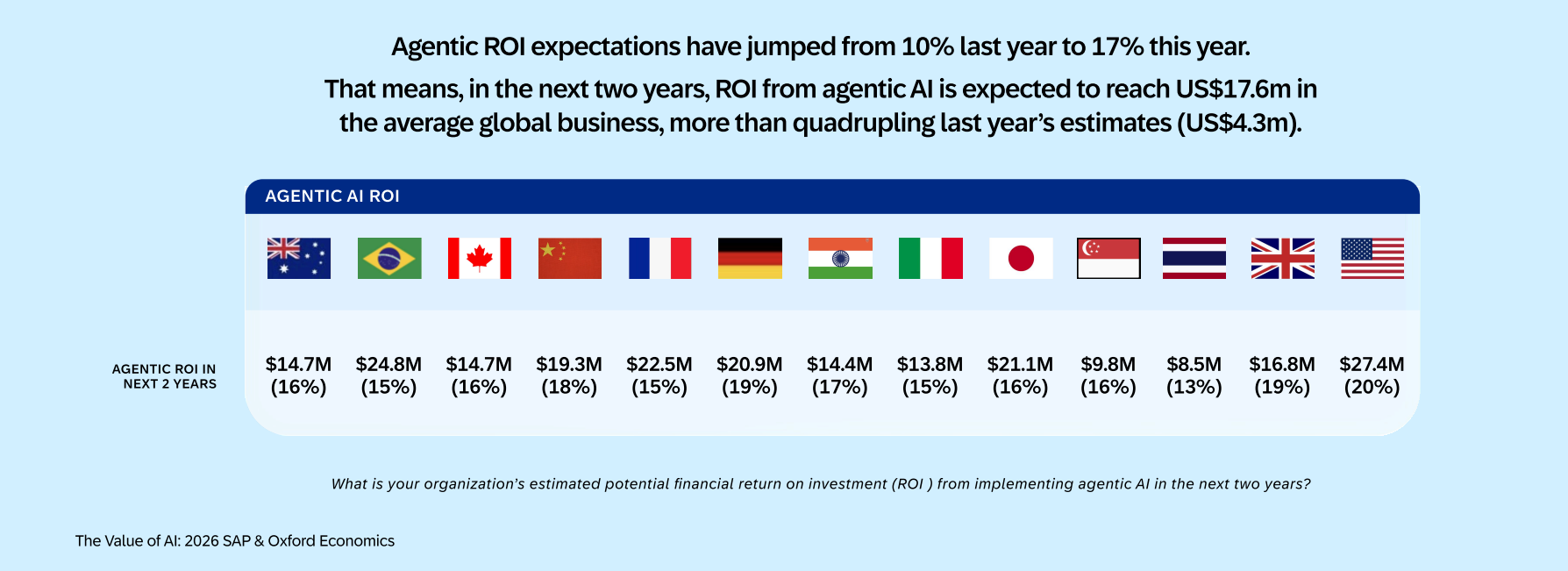
Singapore businesses expect agentic AI to generate a return on investment of $9.8 million over the next two years, nearly double last year’s estimate of $4.9 million, according to “The SAP Value of AI Report 2026” study conducted by Germany’s software giant SAP and Oxford Economics.
Regarding Singapore in the study, in a statement on Tuesday, SAP said the study, featuring 2,600 business leaders across 13 countries, showed that only 2 percent in Singapore say they are fully prepared for the technology.
Total AI ROI across all AI applications is expected to reach 19 percent this year, equivalent to $3.5 million, up from 16 percent last year. The figure is forecast to grow to 36 percent in two years, equivalent to $10.3 million. As many as 98 percent of Singapore businesses believe agentic AI has moderate to very high potential to transform their organization, yet the majority say they are either partially prepared or not prepared at all.
AI is already embedded in day-to-day operations, with 27 percent of all tasks in the average Singapore business currently supported by AI, a figure expected to rise to 47 percent in two years. However, readiness is uneven as only 45 percent of Singapore companies have a dedicated AI leader, 32 percent have leadership KPIs for AI, and 37 percent provide training on AI capabilities and risks. As many as 79 percent are not convinced their upskilling is keeping pace with the evolution of AI tools.
Data readiness has declined, with the share of businesses saying they are data-ready for AI falling from 62 percent in 2025 to 55 percent in 2026. About 82 percent face challenges with incomplete data, and 81 percent report experiencing rework, delays, or backlogs due to low-quality AI outputs.
Governance gaps are also widening as agentic AI adoption grows. Only 12 percent of Singapore businesses say their skills are fully ready to govern AI, and only 10 percent say their processes and frameworks are fully ready. As many as 27 percent do not have a human-in-the-loop process for agentic workflows, 30 percent lack permission and access controls for agents, and only 40 percent maintain a registry of the agents operating in their business. About 66 percent either agree or do not know whether they are deploying agents faster than they can govern them.
Eileen Chua, Managing Director of SAP Singapore, said businesses are moving from AI experimentation to AI execution. Chua said agentic AI raises the stakes for enterprise readiness, as organizations need clear visibility into where agents are operating, what data they can access, and where human oversight is required.
78% of Singapore IT leaders lack real-time data infrastructure, slows AI scaling: Confluent report