

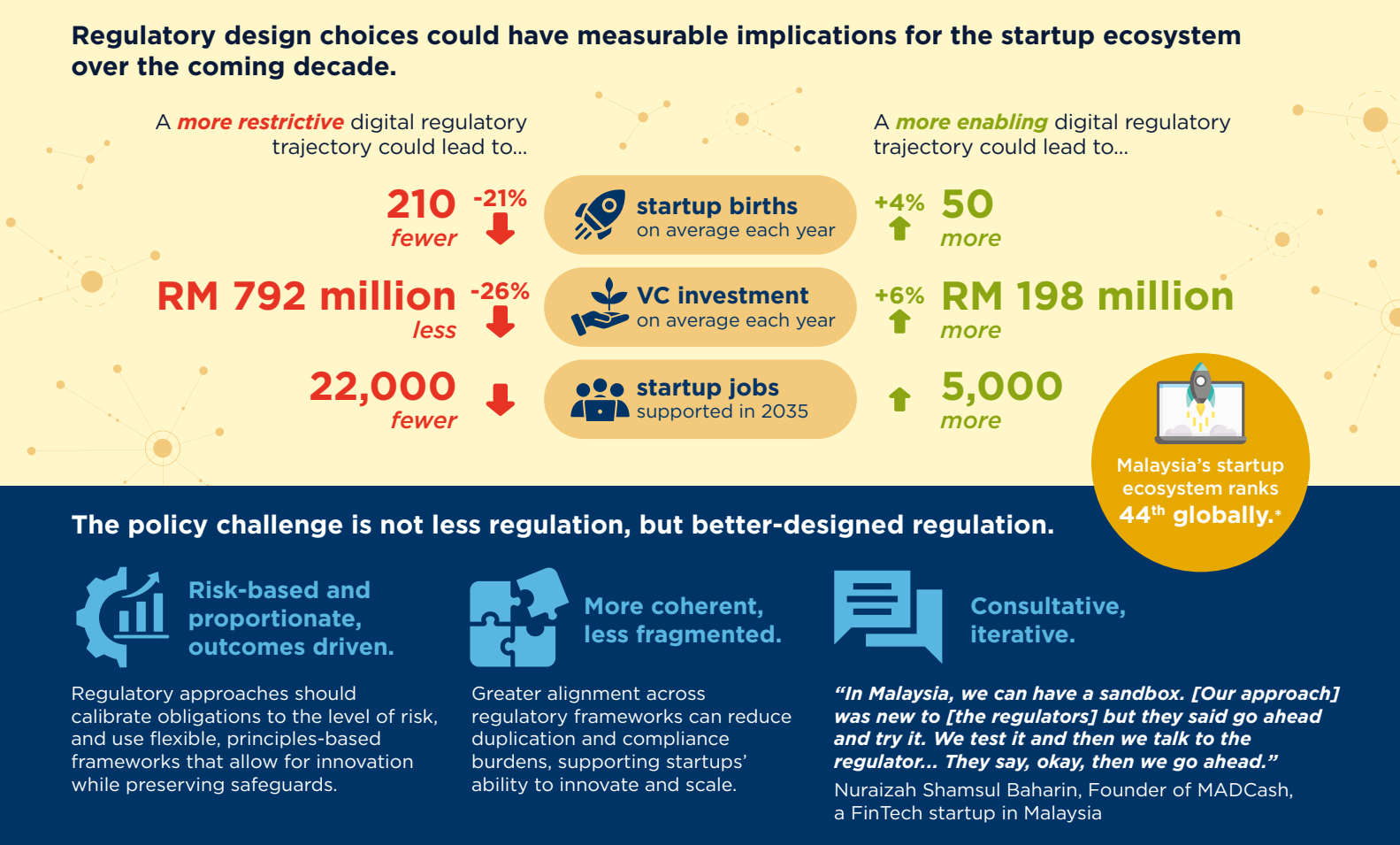
Restrictive digital regulations in Malaysia could reduce venture capital funding by 26 percent, equivalent to RM792 million ($170 million) less per year on average, period from 2026 to 2035.
The figure is part of the “Digital Regulations and the Startup Ecosystem in Malaysia” report conducted by Oxford Economics and Singapore-based Digital Prosperity Asia (DPA), the DPA said in a statement on Tuesday.
The study, which surveyed Malaysian startups, venture capitalists, and incubators, finds that compliance with digital regulations has become a structural cost for many startups. As many as 88 percent of startups report operational constraints from digital regulations, with 23 percent describing the impact as major or severe.
As many as 81 percent say digital regulations increase compliance-related costs. More than eight out of ten startups have to allocate more than 5 percent of operating costs to compliance; of those, 39 percent devote more than 15 percent of operating costs to compliance.
Compliance pressures are also affecting workforce planning and innovation. About 87 percent of startups say digital regulations have affected workforce costs or management. Approximately 74 percent report rising costs for compliance, cybersecurity, and data governance expertise.
As many as 67 percent say financial resources are being diverted from research and development toward compliance, a trend confirmed by 64 percent of VCs and incubators. About 57 percent of startups report delays in product development or longer time-to-market, while 59 percent of VCs note a slowdown in innovation momentum.
The study’s economic modelling presents two scenarios. Under a more restrictive regulatory environment, the share of startups expecting increased investment falls from 47 percent to 27 percent, and VC funding declines by 26 percent on average over the decade.
A shift toward more enabling regulation, by contrast, could increase VC funding by 6 percent, or roughly RM198 million per year more on average over the same period. About 63 percent of startups say digital regulations increase market uncertainty and make it harder to raise capital, and 73 percent of VCs say regulations heighten uncertainty around investment returns.
Henry Worthington, Managing Director of Economic Consulting at Oxford Economics, said the findings show that startups face immediate pressures navigating compliance across a broad range of digital regulations, which often demands specialised talent and changes to operating models, diverting resources from innovation and growth.
Koh Liang Wei of the DPA Secretariat said that as Malaysia’s rules on data, cybersecurity, and AI continue to evolve, the priority should be to preserve the balance between enabling growth and building trust.
Capbay collaborates with MDEC to expand $49M growth financing for Malaysia’s tech companies