

South Korea, Taiwan, Thailand, and Malaysia, as the world’s largest net exporters of AI-related hardware, were the standout performers of the current global technology cycle, driven by advances in and deployment of artificial intelligence (AI) tools, the International Monetary Fund (IMF) said in the July 2026 edition of its World Economic Outlook (WEO).
In the first quarter of 2026, the four mentioned economies recorded an average seasonally adjusted annualized growth surprise of 4.4 percentage points above forecast. The remaining countries in the world averaged a surprise of –0.3 percentage points below forecast in the same period.
The IMF emphasized the four, as the world’s largest net exporters of AI-related hardware, were the standout performers of the current global technology cycle, driven by advances in and deployment of artificial intelligence tools.
South Korea‘s Q1/2026 growth came in at 7.5 percent on a seasonally adjusted annualized basis. The IMF attributed this to a semiconductor and AI-hardware export boom. South Korea is a heavy importer of energy from the Middle East, yet technology exports more than offset the drag from higher energy costs.
South Korea’s full-year 2026 growth projection stands at 2.6 percent, revised upward by 0.7 percentage points from the April WEO. The 2027 projection is 2.5 percent, revised upward by 0.4 percentage points.
Malaysia‘s 2026 growth projection is 4.7 percent, unchanged from the April WEO. The 2027 projection is 4.3 percent. The IMF directly attributes Malaysia’s performance to data center activity and the upturn in the global technology cycle.
Thailand‘s 2026 growth projection is 1.9 percent, revised upward by 0.4 percentage points from the April WEO. The revision reflects emergency fiscal measures and strong technology-related exports and investment. The 2027 projection is 2.2 percent, revised upward by 0.1 percentage points.
The IMF did not provide other details on Taiwan, but provided some information on other notable economies.
China‘s Q1/2026 GDP growth is estimated by IMF staff at 8.1 percent on a seasonally adjusted annualized basis, above expectations. The IMF attributes the expansion to front-loaded public infrastructure investment and a surge in high-tech manufacturing and exports. Full-year 2026 growth is projected at 4.6 percent. The 2027 projection is 4.1 percent, revised upward by 0.1 percentage points.
The United States‘ GDP grew at an annualized rate of 2.1 percent in Q1/2026. Full-year 2026 growth is projected at 2.3 percent. The 2027 projection is 2.2 percent. The IMF cites continued technology-related business investment and productivity strength as a supporting factor.
Vietnam‘s 2026 growth projection is 7.5 percent. The IMF cites stronger-than-expected technology exports and robust domestic demand as the two drivers of the revision.
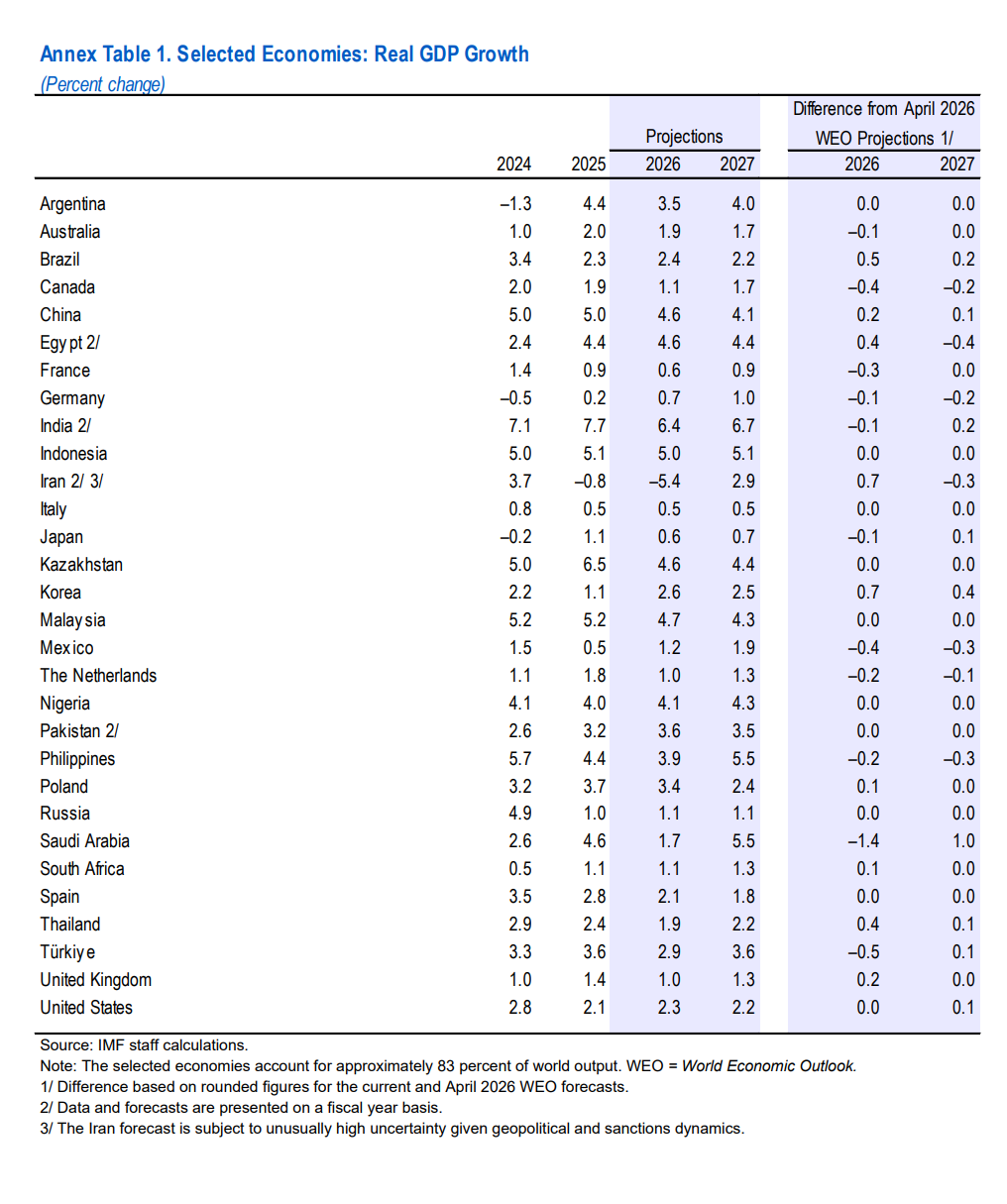
World output is projected at 3.0 percent in 2026 and 3.4 percent in 2027, down from an average of 3.5 percent in 2024–25. Advanced economies are forecast to grow at 1.7 percent in 2026 and 1.8 percent in 2027. Emerging market and developing economies are projected at 3.8 percent in 2026 and 4.5 percent in 2027. World trade volume growth is projected to slow from 5.0 percent in 2025 to 3.5 percent in 2026, before recovering to 4.3 percent in 2027.
AI data center boom tests Malaysia’s power, water and talent limits – AMRO