

Editor’s note: On May 28, 2026, the BGlobal Summit took place during BEYOND Expo 2026, Macao.
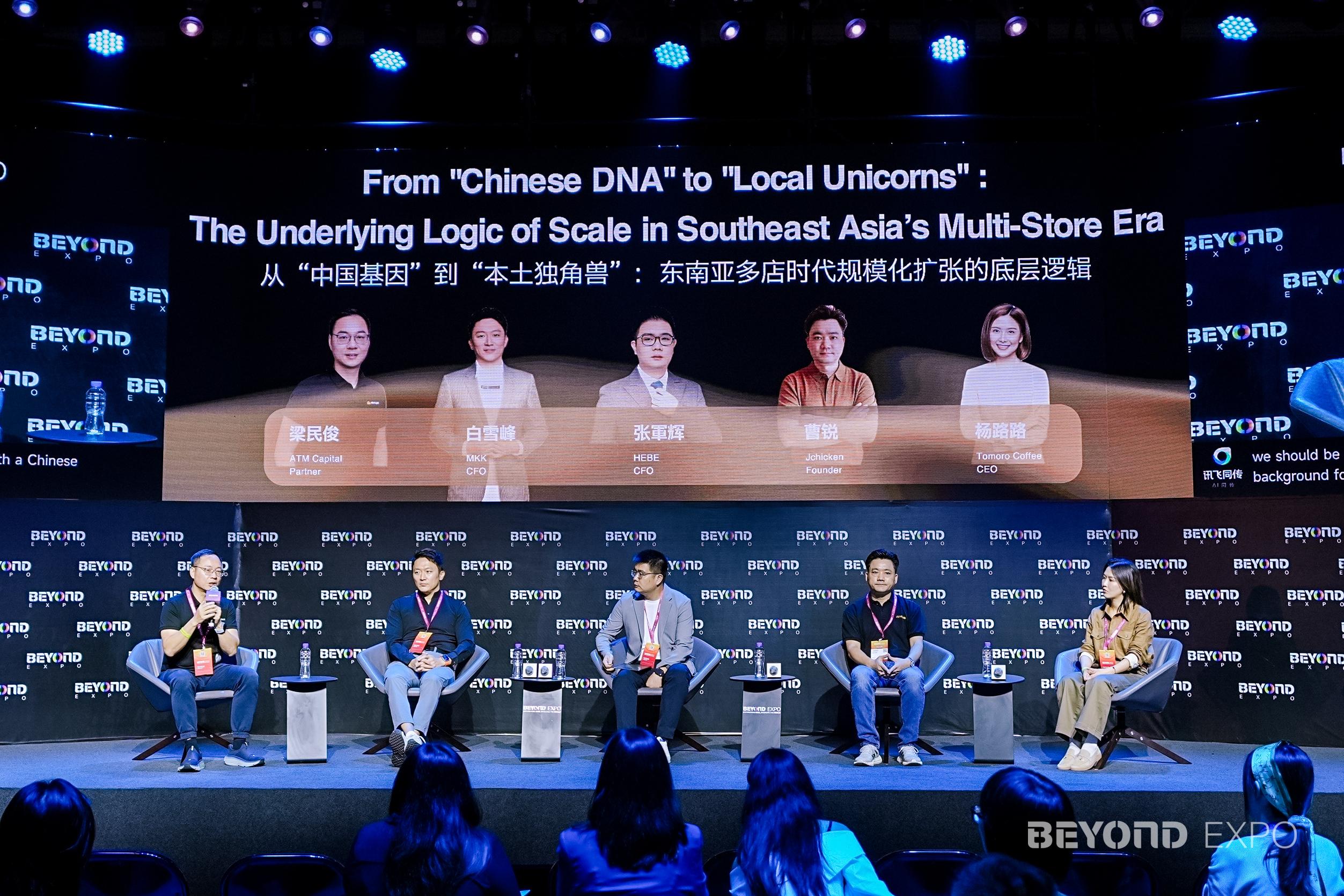
Across the fragmented markets of Southeast Asia, a specific “playbook” for rapid physical expansion has emerged, turning overseas ventures into dominant local players.
This session – From “Chinese DNA” to “Local Unicorns”: The Underlying Logic of Scale in Southeast Asia’s Multi-Store – brought together the strategic architects behind some of the region’s fastest-growing retail empires—spanning the coffee, skincare, baby care, and quick-service restaurant sectors.
While these leaders hail from a shared lineage of world-class supply chain efficiency and high-intensity distribution models, their success lies in their ability to shed the “foreign” tag and operate as true local incumbents. The panelists dived deep into the mechanical reality of scaling a physical footprint to thousands of locations and how “Chinese DNA” is being re-coded to win the hearts and wallets of the Southeast Asian consumer.
Moderated by ATM Capital founding partner Minjun Liang, this panel featured Makuku CFO Xuefeng Bai, Hebe Beauty CFO Junhui Zhang, J.Chicken Founder Cao Rui and Tomoro Coffee CEO Lulu Yang.
The text below has been edited for clarity and brevity:
Makuku CFO Xuefeng Bai:
Makuku focused on baby care products. We sell diapers and this year we will add baby formula. We have entered Southeast Asian market for 4 to 5 years. We have good position in Indonesia. We see good opportunities in baby care industry in Southeast Asia and the Middle East.
We can bring experiences, new products and innovation from China to Southeast Asia. Our customers are moms and babies.
In 2021, when we look at Southeast Asia market, especially the Indonesian market, we see a distinct usage gap. Specific consumer segments in Indonesia utilized baby care products quite differently compared to mainstream market trends.
We sell diapers. We noticed the mothers in Indonesia they are still using old-fashioned diapers which could easily caused rashes for babies. In China, the mothers are already using better technology diapers which are more “breathable”.
We see the opportunity to provide mothers and babies’ quality of life, which in turn provide tremendous business growth. Southeast Asia provides $18 billion worth of market for baby care industry. Indonesia’s population, birth rates provide the space for us to grow.
We always believe good product will speak for itself. So when we bring innovation to Indonesian market, combined with our talents, capabilities, in four years’ time we become the only China brand to rank top 3 in the market.
Hebe Beauty CFO Junhui Zhang:
Founded in 2018, Hebe Beauty focuses on health and beauty wellness industry. We have six brands, including skin care, cosmetics and others.
Hebe Beauty has expanded to Indonesia, Malaysia, the Philippines, Thailand and Vietnam, online and offline channels.
In 2018, in terms of branding, the bigger brand has dominated the high-end market. Local brands, on the other hand, which have their own advantages and differentiated positioning, are also doing well in mass and niche markets.
During that time, China’s cosmetic industry was booming. China has a lot of good supply chain resources. Our team performs well and has capabilities in running offline channels.
In between international brands and local brands, we see our opportunities. Our capabilities in expanding and operating [sales] channels can beat bigger international brands, to achieve better market penetration. At the same time, due to the efficiency and effectiveness of supply chain in China, we can provide consumers better products than the local brands.
We found our market segment and here we are. We think Southeast Asia market continues to grow rapidly supported by tremendous growth in e-commerce, younger generation’s spending, content commerce is growing fast too. Southeast Asia continues to be our focus in the long term.
J.Chicken Founder Cao Rui:
I have been in the fried chicken business since I was in university. In China, our brand is known as “ordered a fried chicken “(叫了个炸鸡).
Besides China, we have branches in the US and Japan.
In 2017, we started to look into Southeast Asia. Southeast Asia could be the biggest fried chicken market outside of China.
In 2022-2023, we were accompanied by ATM Capital, to visit Indonesia. We think this is a market that we can “all-in” in the future.
Over the past two years, we have opened near to 100 stores in Indonesia. Based on the experiences we gained in China, we have made some adjustment for Indonesian market. I think our expansion journey in Indonesia is “so far so good”, things are fine.
Our team was excited when we first wanted to enter Indonesia. Indonesia is a Muslim country, chicken is the main source of protein for the population. Muslims do not take pork, while beef and lamb are more expensive.
When we were in Indonesia, we see all kinds of stores selling chicken. But majority of these shops are food stalls by the roadside. There is insufficient supply for an “upgraded dining experience” such as providing a clean and tidy space for people to dine in. Only international brands like McDonald’s and KFC are available in the market.
So we decided to enter the market, providing an upgraded brand for the local market. That’s how we started J.Chicken.
Over the past two years, we met some challenges. We want to provide better taste fried chicken, a nice environment for people to dine in, cheaper prices. But it’s stressful for us to fulfil all these three criteria concurrently. Looking back now, perhaps we can just be slightly better than local corporations. This is because fulfilling all these three criteria required higher cost on our side.
Tomoro Coffee CEO Lulu Yang:
Tomoro Coffee is now in Indonesia, the Philippines, Singapore, with more than 800 stores. In terms of size, we are the second largest coffee chain in Indonesia.
In 2022, when we enter Indonesia, there is not many coffee chain franchise in the country. Consumers’ demand towards coffee beverages, in terms of professionalism and innovation, has increased.
After three years, we have become the number 2 coffee chain in Indonesia. Our ambition is to become the number one coffee chain in Southeast Asia.
We have done a thorough market research and we noticed the gap in the whole of Southeast Asian market. There is a lack of coffee franchise, lower than 5 percent. Consumers, on the other hand, demand better product innovation and quality. There is a gap in supply, so we see huge opportunities.
Southeast Asia, for example Indonesia, the population is near to 280 million. Annual birth rate is around 5 million to 6 million, very young population with an average age of less than 30 years old. So there is strong demand in terms consumer products and lifestyle.
[BEYOND Expo 2026] Malaysian Team Takes Second Place at BEYOND Hack Day 2026