

While AI has become a near-universal corporate priority, only 29 percentage of enterprises are confident that their infrastructure can meet evolving business demands, according to a new global study from Tata Communications and Bloomberg Media Studios.
In the “Building Durable AI Advantage” report released in early June, the findings showed that the gap between AI ambition and operational readiness is emerging as the defining challenge for enterprise leaders.
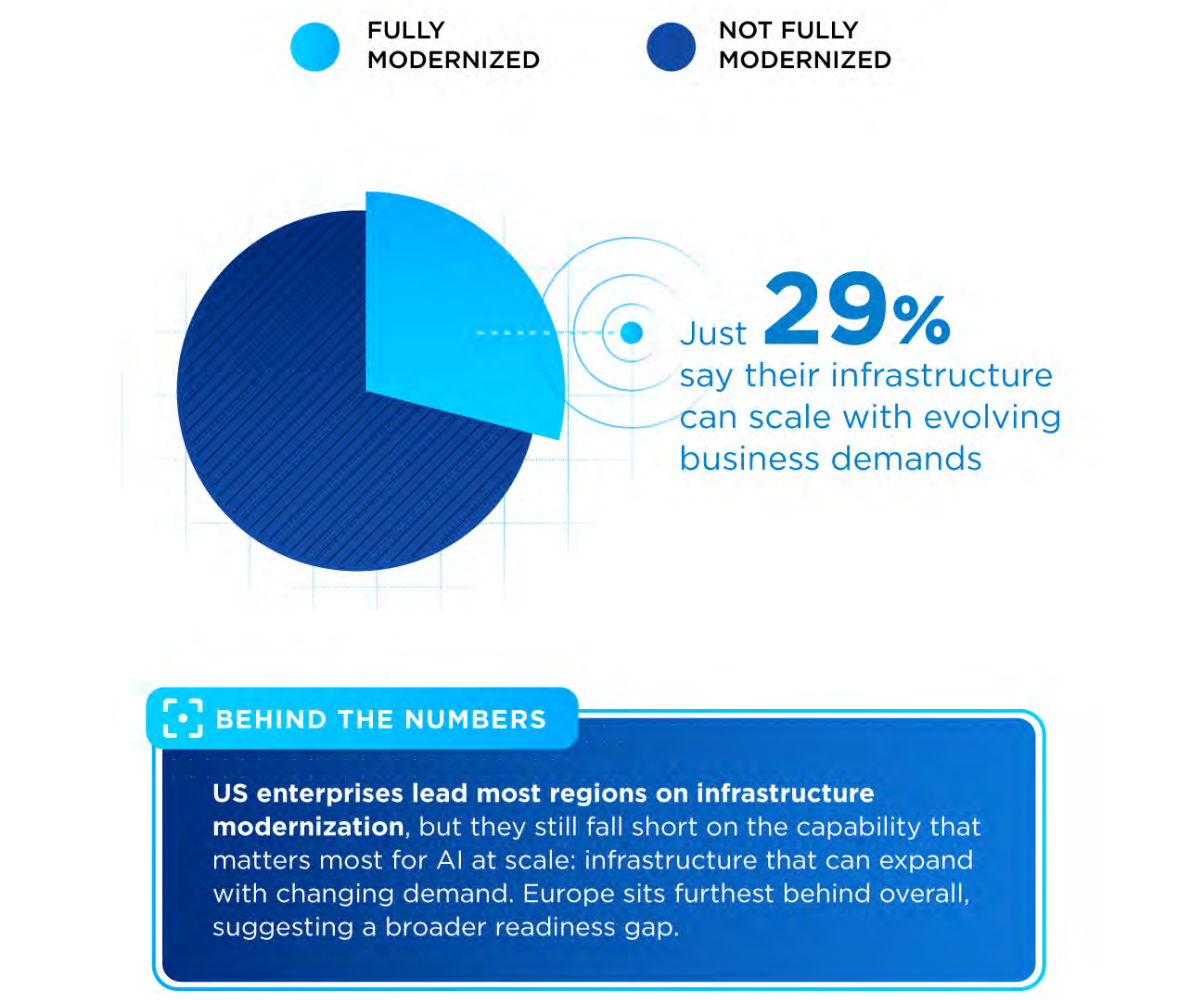
The research, which surveyed 501 senior executives at companies with revenues exceeding $500 million across North America, Europe, and Asia, finds that three quarters of enterprise leaders now treat AI as a board-level priority. Yet nearly two thirds are still operating on legacy or developing infrastructure not designed for the data intensity that enterprise AI demands. AI workloads tend to surge and shift across environments rather than grow in a predictable, linear fashion, making infrastructure scalability a critical requirement rather than a long-term consideration.
The report identifies five interconnected areas that together determine whether AI investment grows in value over time or plateaus. They cover infrastructure modernization, integration across systems, skills distribution, governance processes, and the visibility of return on investment (ROI).
On infrastructure, fewer than half of surveyed enterprises report fully modernized network connectivity, hybrid deployment flexibility, or data architecture. Those with advanced infrastructure are nearly twice as likely to report meaningful business value from AI as those still running on legacy systems.
Integration remains a significant obstacle. More than a quarter of leaders identify difficulty connecting AI with legacy systems as a primary barrier to realizing value, while 38 percentage say integration concerns are slowing down approval and procurement cycles. Two thirds of respondents view the seamless combination of digital automation and human interaction across channels as critical to successful AI execution.
Skills gaps are growing with organizational scale. About 30 percentage of enterprises overall cite talent shortages as a significant barrier, but among companies generating more than $5 billion in annual revenue that figure rises to 45 percentage. Larger organizations face a more complex challenge, requiring AI capability to be distributed beyond specialist teams and into business units across the enterprise.
On governance, security and compliance reviews account for the largest share of approval delays, cited by 42 percentage of respondents, followed by integration concerns and procurement complexity at 38 percentage each. As the strategic significance of AI investments grows, so do the committees overseeing them, and without clearly defined ownership, standards, and risk frameworks established early, review processes can slow deployment.
The ROI picture shows progress that has yet to reach its potential. Nine in ten report seeing some value from modernization efforts, but more than six in ten say they have not reached optimal outcomes.
Looking ahead, enterprises indicate broad technology investment plans over the next three years, with spending spread across multiple priorities simultaneously. Data, AI, and automation rank highest, cited by 66 percentage of respondents, followed by cybersecurity and zero trust at 60 percentage, cloud and data infrastructure at 57 percentage, and network transformation at 48 percentage.
Sumeet Walia, President and Chief Revenue Officer at Tata Communications, said the real differentiator in enterprise AI is no longer the AI itself but the infrastructure and integration that allow it to deliver value at scale. The executive noted that while enterprise ambition is accelerating, readiness remains uneven, and the organizations positioned to lead are those investing in foundations that connect people, systems, data, and intelligence across the enterprise.
Asia Pacific AI-driven data center boom reshapes Southeast Asia landscape