

As we usher into the new year, we sought insights from prominent figures across the Southeast Asian tech landscape. These leaders reflected on their triumphs in 2025, sharing valuable perspectives on their achievements and the challenges they overcame.
They also unveiled their ambitious aspirations, meticulously outlined their strategic plans for 2026, and offered insightful predictions on the trajectory of the tech industry in the new year.
We talked to Chang Lih Kang, Malaysia’s Minister of Science, Technology and Innovation, to learn more about the ministry’s achievements in 2025 and its plans and aspirations for 2026. He also shared his views on the outlook of tech ecosystem in Malaysia and Southeast Asia for 2026.
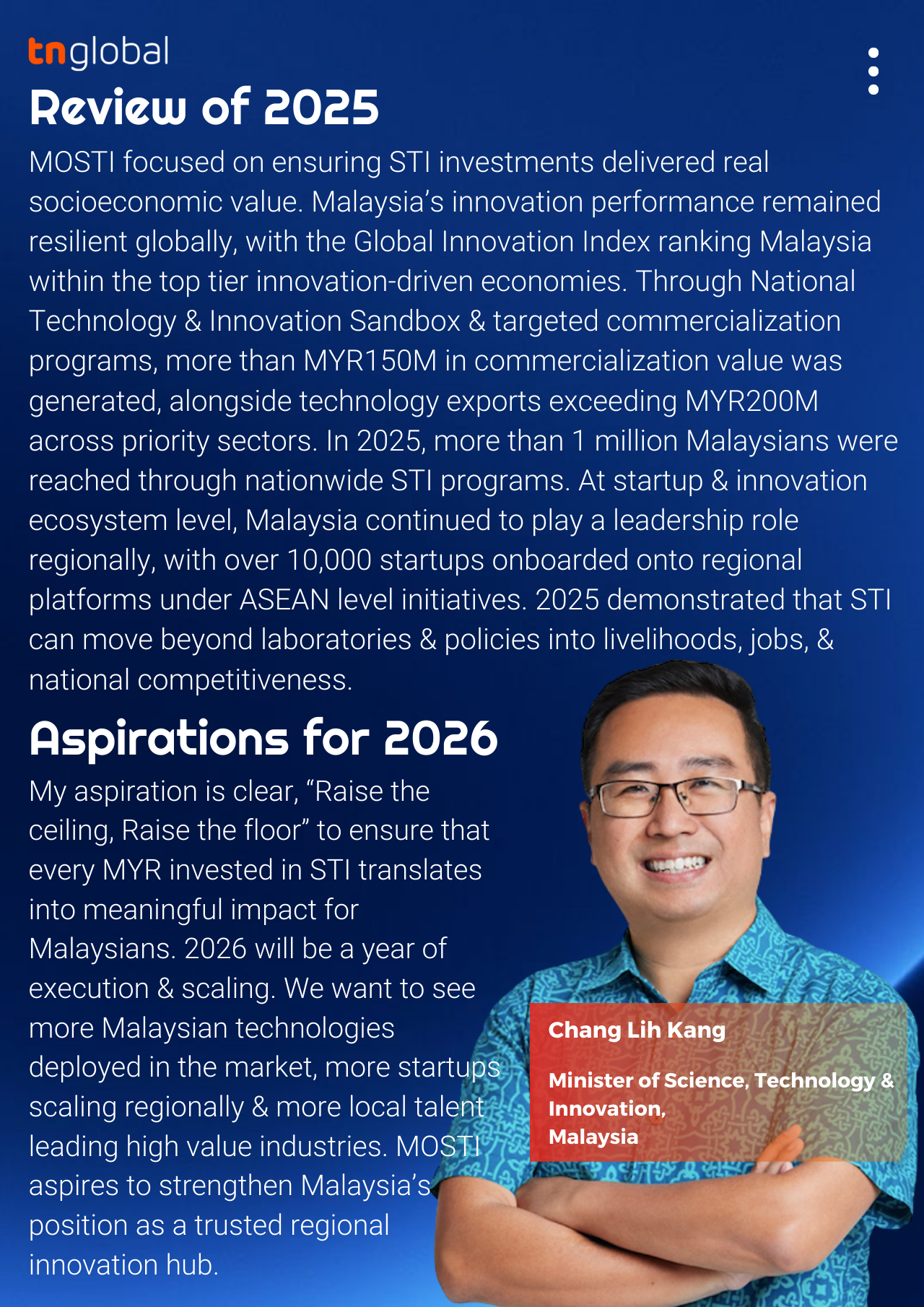
How was Ministry of Science, Technology and Innovation (MOSTI)’s 2025?
2025 was a defining year for MOSTI, where science, technology and innovation were translated into tangible outcomes for the people (rakyat) and the economy. Guided by the principle of “Merakyatkan Sains, Menginsankan Teknologi dan Mengarusperdanakan Inovasi “(Democratizing Science, Humanizing Technology, and Mainstreaming Innovation), MOSTI focused on ensuring that science, technology and innovation (STI) investments delivered real socioeconomic value.
Among the key achievements, Malaysia’s innovation performance remained resilient globally, with the Global Innovation Index placing Malaysia within the top tier of innovation driven economies. Through national platforms such as the National Technology and Innovation Sandbox and targeted commercialization programs, more than MYR150 million ($38.04 million) in commercialization value was generated, alongside technology exports exceeding MYR200 million ($50.78 million) across priority sectors including advanced manufacturing, health technology, agri innovation and digital solutions.
Talent development remained a central pillar. In 2025 alone, more than one million Malaysians were reached through nationwide STI programs, including Techlympics, innovation challenges and digital skills initiatives, strengthening the national talent pipeline from school to industry. At the startup and innovation ecosystem level, Malaysia continued to play a leadership role regionally, with over 10,000 startups onboarded onto regional platforms under ASEAN level initiatives, improving visibility, access to markets and investor networks.
Most importantly, 2025 demonstrated that STI can move beyond laboratories and policies into livelihoods, jobs, and national competitiveness. This strong foundation sets the tone for MOSTI’s mandate moving into 2026.
What’s your expectation/aspiration for 2026?
For 2026, my aspiration is clear, “Raise the ceiling, Raise the floor” to ensure that every ringgit invested in science, technology and innovation translates into meaningful impact for Malaysians. Innovation must move decisively from lab to livelihood, creating jobs, strengthening industries and improving quality of life.
2026 will be a year of execution and scaling. We want to see more Malaysian technologies deployed in the market, more startups scaling regionally, and more local talent leading high value industries. This aligns closely with the Malaysia MADANI vision, where innovation is not exclusive, but inclusive, sustainable and people centric.
MOSTI also aspires to strengthen Malaysia’s position as a trusted regional innovation hub, particularly in emerging fields such as artificial intelligence, green technology, biotechnology and advanced manufacturing. Talent will remain at the heart of this aspiration, because without skilled, future ready Malaysians, innovation cannot be sustained.
What are the plans of MOSTI in 2026? What is the focus in the new year?
In 2026, MOSTI’s focus will be on three key priorities.
First, accelerating commercialisation and deployment. Research and development must not stop at publications or prototypes. Through enhanced commercialisation funding, industry collaboration and regulatory support, MOSTI will push more technologies into real world adoption across healthcare, food security, energy transition and smart manufacturing.
Second, strengthening talent and skills for an innovation driven economy. MOSTI will expand talent development programmes across AI, deep tech, data science and future technologies, working closely with universities, industry and regional partners to ensure Malaysian talent remains competitive locally and globally.
Third, positioning Malaysia as a regional STI connector. Building on ASEAN level platforms and cooperation, MOSTI will continue to support cross border collaboration, market access and investment flows, ensuring Malaysian innovators are not limited by geography.
All these efforts are guided by one central principle, innovation must serve people, create opportunities and drive sustainable growth.
How is the outlook for 2026 for tech ecosystem in Malaysia and Southeast Asia?
The outlook for 2026 is cautiously optimistic, but full of opportunities. Malaysia and Southeast Asia are entering a phase where technology adoption is accelerating across sectors, from digital government and smart cities to green transition and advanced manufacturing.
Malaysia is well positioned within this regional ecosystem. We have strong fundamentals, a growing pool of skilled talent, supportive policies and an increasingly connected startup and innovation network across ASEAN. With platforms that improve visibility, deal flow and collaboration, Malaysian startups and technology companies are better placed to scale regionally.
However, success in 2026 will depend on our ability to develop talent, build trust in emerging technologies and ensure inclusive growth. MOSTI’s role is to ensure that the tech ecosystem grows not only in size, but in quality, impact and sustainability, contributing to shared prosperity for Malaysia and the region.
Malaysia’s Carsome: more EVs expected to enter secondary market in 2026 [Q&A]