

As we usher into the new year, we sought insights from prominent figures across the Southeast Asian tech landscape. These leaders reflected on their triumphs in 2025, sharing valuable perspectives on their achievements and the challenges they overcame.
They also unveiled their ambitious aspirations, meticulously outlined their strategic plans for 2026, and offered insightful predictions on the trajectory of the tech industry in the new year.
We talked to Gobi Partners Co-Founder and Chairperson Thomas G. Tsao to learn more about the Asia-focused venture capital firm’s achievements in 2025 and its plans and aspirations for 2026. He also shared his views on the outlook of tech ecosystem in Southeast Asia in 2026. Gobi Partners is an Asia-focused venture capital firm with $1.6 billion in assets under management. Headquartered in Kuala Lumpur and Hong Kong, the firm supports entrepreneurs from the early to growth stages and focuses on emerging and underserved markets.
Founded in 2002, Gobi has raised 24 funds and invested in over 400 startups with 62 operating in the Circular Economy. Gobi has grown to 16 locations across key markets in Bangkok, Beijing, Dhaka, Guangzhou, Ho Chi Minh City, Hong Kong, Jakarta, Karachi, Kuala Lumpur, Lahore, Manila, Seoul, Shanghai, Shenzhen, Singapore and Tianjin, information from its website showed.
How was Gobi Partners’ 2025?
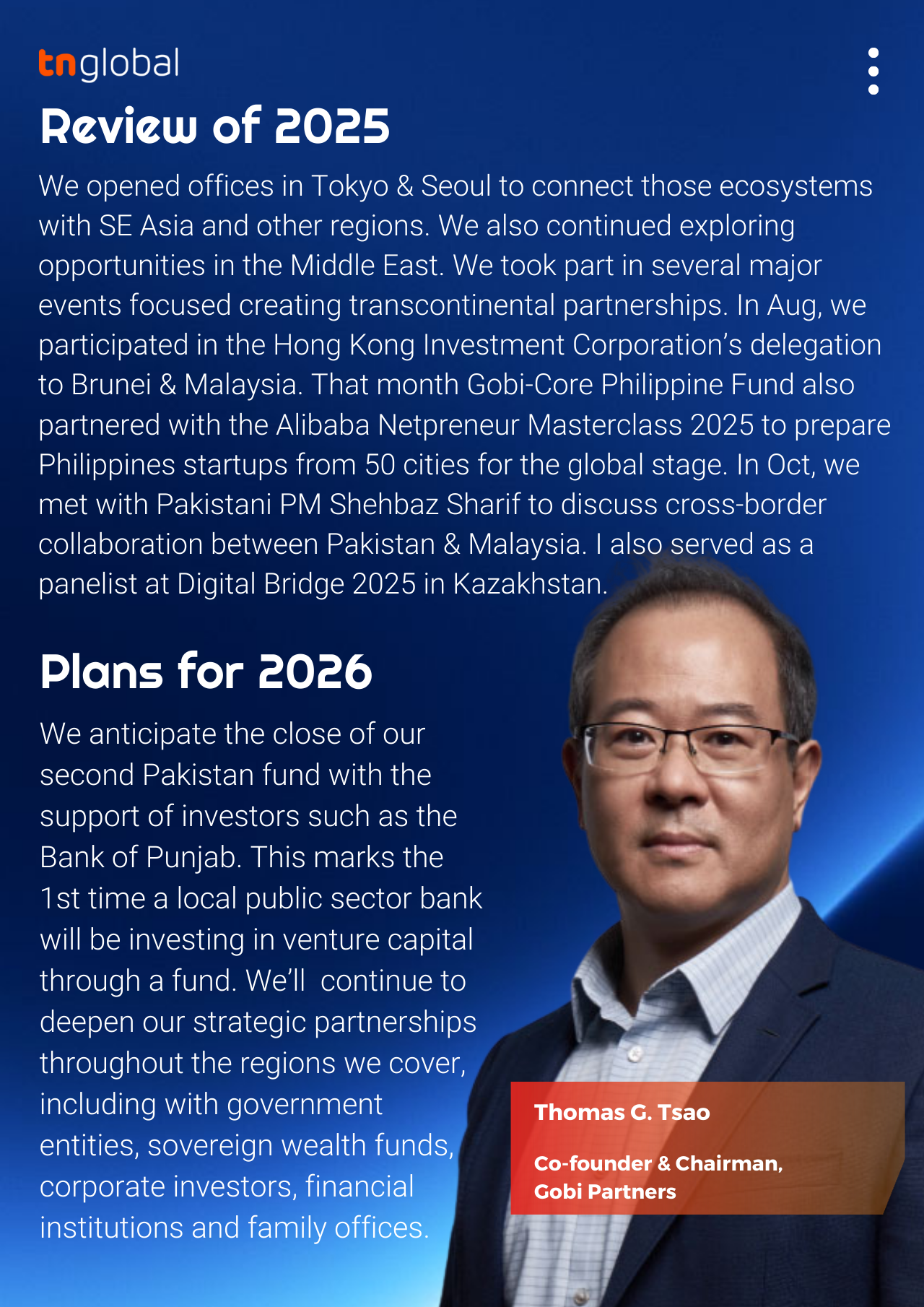
Gobi made significant progress in our mission of bringing Asian markets closer together. We opened offices in Tokyo and Seoul to connect those ecosystems with Southeast Asia and other regions. We also continued exploring opportunities in the Middle East.
We took part in several major events focused creating transcontinental partnerships. In August we participated in the Hong Kong Investment Corporation’s delegation to Brunei and Malaysia. That month Gobi-Core Philippine Fund also partnered with the Alibaba Netpreneur Masterclass 2025 to prepare Philippines startups from 50 cities for the global stage. Then in October, we met with Pakistani Prime Minister Shehbaz Sharif to discuss cross-border collaboration between Pakistan and Malaysia. I also served as a panelist at Digital Bridge 2025 in Kazakhstan. We believe that building bridges between regions is integral as the world continues to reglobalise around Asia, where 50 percent of the global population lives.
Gobi also continued to drive breakthroughs in sectors like AI, DeepTech, semiconductors, BioTech, the Circular Economy, financial inclusion, TaqwaTech and healthcare. All our investments are guided by our commitment to uncovering solutions that will have the greatest impact on underserved communities. Our approach to investment was further validated by exits like our sale of secondary shares in Airwallex, Brite Semiconductor’s IPO and Synagistics’ de-SPAC.
What are your expectation/aspirations for 2026?
I’m very excited about Gobi’s increasingly close ties to universities, where some of the most important technology is waiting to be commercialized. In 2025 we forged important uni-tech partnerships to help us find opportunities in sectors like AI, DeepTech, BioTech and robotics. These kinds of technologies requires patient capital, which is why we partnered with Hong Kong Investment Corporation Limited (HKIC) on the first International Forum for Patient Capital in May.
These included the Gobi-Redbird Innovation Fund with the Hong Kong University of Science and Technology (HKUST) and HKIC. We are also very close to expanding the HKU Entrepreneurship Engine Fund with the University of Hong Kong (HKU) and HKIC. We have already invested in a number of startups and plan to double-down on uni-tech in the New Year.
Gobi has already held the first close for two funds, Gobi Meranti ASEAN Growth (MAG) Fund II and Gobi United Fund, and started deploying capital in 2026. Both funds will focus on connecting markets in Asia. They will also provide patient capital.
In 2026, we anticipate the close of our second Pakistan fund with the support of investors such as the Bank of Punjab. This marks the first time a local public sector bank will be investing in venture capital through a fund, an important milestone for Pakistan’s startup ecosystem.
We will also continue to deepen our strategic partnerships throughout the regions we cover, including with government entities, sovereign wealth funds, corporate investors, financial institutions and family offices. These collaborations are fundamental to building strong ecosystems throughout the continent.
What are Gobi’s plans in 2026? What is the focus in the new year?
ESG (Environmental, Social and Governance) is foundational to our investment philosophy and we will continue to uphold its principles. For example, strong governance is essential to increasing the number of startup exits in emerging markets, which pulls in more investment and enables sustainable ecosystems.
In terms of sectors, we are excited about semiconductor opportunities as global supply chains continue to realign. Gobi expects to see more multi-national corporations turn to Malaysia, which is strategically upstreaming its semiconductor industry, and other Southeast Asia countries. Our current portfolio companies in the space include SkyeChip and NanoSkunkWorkX.
Gobi will also focus on startups that are using AI to enable different forms of inclusion, including financial inclusion, accessible healthcare, and sustainable mobility. For example, our portco ArmourZero makes AI-enabled cybersecurity technology accessible to SMEs and developers throughout Southeast Asia, giving them an alternative to costly legacy solutions. Another example from our portfolio is RushOwl, which uses a AI-based dynamic routing algorithm for more efficient ride-pooling.
We’ll also continue working closely with global incubation platform GUIDE to drive the commercialization of university research and venture building. The value of GUIDE is evident in an environment where many foundational sectors are emerging, including DeepTech. Like Gobi, GUIDE is committed to helping frontier technologies expand across the region with cross-border initiatives that span MENA, Southeast Asia, the Greater Bay Area and Central Asia.
How is the outlook for 2026 for the tech ecosystem in Southeast Asia?
We believe that Southeast Asia will continue to attract capital, despite global market and geopolitical headwinds. Global competitive dynamics will continue to drive the diversification of supply chains, and we expect that to benefit Southeast Asian startups across sectors.
We also expect exits to continue, thanks in part to alternative exit routes like mergers and acquisitions and special purpose acquisition vehicles. Our highest-confidence IPO sectors are ones where Asia controls real leverage: Circular Economy platforms like Carsome and CompAsia; semiconductors like SkyeChip and Efinix; Islamic digital infrastructure through Bitsmedia and Durioo++; and FinTech plumbing via PolicyStreet and HealthMetrics.
Southeast Asia is one of the most diverse regions in the world, combined with a youthful population that has proven itself eager to adopt new technologies. We expect it to become a global innovation hub in its own right.
Malaysia’s Carsome: more EVs expected to enter secondary market in 2026 [Q&A]