

Singapore was the largest cryptocurrency market in a region spanning Central and Southeast Asia and Oceania, with $284 billion in activity in the year to June, blockchain-analytics firm Chainalysis said.
In a statement on Thursday for the release of its “The 2026 Geography of Crypto Report” document, Chainalysis said Singapore continued its leading position even as the region’s overall crypto economy shrank.
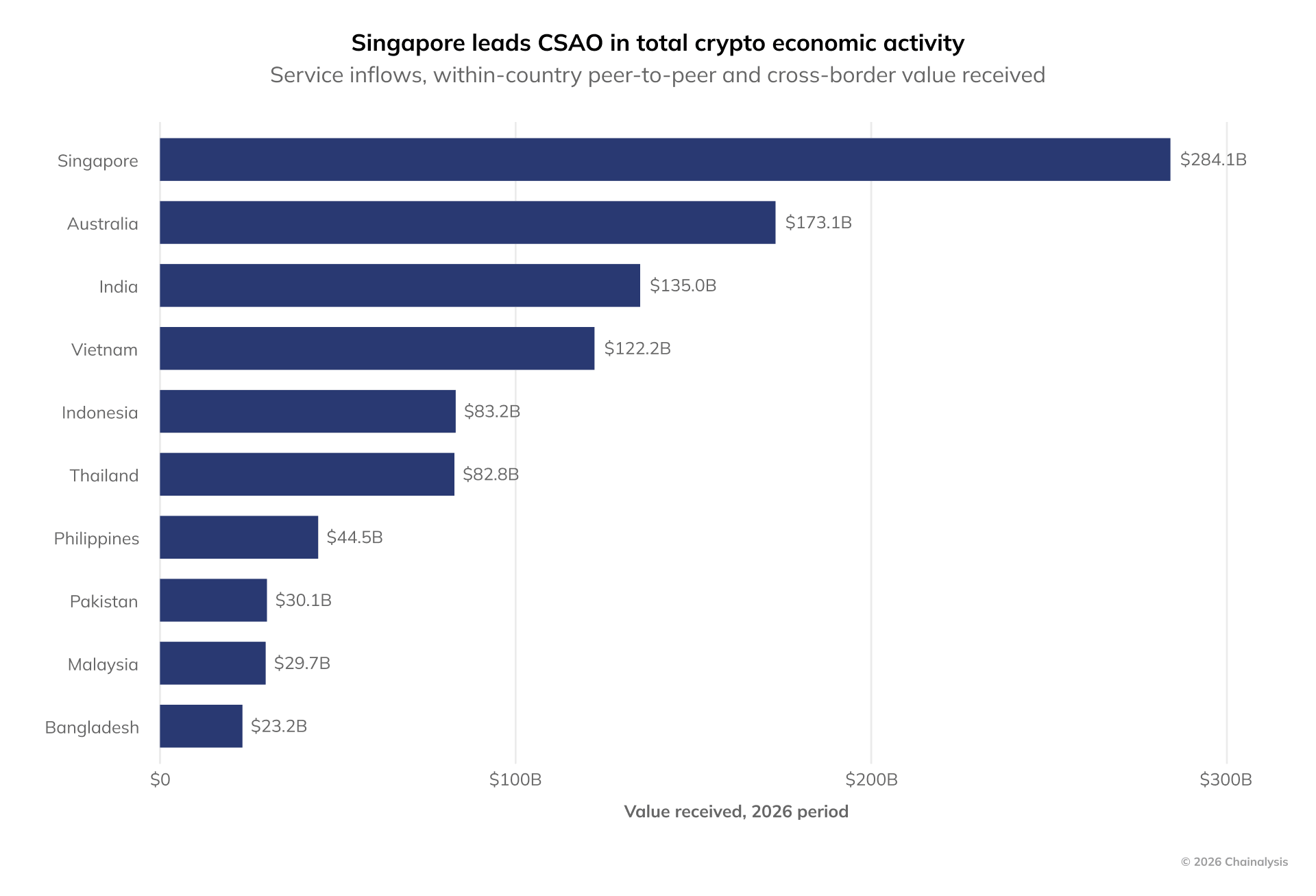
Singapore’s crypto activity rose 55.4 percent, regaining the regional lead, Chainalysis said in its 2026 report covering July 2025 to June 2026. The growth was led by institutional trading, up 94 percent to $60 billion and concentrated among a few market makers, over-the-counter firms and brokerages, though flows into both centralized and decentralized exchanges also rose. The wider region contracted 6.8 percent.
Australia was the second-largest market at $173.1 billion, the report said. Its overall activity fell 5.6 percent on a drop in decentralized-exchange flows, but centralized-exchange and institutional activity grew, with institutional-platform flows up 33.3 percent to $39.9 billion, led by custodians and over-the-counter desks.
India recorded one of the sharpest declines, down 14.7 percent, but remained a major market at $135 billion and had the region’s largest inflows into centralized exchanges, Chainalysis said.
Vietnam ranked fourth with $122.2 billion, followed by Indonesia with $83.2 billion, Thailand with $82.8 billion, and the Philippines with $44.5 billion.
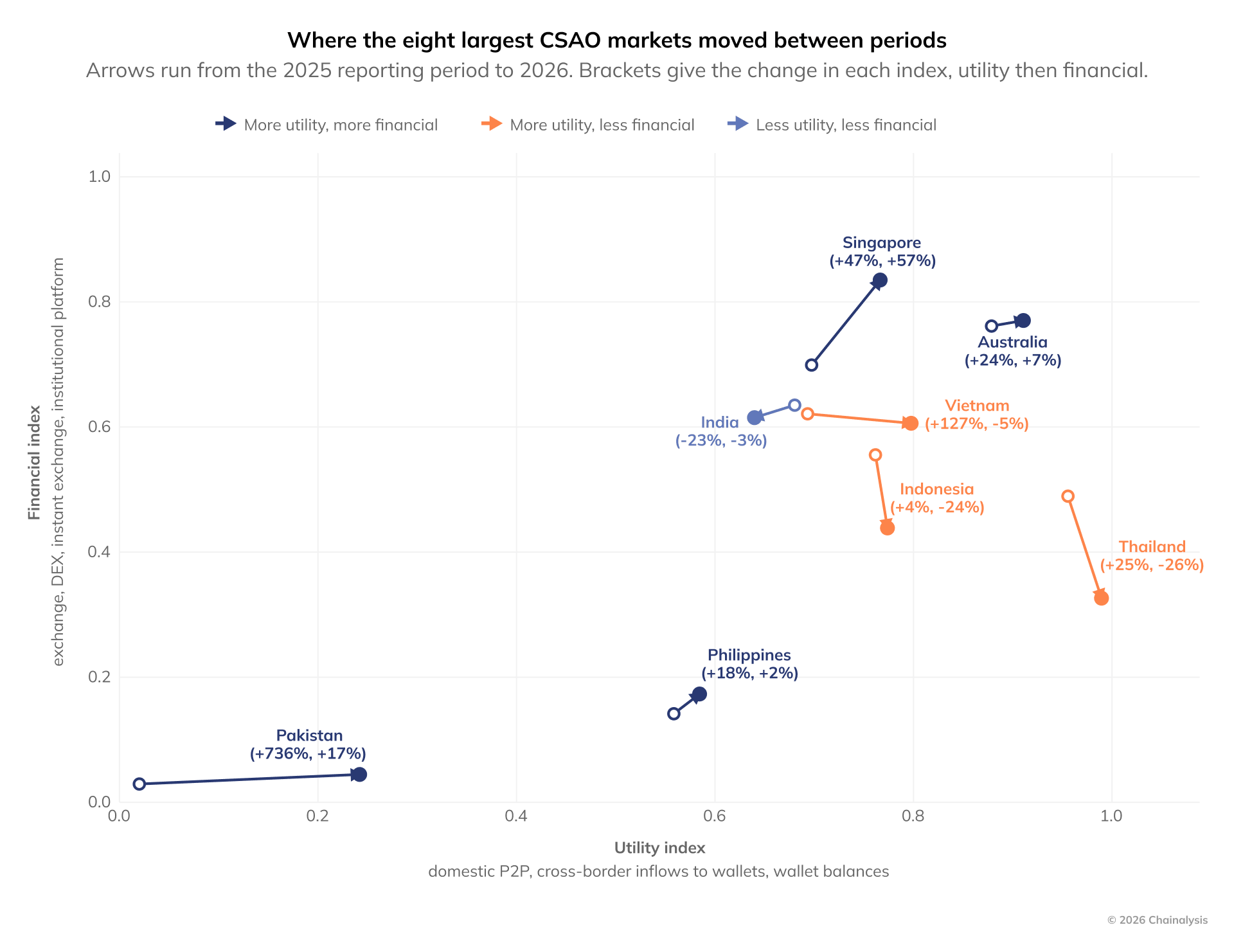
Regarding crypto adoption for both financial activity (trading, leading, staking) and utility activity (day-to-day activities such as remittances, payments), Chainalysis said Singapore and Australia grew on both.
Pakistan posted the region’s standout gain in everyday use, up 736 percent, though from a very small base — about $69 million in the prior year to $351 million, Chainalysis said. The jump followed Pakistan’s move in April to lift a seven-year ban on banks dealing with crypto companies.
The Philippines, Thailand and Vietnam grew in everyday use through peer-to-peer payments, together accounting for 14.4 percent of the world’s small-value peer-to-peer transfers — about 5.4 million transactions under $10,000 — despite making up just 2.5 percent of the global crypto economy, according to the report.
Crypto services in Vietnam must report suspicious cases to central bank