

Around one in five employees in ASEAN lose more than seven hours a week moving information and reconciling data between disconnected systems, even as 86 percent say AI has improved their day-to-day work experience.
Enterprise software company Workday (NASDAQ: WDAY), based in the United States, noted the figures in its “The Copy/Paste Economy: Why Task-Oriented AI Is Failing the Enterprise” report. The report cover Indonesia, Malaysia, Singapore, and Thailand, Workday said in a statement on Tuesday.
The report finds that productivity gains from AI are frequently offset by manual integration work. As many as 66 percent of ASEAN employees spend at least half their work time translating and coordinating between systems and teams, and only 30 percent of organizations have embedded AI into the core of their business.
Despite reporting high levels of day-to-day satisfaction as 97 percent rate their work experience positively and nearly nine in ten report a strong sense of progress, ownership, and connection to organisational goals, employees are simultaneously burdened by the manual integration work. Four in five say navigating processes and systems is a source of stress.
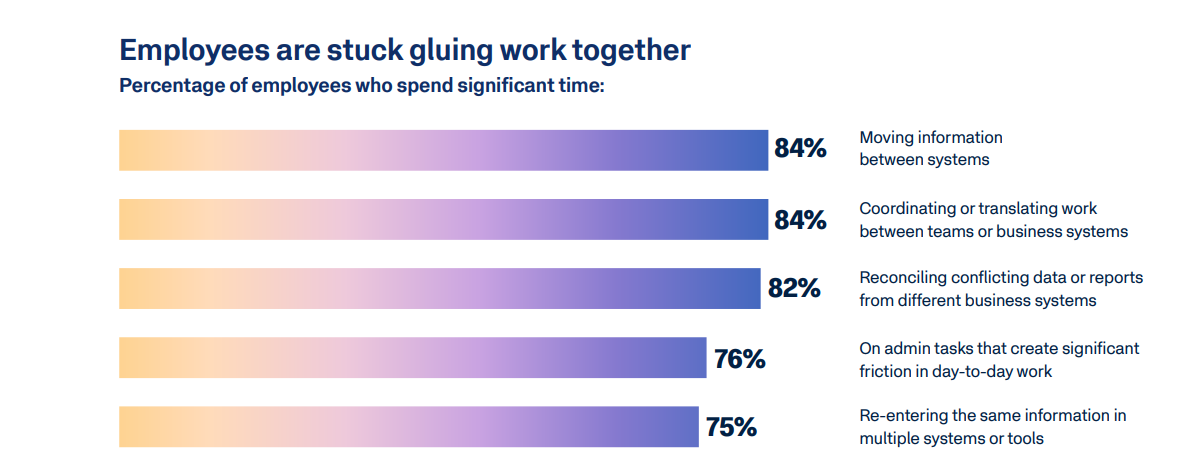
The research identifies five specific sources of friction. As many as 84 percent of employees spend significant time moving information between systems, and an equal 84 percent spend significant time coordinating or translating work between teams or business systems.
About 82 percent regularly spend significant time reconciling conflicting data or reports from different systems. 76 percent say administrative tasks create significant day-to-day friction.
Nearly 75 percent spend significant time re-entering the same information across multiple systems or tools. Separately, three-quarters of ASEAN employees say decisions are delayed when information is missing or unclear, and 72 percent of teams regularly disagree over whose data is correct.
The administrative burden is more acute in ASEAN than globally. The global average for employees spending significant time on administrative and bureaucratic tasks is 70 percent, compared with an ASEAN weighted average of 76 percent, a gap of six percentage points. Indonesia at 84 percent and Malaysia at 77 percent are both above the ASEAN average.
The report also finds that AI delivers measurably better results in embedded core systems. In Asia-Pacific and Japan, employees in organizations with AI deeply embedded in core systems are 1.8 times more likely to report AI cuts task time by 25 percent or more than those without AI as core systems.
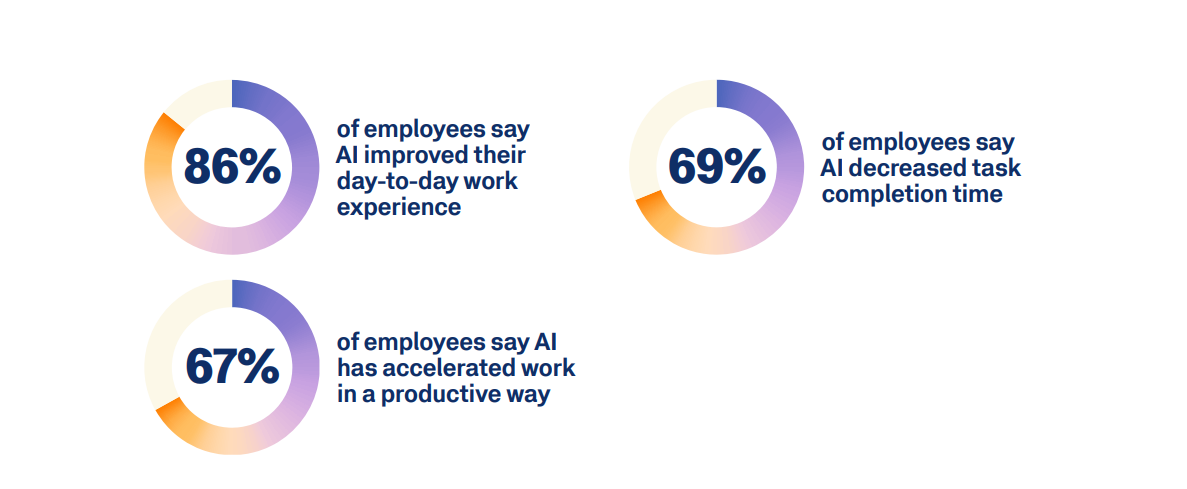
About 67 percent of ASEAN employees say AI has accelerated work productively, above the global benchmark of 54 percent. The top AI use cases within core systems are monitoring metrics and suggesting actions at 55 percent, assisting onboarding at 51 percent, answering HR and policy questions at 42 percent, budgeting and forecasting at 41 percent, supporting financial close or reporting at 40 percent, and routing cross-departmental approvals at 38 percent.
Jess O’Reilly, General Manager for ASEAN at Workday, said the real friction is structural — stemming from unclear guidance, inconsistent outputs, and tools that do not integrate where work actually happens — and that organisations need to move beyond task-based AI use cases toward an operating model where AI is integrated within the flow of work.
Workday appoints tech veteran Yen Yen Tan to APAC International Advisory Board