

Grab, the Singapore-based superapp, reported revenue of $1.95 billion for the first half of 2026, up 23 percent year-on-year, with profit for the period of $355 million compared with $30 million a year earlier, Grab said in its quarterly review released on Tuesday.
Adjusted EBITDA in H1/2026 was $323 million, up approximately 50 percent year-on-year from $215 million. Operating profit was $41 million, compared with an operating loss of $14 million in the first half of 2025.
Grab also highlighted its AI intelligence layer is now embedded across every layer of its platform and is expected to strengthen further as it scales.
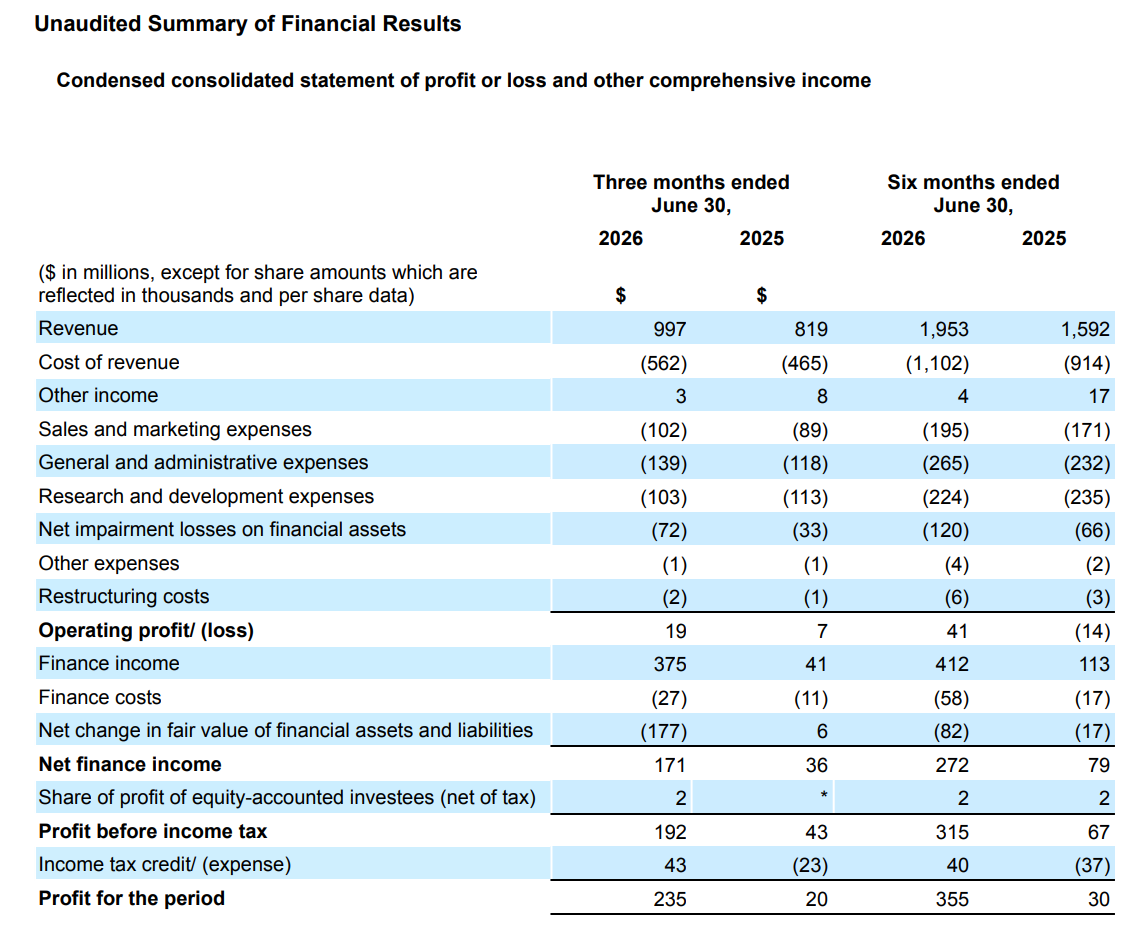
For the second quarter alone, revenue was $997 million, up 22 percent year-on-year, with adjusted EBITDA of $168 million, up 54 percent year-on-year, marking the company’s eighteenth consecutive quarter of adjusted EBITDA growth.
On-demand gross merchandise value (GMV) grew 21 percent year-on-year to $6.5 billion. Monthly transacting users (MTU) reached a record 54 million, up 17 percent year-on-year.
Profit for Q2/2026 was $235 million, up from $20 million a year earlier, though the company noted that $307 million of this reflects a one-time gain from consolidating Superbank in June 2026 and does not expect this to recur in the second half.
Deliveries revenue grew 21 percent year-on-year to $531 million in the second quarter, with GMV up 24 percent on a constant currency basis to $4.25 billion. Average monthly active delivery merchant-partners grew 8 percent year-on-year while their average earnings grew 14 percent year-on-year. Total quarterly active advertisers on the self-serve platform grew 21 percent year-on-year, with average spend per advertiser growing 24 percent year-on-year.
Mobility revenue grew 12 percent year-on-year to $331 million in the second quarter, with GMV up 18 percent to $2.21 billion. Mobility transactions grew 28 percent year-on-year as Grab expanded affordable service tiers. Average monthly active driver-partners reached an all-time high, growing 19 percent year-on-year.
Grab committed more than $7 million during the quarter to support driver-partner earnings amid fuel cost increases across the region.
Financial Services revenue grew 59 percent year-on-year to $134 million in the second quarter, with total loans disbursed rising 72 percent year-on-year to an all-time high of $1.2 billion. The gross loan portfolio scaled 197 percent year-on-year to $2.3 billion, driven largely by the consolidation of Superbank.
Grab raised its full-year 2026 guidance to revenue of $4.10 billion to $4.15 billion, representing growth of 22 to 23 percent year-on-year. It also revised its adjusted EBITDA of $720 million to $740 million, representing growth of 44 to 48 percent year-on-year, reflecting the consolidation of Superbank and the acquisition of Stash.
Anthony Tan, Group CEO and Co-Founder of Grab, said the AI intelligence layer is now embedded across every layer of the platform, lifting driver and merchant-partner earnings while improving operating efficiency. On-demand GMV growth accelerated to 22 percent year-on-year on a constant currency basis, the executive added.
Tan said the intelligence layer is expected to strengthen further as it scales, translating into deeper user engagement and durable profitable growth.
Grab operates across deliveries, mobility, and digital financial services in eight Southeast Asian countries, serving over 900 cities. It also operates supermarkets in Malaysia under the Jaya Grocer and Everrise brands.
Singapore’s Minister Josephine Teo, Grab’s founder Anthony Tan join AI for Good Global Commission