

Only 29 percent of Singapore businesses can produce an audit trail to prove AI-driven decisions to regulators, shareholders, or customers, trailing the Asia-Pacific average of 38 percent who hold a tamper-proof audit trail.
UK-based compliance technology company Sumsub, in a joint survey with the Singapore Fintech Association, revealed the figures in its “APAC State of Digital Trust: AI Governance Benchmark” report.
The report highlighted the gap as 94 percent of Singapore businesses are now using or piloting multi-step AI systems. Besides, 95 percent of organizations across APAC say they are confident they can explain an AI-driven decision, but only 50 percent can reconstruct the decision pathway, the reported stressed.
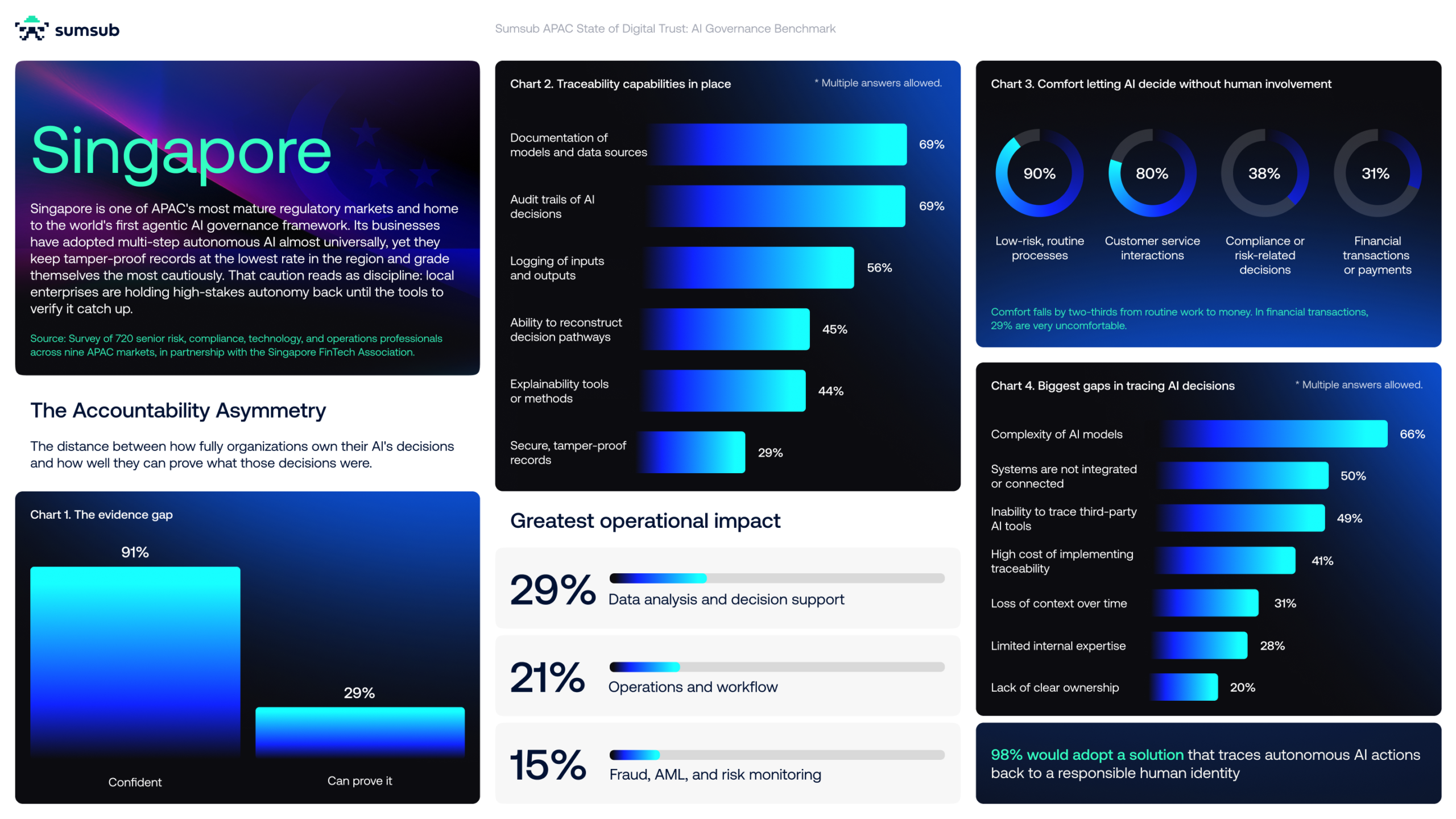
The report describes this as the Accountability Asymmetry: organizations are willing to own their AI’s decisions in principle but lack the infrastructure to clarify the decisions. Without a traceable record, every unmonitored AI action represents a deferred rather than avoided cost, exposing businesses to operating losses, compliance fines, and broken customer trust.
Singapore scored 65.6 on the overall governance benchmark, just below the APAC average of 67.1. Thailand leads the region at 70.3, followed by the Philippines at 69.6, India at 68.5, China at 68.0, Hong Kong at 66.7, Australia at 66.7, Indonesia at 66.0, and Malaysia at 62.4.
The report notes that Singapore’s position near the lower end of the index reflects its advanced regulatory foundation rather than a lack of progress. Singapore was the first government in the world to provide governance guidance for AI agent use through the Model AI Governance Framework for Agentic AI, launched earlier in 2026.
Other key Singapore findings include: 70 percent of businesses maintain explicit guidelines assigning direct responsibility for AI outcomes to a specific person at 40 percent or team at 30 percent, matching the APAC average; 90 percent are comfortable letting AI handle low-risk routine tasks, above the APAC average of 88 percent; and only 16 percent significantly increased the scope or autonomy of their AI systems in the last year, the most measured deployment rate in APAC.
Singapore businesses report the greatest real-world AI impact in data-related tasks at 29 percent and operations or workflow processing at 21 percent, followed by fraud detection, anti-money laundering, and risk monitoring at 15 percent.
On technical priorities, 66 percent cite navigating model complexity as a primary engineering challenge, followed by platform integration at 50 percent and building tracking parameters for third-party AI tools at 49 percent. As many as 98 percent of Singapore businesses say they are ready to adopt a third-party verification solution that ties autonomous AI actions to a verified identity network.
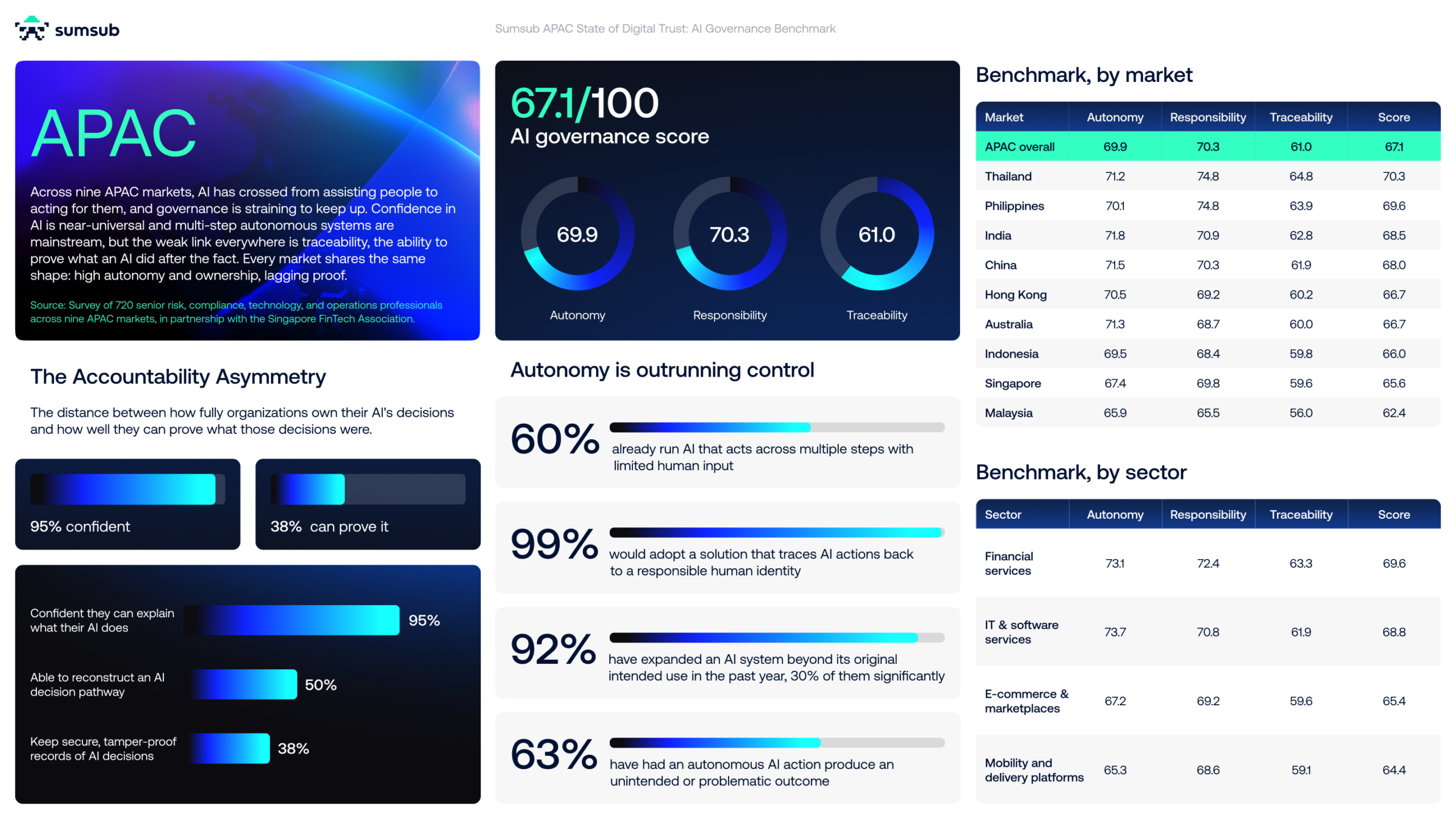
By sector across APAC, financial services leads the governance benchmark at 69.6, supported by a region-leading 68 percent audit trail adoption rate. IT and software services follows at 68.8. E-commerce platforms score 65.4, with only 29 percent using independent audits. The mobility and delivery sector trails at 64.4.
Holly Fang, President of the Singapore Fintech Association, said the bigger question is not how quickly AI is advancing but whether governance is keeping pace, and that as AI moves into autonomous agents handling critical workflows, the focus must shift to building traceability, accountability, and governance needed to deploy AI at scale.
Penny Chai, Vice President for APAC at Sumsub, said prudence rather than a lack of strategic intent defines how enterprises are scaling AI agents, and that immature traceability systems create unacceptable operational risk when financial liabilities are involved.