

In my first year covering India and SAARC for Neat, I spent a lot of time in meeting rooms that told a familiar story. Companies running Teams or Google Meet at serious scale, solid deployments, proper licences, real investment in the platform. But then you’d sit in the room where the actual meeting was happening and find a laptop propped on a stack of books with a TV mounted too high on the wall. The software side had been figured out, but the physical side hadn’t caught up yet.
India sits at the acute end of a gap that runs across the whole region, where collaboration software has consistently moved faster than the infrastructure it runs on. What’s happened over the past couple of years hasn’t closed that gap so much as made it more visible. Offices across APAC are being redesigned around collaboration, with fewer fixed desks and more small rooms, and the huddle space is steadily becoming the primary unit of day-to-day work. The direction is right, but the thinking behind what actually goes inside these rooms is still catching up.
Rethinking the small room
Much of what is being built right now follows the same model as the old conference room, just smaller. A central codec or AV rack that the rest of the room’s technology depends on, contained in a more compact footprint. That approach made sense when meeting rooms were large, permanent, and rarely reconfigured. It’s a less natural fit for a space designed for small teams, quick turnarounds, and a range of use cases across the week.
Most enterprises have moved toward hardware that supports multiple platforms natively, recognizing that rooms tied to a single vendor become inflexible as organizations grow and change. But the platform a room runs on isn’t really what determines whether the meeting works well. What shapes the day-to-day experience more directly is how intelligence is distributed inside the room itself. When everything runs through a single central controller, that controller becomes both the anchor and the bottleneck, and maintenance, upgrades, and troubleshooting all flow back to it.
This is the problem distributed architecture was designed to solve. Instead of concentrating intelligence in one box, it embeds compute, sensing, audio, and video across the room’s components so they coordinate with each other rather than deferring to a central point. Cameras adjust framing as conversations move around the space, audio adapts without manual intervention, and the room behaves as an integrated system rather than a collection of devices. For a small huddle space, this matters practically. It means the room can be compact and still deliver a consistent experience, and it can be deployed and managed remotely, which in a region where IT teams are often stretched across multiple markets is a genuine operational advantage rather than just a technical detail.
What India showed me about scaling fast
When Neat’s India partner network grew from 2 to over 200 across four years, the conversations I had with customers were rarely about feature sets. They were about what could work reliably at pace, in cities and business districts where local IT support wasn’t always available and where a company deploying rooms in one location might be opening three more the following month. Zero-touch deployment, which is hardware that works straight out of the box and is managed from a central cloud dashboard, became the baseline expectation quickly, because it was the only model that made sense for the speed at which Indian enterprises were expanding into Tier 2 and Tier 3 cities.
The same dynamic is playing out across Southeast Asia now. Businesses in Singapore, Malaysia, and Indonesia that are opening new offices or entering new markets are facing the same fundamental pressure: the room needs to work from day one without on-site configuration, and it needs to be monitored and updated centrally as the footprint grows. For organizations scaling quickly across the region, that kind of manageability shapes whether the expansion is operationally practical.
Getting the room right
A small room equipped with a consumer-grade camera and a device locked into a single platform will struggle to deliver what a well-designed huddle space should. In markets where office rents are high, and meeting room utilization is increasingly tracked at the senior level, the difference between a room that consistently works and one that doesn’t has real business consequences.
The organizations that can navigate this aren’t necessarily spending more than their peers. They’re starting by asking how people actually move and talk in a small room and building technology around that, instead of inheriting the assumptions of the old conference room model in a smaller form factor. The result, when it’s done well, is what we at Neat have started calling a thinking environment: a space that senses and responds to what’s happening in the room, rather than one that simply captures it. This has a direct bearing on employee experience. When a room just works, people use it more, and when the technology quietly takes care of itself, employees feel supported in a way no policy or perk quite replicates.
What the huddle room was always meant to enable is a meeting that starts without friction, where someone joining remotely has the same presence as the people in the room and where the technology recedes enough for the conversation to take over. The infrastructure to deliver that exists. It’s just a matter of designing around it from the start.
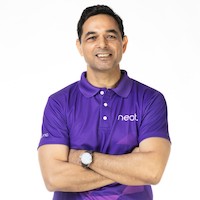
Manu Sharma is Regional Director, India & SAARC at Neat. With nearly 26 years of experience, Manu has consistently achieved breakthrough sales objectives and adeptly managed intricate business relationships. His career spans leadership positions at prominent companies such as Panasonic, Poly, Avaya, Oracle, Microsoft, Tata Communications, and Wipro. Manu holds a Bachelor of Engineering in Mechanical from Guru Nanak Dev Engineering College, Ludhiana.
TNGlobal INSIDER publishes contributions relevant to entrepreneurship and innovation. You may submit your own original or published contributions subject to editorial discretion.
Featured image: Phil Hearing on Unsplash
AI agents are joining the workforce; Inclusion must be part of the job description