

Editor’s note: On May 28, 2026, the BGlobal Summit took place during BEYOND Expo 2026, Macao.
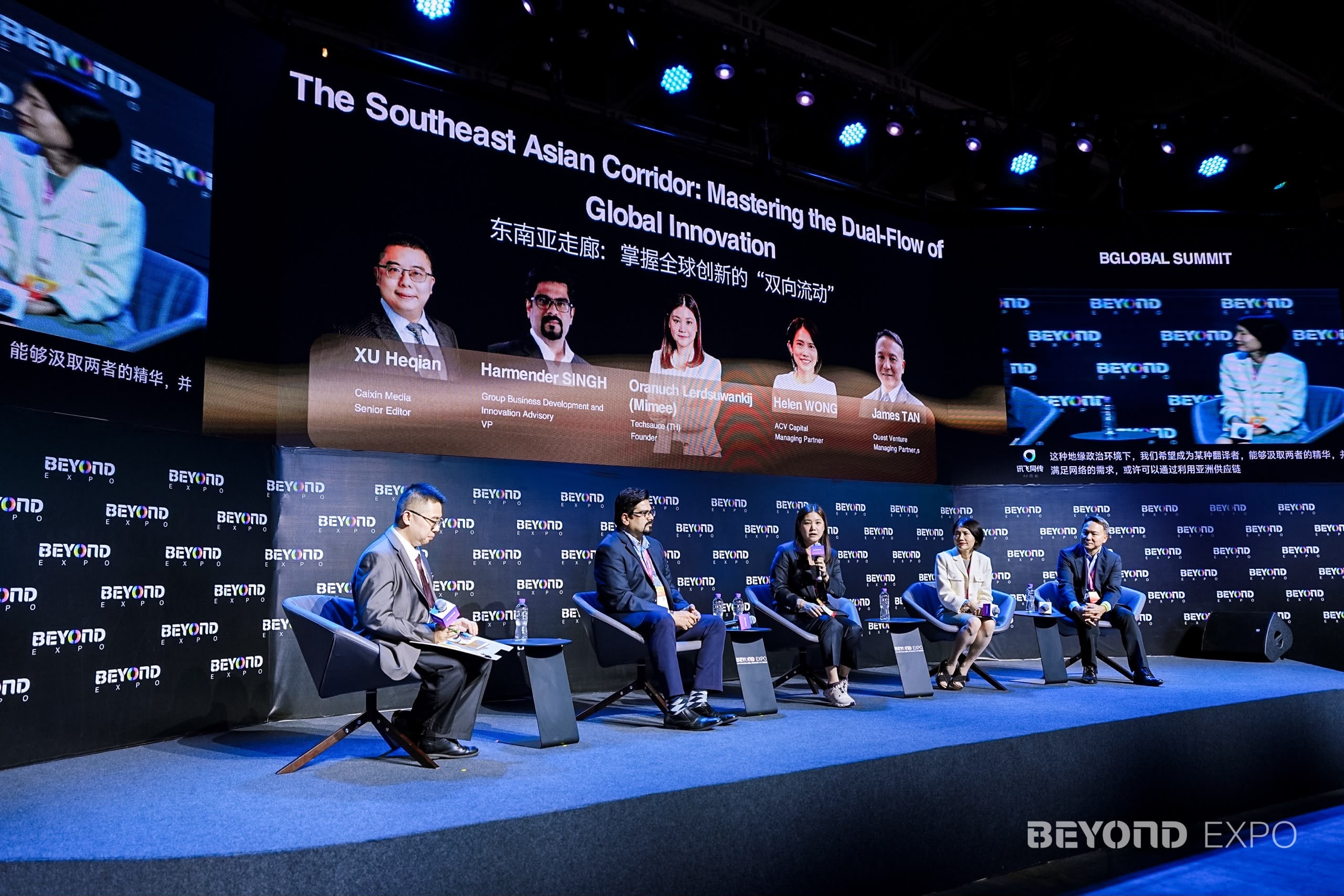
The session “Southeast Asian Corridor: Mastering the Dual-Flow of Global Innovation” at the BEYOND Expo focused on Southeast Asia’s capability to become the world next engine of global growth.
Focusing on artificial intelligence (AI), the session concluded that Southeast Asia cannot compete at the foundational layers of AI, chips and large language models, where the US and China dominate. But the region can utilize real opportunity in energy infrastructure for data centers and in applying existing AI tools to manufacturing, finance, and vertical sectors like agriculture and healthcare. The region’s geopolitical neutrality can provide another quiet advantage: unlike users in China, Southeast Asians can freely access both American and Chinese AI tools.
Harmender Singh, SVP (Group Business Development & Innovation Advisory), Cradle Fund: What we’re seeing right now is that the applications and benefits of AI are outweighing a lot of other concerns, whether in manufacturing, analytics, or the speed at which you can get insights.
You can’t take that away from industry because ultimately it’s a business decision. But when it comes to AI ethics and governance, this is something very new, not just for Southeast Asia, but for the entire globe. You can look at advanced ecosystems in the United States or Europe where these issues have come up.
What we can do is work toward a uniform baseline of what is acceptable. And we are already seeing some form of agreement in Southeast Asia. The ASEAN has certain common standards around AI ethics, and there are ongoing dialogue sessions touching on these topics. The framework is not complete, but the gap is narrowing. How much freedom we allow and how we ensure safety in usage will be crucial.
Helen Pei-Hua Wong, Managing Partner, ACV Capital: For AI, I think we need to talk about the key layers, as Jensen Huang mentioned energy, chips, LLMs, applications. For the LLM and chip layers, it’s very hard for Southeast Asia to compete. Malaysia has some semiconductor testing and assembly capacity, but for the whole of Southeast Asia, this is really a game between the two giants, the United States and China.
Where I think Southeast Asia has more of a role is on the energy side, by pushing renewable energy and cooling technologies for the massive data center build-out happening in the region.
On the application layer, a lot of VCs are hesitant to invest at the application level because so much is still just a wrapper around the underlying LLM. The models are iterating so fast that Anthropic or OpenAI can eat up a certain SaaS category overnight. So what we ask our portfolio companies is to adopt AI to make their own internal processes more productive, not to position themselves as “AI startups,” but to apply AI within their operations.
Oranuch Lerdsuwankij, Co-Founder & CEO, Techsauce: We should think about the full AI stack. On the model layer, many countries right now are trying to bring in open-source models from China and build their own versions. For example, in Thailand, many corporates are trying to build proprietary models by leveraging open-source models, because they realize that token costs are very high, and in the long term, if you don’t control this, it creates enormous cost for the company.
That said, in the long term, it’s quite hard to build applications that can compete with the big US or Chinese players. So companies need to think about vertical AI, such as AI for agriculture, AI for healthcare, where local players can still carve out opportunity. The challenge is: once the big players come, how do you compete?
Another important issue is that right now many governments are focused on creating AI users, but we need to also ask how we empower AI builders in our own countries. That’s one of the key challenges at the moment.
James Tan, Managing Partner, Quest Ventures: Southeast Asia has a part to play in certain components, because certain components will necessarily be dominated by China or the US. For us, we’re looking at what we call applied AI, taking what’s available and applying it to real-world use cases, rather than working in theory or in the lab.
Regarding AI sovereignty, certain data and models should be retained within national borders. Southeast Asia is still underdeveloped in government enforcement of AI and data sovereignty. I would love to see that change. While the models are being improved by major players elsewhere, confidential and sensitive data, such as my health data, should stay within the borders of whichever country I’m from.
Helen Pei-Hua Wong, Managing Partner, ACV Capital: First, because we (Southeast Asia) are neutral, we can use different models. I understand that people in China have a hard time using US models. they need VPNs or SIM cards from Singapore. But in Southeast Asia, we can just use Claude, use whatever tool we want very easily. So we can leverage the best of both worlds.
Second, what I think is really interesting for Southeast Asia is that there’s actually a shortage of talent here, which means that hopefully Southeast Asia can leverage AI and become equally competitive without needing the same number of engineers as before. That’s a real opportunity.
I also think there’s room to collaborate with China, because China has a lot of what they call forward-deployed engineers. If they can help Southeast Asian companies adopt AI faster, that would be very powerful. AI is moving more toward “service as software” rather than “software as a service,” and if we need deeper human engagement to deliver that service, then maybe China’s engineering talent can help accelerate ASEAN’s adoption of AI.