

I built a free directory of tools for Filipino learners after hours, on my own, because I know what it feels like when your budget sets the ceiling on your potential.
In the Philippines, getting an education is rarely the hardest part. Paying for the software to complete it often is. I grew up knowing this firsthand. Years later, working as a full-stack developer in Abu Dhabi, I still think about it. For millions of students in public schools, provincial towns, and low-income urban communities, the cost of licensed productivity tools like word processors, design applications, and code editors quietly determines whether they keep up or fall behind. It is a problem that rarely makes headlines, but it shaped the work I now do after hours.
This piece is not primarily about what I built. It is about the problem that made building it feel necessary, and about why open-source software, when properly curated and put in the right hands, may be one of the most practical tools we have for addressing digital exclusion in Philippine education.
The digital divide goes deeper than devices
The numbers frame the challenge clearly. According to a 2024 study published in Multidisciplinary Reviews, more than 35 percent of public schools in the Philippines still lack internet connectivity, and roughly 20 percent have no functional computers at all. Meanwhile, only 28 percent of Filipino households had fixed internet access in 2023, far behind regional neighbors like Vietnam at 79 percent, Thailand at 55 percent, and Malaysia at 54 percent, according to The Borgen Project.
But the conversation about the digital divide tends to stop at hardware and connectivity. What research consistently shows, from peer-reviewed studies in the Philippine Journal of Educational Policy to the UNESCO 2023 Global Education Monitoring Report, is that software access is its own barrier and often an invisible one. Students from rural and underserved communities are routinely expected to submit digital assignments, use design tools, and collaborate on research. Yet they lack access to the applications required to do so safely and legally.
When a student cannot afford licensed software, the options are grim. They can turn to piracy, which carries malware risks and ethical consequences. They can try expensive workarounds that strain already tight household budgets. Or they can simply not complete the work, with all the academic and long-term costs that follow. This is not a fringe problem. It is a quiet, systemic one that follows students across every year of their schooling.
Brilliant students and dedicated teachers are being held back right now, not because they lack ambition or capability, but because the tools of participation cost more than their budgets allow. A person’s financial circumstances should never dictate the quality of their work or place a ceiling on their potential.
I lived this problem
My motivation is not theoretical. It is personal. During my college years in the Philippines, my daily allowance left no room for licensed software. I needed tools like Microsoft Office and Adobe Dreamweaver for coursework, and like many students, I spent hours navigating scattered websites and unreliable downloads looking for safer alternatives. It was frustrating, time-consuming, and honestly a little scary in ways I did not fully understand at the time.
I know how demoralizing it is when your potential feels limited not by your effort or your intelligence, but by your budget. That frustration stayed with me for a long time. Eventually, it turned into a question I could not stop asking: why does every Filipino student have to go through that same exhausting search alone? Why is there no single trustworthy place to find the best free tools, vetted and relevant to our local context?
Today I work full-time as a full-stack developer. Abakada.org, the platform I built as my answer to that question, is something I work on after hours. On evenings and days off, from my apartment in Abu Dhabi. I have no massive team or significant funding. What I have is a computer, years of experience in software development, and a strong belief that good technology should be free and accessible to everyone who needs it.
Why open-source software is part of the answer
The academic case for free and open-source software in education is well established. Studies published in journals such as the International Journal of Research and Innovation in Applied Science consistently find that poor digital literacy among Filipino high school students is driven not by lack of motivation but by socioeconomic disparities and limited access to working tools. Providing free, legal, and actively maintained software directly addresses these root causes rather than working around them.
Open-source software is not a compromise. Tools like LibreOffice, GIMP, and Zotero are capable, stable, and used by professionals around the world. The gap is not in quality. It is in discoverability, context, and trust. A student in Davao or Pampanga who needs a word processor for a thesis does not lack options. They lack a reliable way to find the right one for their device, their internet speed, and their specific needs.
There is a whole world of incredible free software out there. But finding the right tools that actually fit our local context and internet conditions can be overwhelming, especially for learners who are not technically confident. That is the gap worth closing. And it does not require building new software. It requires curation, context, and trust.
What I built, and how it works
A curated FOSS directory
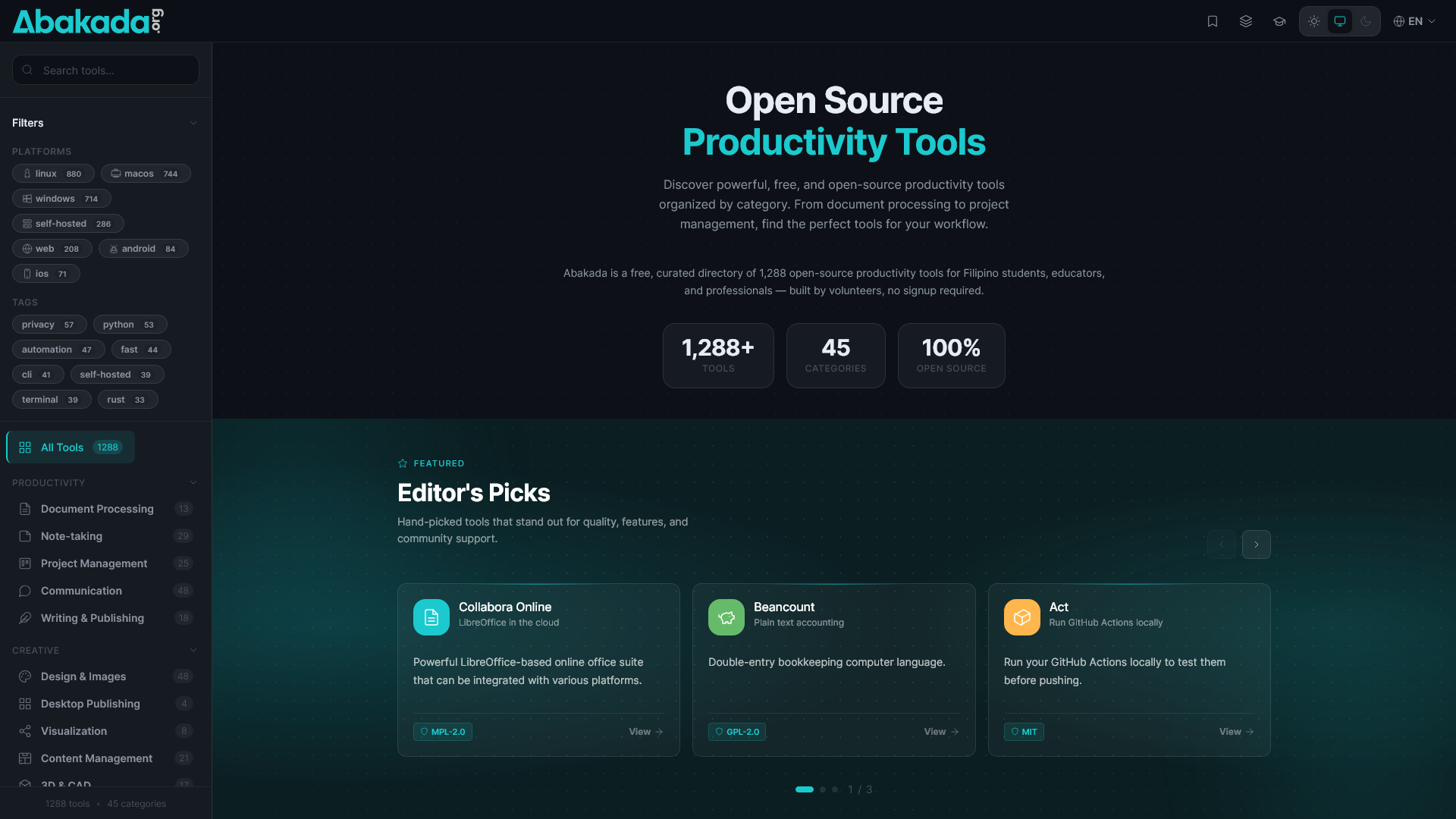
Abakada.org is a free, curated online directory of open-source and no-cost software for education and productivity. At its core, it is structured and searchable, organized so that users can find what they need quickly and with confidence. Tools are grouped into clear categories: office productivity, graphic design and multimedia, programming and development, communication and collaboration, and learning and research utilities.
Rather than simply listing software names, every entry is vetted for stability, safety, and local relevance. The platform screens tools for active maintenance and displays a transparent health status so users know they are not installing something abandoned or unsafe. Feedback from teachers and students shapes ongoing curation, keeping the directory grounded in real classroom needs rather than generic recommendations.
Learning paths for every stage
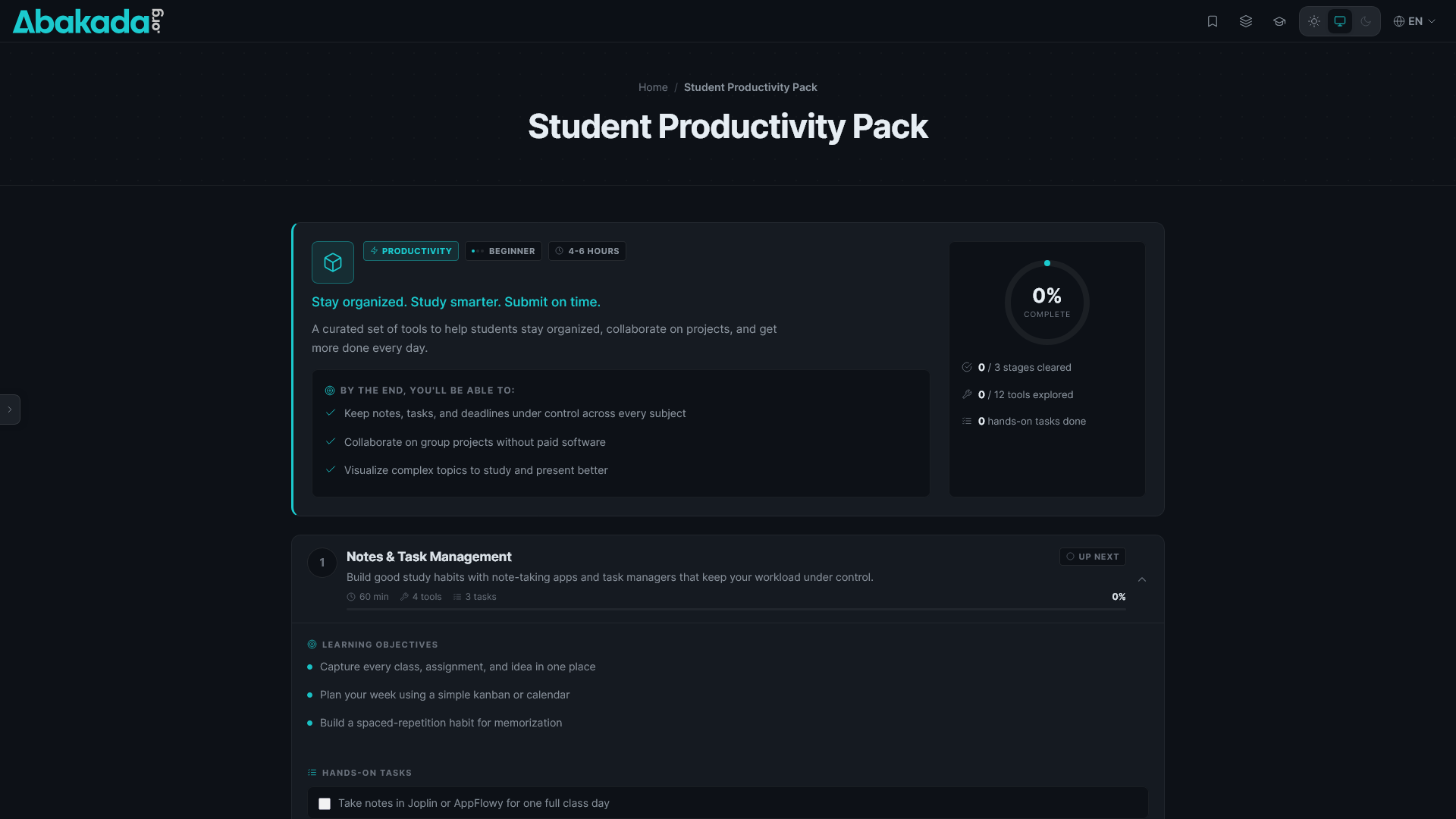
Beyond the directory, the platform organizes tools into learning pathways tailored to different users. Students working on academic submissions, teachers designing lessons, out-of-school youth building marketable digital skills, and professionals looking to retrain without expensive software investments all have their own starting points. Recommended tools include LibreOffice for documents and spreadsheets, GIMP for graphic design, Zotero for academic research and citation management, and a range of communication and coding platforms suited to varying internet speeds and device capabilities.
Safety, privacy, and accessibility
Every tool in the directory is assessed for privacy compliance and security. This matters especially for young users and schools with limited IT oversight. The platform is also built with inconsistent connectivity in mind, ensuring that the tools listed are not only free but genuinely usable across provincial and low-bandwidth environments.
Who this reaches and why it matters
The impact of accessible open-source software goes well beyond individual students. Teachers struggling with underfunded school ICT budgets need software they can confidently recommend without legal or safety concerns. Out-of-school youth, a population numbering in the millions across the Philippines, need tools that support self-directed learning, creative work, and the development of freelancing skills. Working professionals in provincial areas, where training resources are scarce, need a way to build digital competencies that improve their employment prospects without requiring expensive subscriptions.
Digital inclusion is not a single-variable problem. Closing the gap requires attention to devices, connectivity, and software all at once. Progress on one without progress on the others leaves learners only partially equipped. My work on Abakada.org sits at the software end of that equation, alongside civic-tech initiatives I also work on. BetterSolano.org connects residents of Solano with their local government at no cost. BetterGov.ph is a volunteer-run platform for government transparency. Each project comes from the same conviction: access to information and tools is a right, not a privilege.
A mobile app version of Abakada.org is currently in development, pending resources and time, which would extend access to learners on low-cost smartphones. Smartphones are the primary device for millions of Filipinos, and reaching people there feels like the next real step.
What still needs to happen
I will be honest. Building at scale alone is difficult. Curation takes time. Outreach takes resources. Reaching the classrooms, community learning centers, and skills-training programs where this platform could have the most impact requires partnerships that a solo developer working after hours cannot build on his own.
The opportunity I see is for educators, NGOs, technology advocates, and government agencies to take open-source integration in Philippine education seriously. Not just as a budget workaround, but as a genuine digital inclusion strategy. Curated, locally contextualized free software can help equip learners at every level, at a fraction of the cost of proprietary licensing, without compromising on quality or safety.
If you work in education technology, open-source advocacy, or development programs focused on the Philippines, I would welcome the conversation. This is an open invitation for anyone who believes that the next generation of Filipino learners deserves the tools to create without limits.
For now, what I have is one platform, one laptop, and a clear sense of purpose. That is enough to start. But it should not be enough to finish. It will not be, if more people choose to get involved.

Ramon Logan Jr. is a Filipino full-stack developer based in Abu Dhabi, UAE, and the founder of Abakada.org, a free, curated directory of open-source and no-cost software for students, teachers, and learners across the Philippines. Driven by his own experience navigating tight budgets during his college years, he built the platform to ensure that cost is never a barrier to digital education. He also founded BetterSolano.org and contributes to BetterGov.ph, both civic-tech initiatives aimed at improving public access to government information.
By day, Ramon works in software development. By night and on weekends, he codes the tools he believes should be available to every Filipino, regardless of where they live or what they can afford. Visit abakada.org to explore the directory, submit tool suggestions, or learn more about the advocacy.
TNGlobal INSIDER publishes contributions relevant to entrepreneurship and innovation. You may submit your own original or published contributions subject to editorial discretion.
Featured image: Matthew Al Uzziah Gabe on Unsplash
The future belongs to the confident child: Why preschools must look beyond early coding