

As we usher into the new year, we sought insights from prominent figures across the Southeast Asian tech landscape. These leaders reflected on their triumphs in 2025, sharing valuable perspectives on their achievements and the challenges they overcame.
They also unveiled their ambitious aspirations, meticulously outlined their strategic plans for 2026, and offered insightful predictions on the trajectory of the tech industry in the new year.
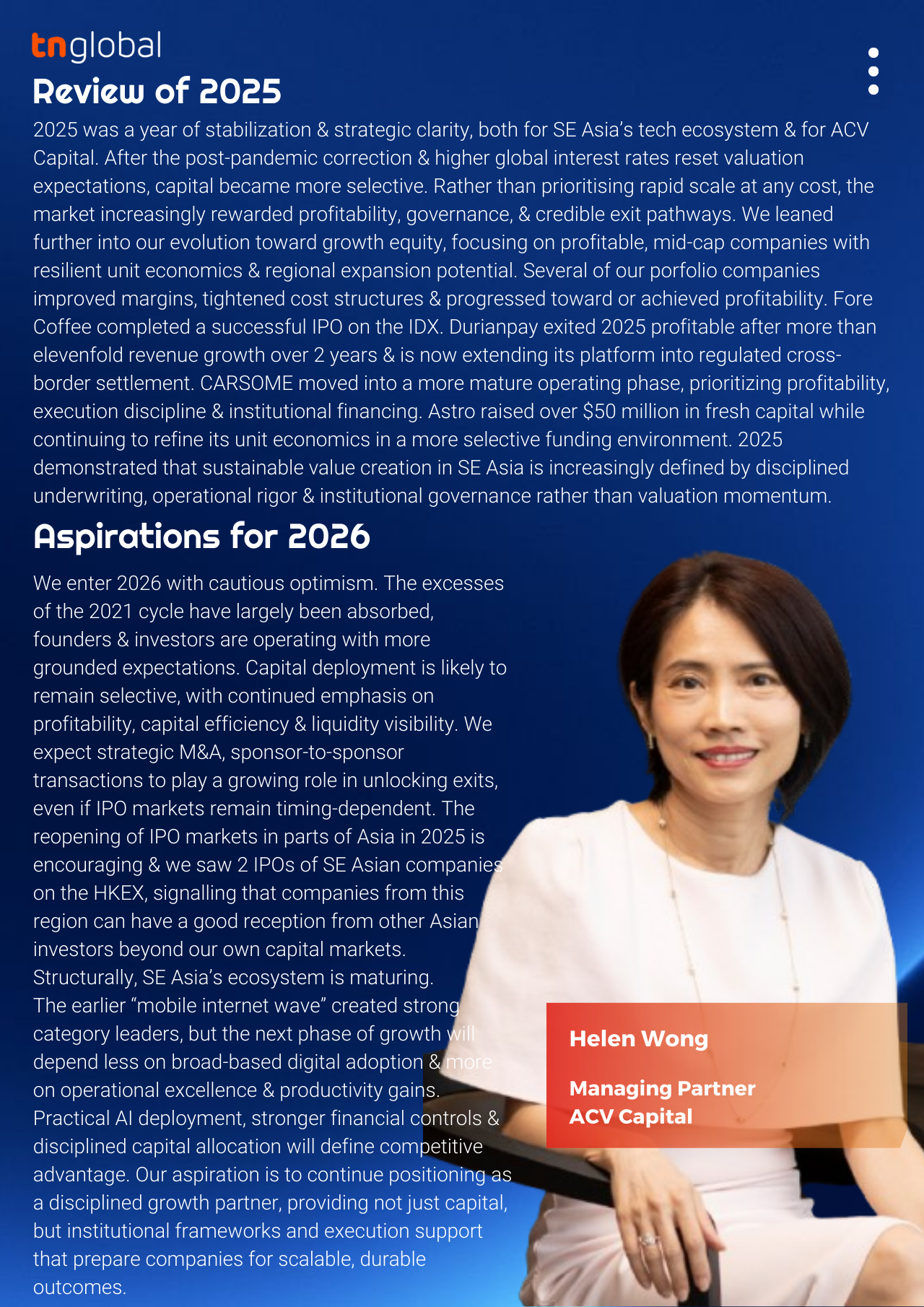
We talked to Helen Wong, Managing Partner at ACV Capital, to learn more about AVC Capital’s achievements in 2025 and its plans and aspirations for 2026. She also shared her views on the outlook of tech ecosystem in Indonesia and Southeast Asia for 2026.
ACV Capital is a private equity investment firm backing high-growth businesses across Southeast Asia. With offices across Southeast Asia and headquartered in Indonesia, and a global network of partners, the firm said it helps scale high-potential companies into market leaders. The firm manages over $500 million across five funds and, over the past eight years, has invested in more than 100 companies across Southeast Asia.
How was ACV Capital’s 2025?
2025 was a year of stabilization and strategic clarity, both for Southeast Asia’s tech ecosystem and for ACV Capital.
After the post-pandemic correction and higher global interest rates reset valuation expectations, capital became more selective. Rather than prioritising rapid scale at any cost, the market increasingly rewarded profitability, governance, and credible exit pathways.
Against that backdrop, we leaned further into our evolution toward growth equity, focusing on profitable, mid-cap companies with resilient unit economics and regional expansion potential.
Across our portfolio, operating discipline strengthened meaningfully. Several companies improved margins, tightened cost structures, and progressed toward or achieved profitability. For example, Fore Coffee completed a successful IPO on the Indonesian Stock Exchange, reflecting stronger governance, reporting standards, and scalable operations in Indonesia’s consumer sector. In financial infrastructure, Durianpay exited 2025 profitable after more than elevenfold revenue growth over two years, and is now extending its platform into regulated cross-border settlement. In mobility, CARSOME moved into a more mature operating phase, prioritising profitability, execution discipline, and institutional financing as the regional used-car and EV secondary markets develop. Meanwhile, Astro, the leading quick commerce company in SE Asia, raised over $50 million in fresh capital while continuing to refine its unit economics in a more selective funding environment.
Taken together, 2025 demonstrated that sustainable value creation in Southeast Asia is increasingly defined by disciplined underwriting, operational rigor, and institutional governance rather than valuation momentum.
What are your expectations and aspirations for 2026?
We enter 2026 with cautious optimism. The excesses of the 2021 cycle have largely been absorbed, and both founders and investors are operating with more grounded expectations. Capital deployment is likely to remain selective, with continued emphasis on profitability, capital efficiency, and liquidity visibility.
We expect strategic M&A and sponsor-to-sponsor transactions to play a growing role in unlocking exits, even if IPO markets remain timing-dependent. The reopening of IPO markets in parts of Asia in 2025 is encouraging, and we saw 2 IPOs of Southeast Asian companies on the Hong Kong Stock Exchange, signalling that companies from this region can have a good reception from other Asian investors beyond our own capital markets.
Structurally, Southeast Asia’s ecosystem is maturing. The earlier “mobile internet wave” created strong category leaders, but the next phase of growth will depend less on broad-based digital adoption and more on operational excellence and productivity gains. Practical AI deployment, stronger financial controls, and disciplined capital allocation will define competitive advantage.
Our aspiration is to continue positioning ACV Capital as a disciplined growth partner, providing not just capital, but institutional frameworks and execution support that prepare companies for scalable, durable outcomes.
What are ACV Capital’s plans in 2026? What is the focus in the new year?s
In 2026, our primary focus remains growth equity in profitable, mid-cap companies across Southeast Asia.
We will prioritise:
● Disciplined underwriting with strong downside protection
● Institutional governance and reporting standards
● Operational value creation, particularly in digitisation and AI-enabled productivity
● Clear pathways toward structured liquidity or strategic exits
While equity-led growth capital remains our core strategy, we are closely monitoring the development of private credit and structured capital solutions in the region. As Southeast Asia matures, hybrid capital structures may play a more meaningful role for companies with predictable cash flows that do not require incremental equity dilution.
However, our near-term priority remains building durable equity value in fundamentally strong businesses that can scale regionally without relying on perpetual equity raises.
How is the outlook for Indonesia and Southeast Asia’s tech ecosystem in 2026?.
The Southeast Asia venture market has stabilised, but the recovery remains uneven across countries and sectors.
Deal volumes appear to have found a functional floor following the cyclical downturn, yet exit visibility remains the primary constraint on renewed momentum. Capital recycling is slower, and investors are more disciplined in deployment decisions.
Indonesia remains fundamentally attractive due to its domestic market scale, urbanisation trends, and relatively resilient macroeconomic profile. However, investor sentiment is more cautious, particularly around governance standards, consumer credit exposure, and the sustainability of growth models.
We are also seeing greater regional dispersion in momentum. Some markets are demonstrating stronger exit pipelines and cross-border capital flows, influencing allocation decisions across Southeast Asia.
From a structural perspective, the ecosystem is transitioning from a capital-abundant, early-stage-driven environment to one that rewards operational excellence, governance discipline, and financial sustainability. While this may result in a slower headline funding recovery, it ultimately strengthens the quality of companies being built.
If 2025 was a year of stabilization, 2026 is likely to be a year of selective rebuilding, not a return to exuberance, but the emergence of a more institutional and resilient phase for Southeast Asia’s technology and growth capital markets.
True Digital Park: 2026 is the year for Thai tech ecosystem to “find its true rhythm” [Q&A]