

As we usher into the new year, we sought insights from prominent figures across the Southeast Asian tech landscape. These leaders reflected on their triumphs in 2025, sharing valuable perspectives on their achievements and the challenges they overcame.
They also unveiled their ambitious aspirations, meticulously outlined their strategic plans for 2026, and offered insightful predictions on the trajectory of the tech industry in the new year.
We talked to Sarita Singh, Regional Head & Managing Director, Stripe, Southeast Asia & Greater China, to learn more about the firm’s achievements in 2025 and its plans and aspirations for 2026. She also shared her views on the outlook of tech ecosystem in Southeast Asia for 2026.
Headquartered in San Francisco and Dublin, Stripe builds programmable financial services. Millions of companies—from the world’s largest enterprises to the most ambitious startups—use Stripe to accept payments, grow their revenue, and accelerate new business opportunities, information from its Linkedin page showed.
How would you describe your company’s journey in 2025?
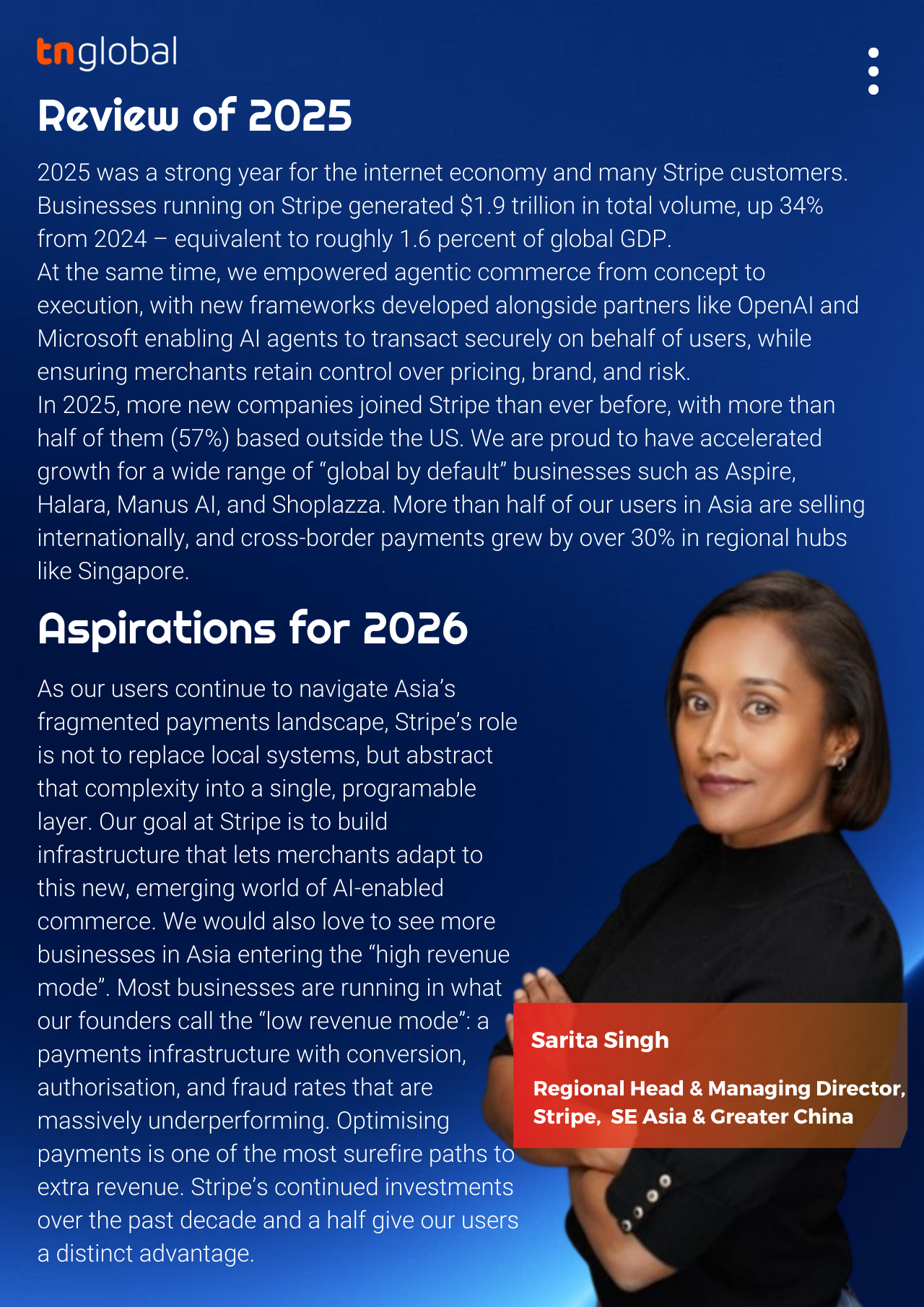
2025 was a strong year for the internet economy and many Stripe customers. Businesses running on Stripe generated $1.9 trillion in total volume, up 34 percent from 2024 – equivalent to roughly 1.6 percent of global GDP. At the same time, we empowered agentic commerce from concept to execution, with new frameworks developed alongside partners like OpenAI and Microsoft enabling AI agents to transact securely on behalf of users, while ensuring merchants retain control over pricing, brand, and risk.
In 2025, more new companies joined Stripe than ever before, with more than half of them (57 percent) based outside the US. We are proud to have accelerated growth for a wide range of “global by default” businesses such as Aspire, Halara, Manus AI, and Shoplazza. More than half of our users in Asia are selling internationally, and cross-border payments grew by over 30 percent in regional hubs like Singapore.
What are your key expectations or aspirations for 2026?
As our users continue to navigate Asia’s fragmented payments landscape, Stripe’s role is not to replace local systems, but abstract that complexity into a single, programmable layer. Our goal at Stripe is to build infrastructure that lets merchants adapt to this new, emerging world of AI-enabled commerce.
We would also love to see more businesses in Asia entering the “high revenue mode”. Most businesses are running in what our founders call the “low revenue mode”: a payments infrastructure with conversion, authorisation, and fraud rates that are massively underperforming. Optimizing payments is one of the most surefire paths to extra revenue. Stripe’s continued investments over the past decade and a half give our users a distinct advantage.
What are your company’s key plans and priorities for 2026?
Our priorities for 2026 are grounded in helping businesses adapt to structural shifts in how commerce is built and scaled. Looking ahead, Stripe’s investment will be defined by the twin revolutions in artificial intelligence (AI) and money – two areas where we anticipate a clear, compounding impact for businesses operating globally from Asia.
● In partnership with major brands, ecommerce platforms and top AI companies such as OpenAI and Microsoft, Stripe is defining the future of agentic commerce by building the infrastructure layer such as the Agentic Commerce Protocol.
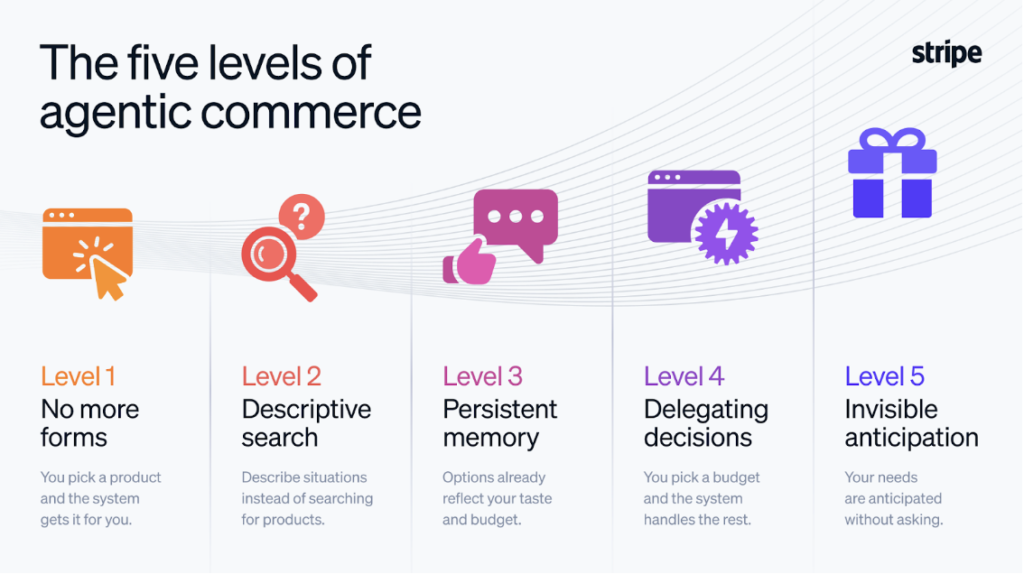
We have further iterated our thinking around agentic commerce into five levels. (see below)
Like the internet, success is contingent on universal interoperability. Our ascent through the five levels depends on our ability to work together.
● Stablecoins adoption is spiking—not because of faith, but because of actual utility. Stablecoin payment volumes doubled to around $400 billion last year, with a sizable 60 percent tied to business payments. Our study last year found out that almost half of Asian businesses are planning to start using stablecoins within 48 months. Stripe is well positioned to prepare our users in Asia to unlock the potential of global money movement via stablecoins.
How do you view the outlook for the tech ecosystem in Southeast Asia in 2026?
The internet economy is speeding up and Southeast Asia has been at the center of this exponential surge. 2026 marks 10 years since Stripe’s launch in Singapore. Looking back, the past decade of internet GDP growth in Asia was built on the modernisation of payments, logistics, and platforms. The decade ahead will be shaped not just by scale, but by programability – we’re doing this via a unified global infrastructure, while handling compliance and reliability at scale.
Malaysia’s Tech Minister shares plans as SE Asia’s tech adoption accelerates across sectors [Q&A]