

As we usher into the new year, we sought insights from prominent figures across the Southeast Asian tech landscape. These leaders reflected on their triumphs in 2025, sharing valuable perspectives on their achievements and the challenges they overcame.
They also unveiled their ambitious aspirations, meticulously outlined their strategic plans for 2026, and offered insightful predictions on the trajectory of the tech industry in the new year.
We talked to Yen Ming Lee, Co-Founder and Group Chief Executive Officer of PolicyStreet to learn more about the firm’s achievements in 2025 and its plans and aspirations for 2026. He also shared his views on the outlook of tech ecosystem in Southeast Asia in 2026.
Polisea Sdn. Bhd., under the brand name PolicyStreet, is an insurtech firm that collaborates directly with over 40 life, general, and Takaful providers to offer a comprehensive range of products and services — from embedded insurance and customised employee benefits to financial advisory, insurance aggregation, and bespoke digital solutions.
In Malaysia, PolicyStreet is an approved Financial Adviser and Islamic Financial Adviser licensed by Bank Negara Malaysia. Beyond Malaysia, the Polisea Group of Companies holds licenses as a reinsurer, general insurer, and reTakaful operator under the Labuan Financial Services Authority (LFSA) and is a registered Australian Financial Services Licensee under the Australian Securities and Investments Commission (ASIC).
Backed by Khazanah Nasional Bhd, Malaysia’s sovereign wealth fund, PolicyStreet serves over 5 million customers and has a total sum insured exceeding $ 10 billion, information from its website showed.
How would you describe your company’s journey in 2025?
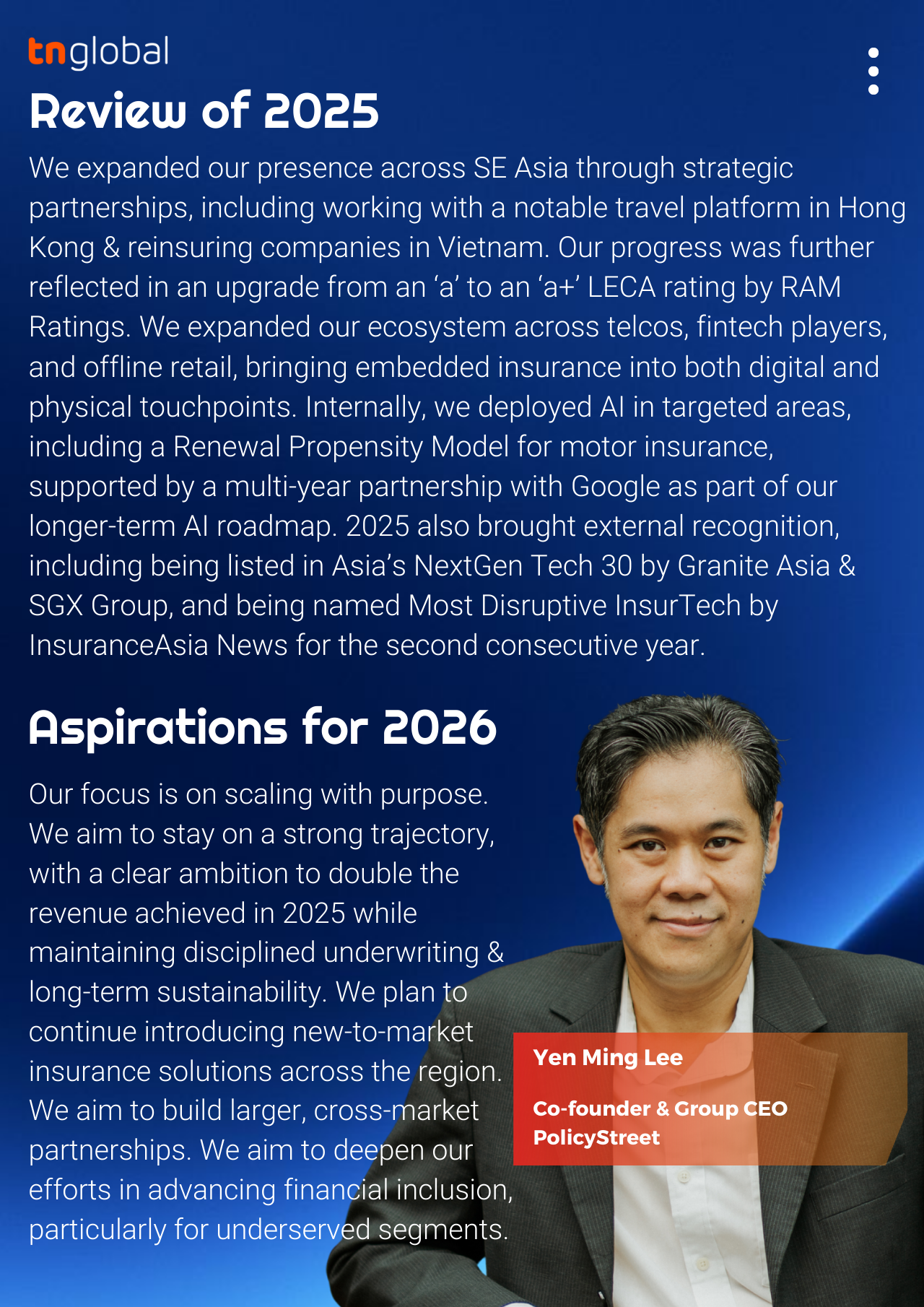
2025 was a pivotal year for PolicyStreet, where regional ambition translated into execution. We expanded our presence across Southeast Asia through strategic partnerships, including working with a notable travel platform in Hong Kong and reinsuring companies in Vietnam.
These milestones reinforced our regional underwriting and reinsurance capabilities. Our progress was further reflected in an upgrade from an ‘a’ to an ‘a+’ LECA rating by RAM Ratings, underscoring stronger underwriting performance and balance sheet strength.
Partnerships remained a key growth driver, as we expanded our ecosystem across telcos, fintech players, and offline retail, bringing embedded insurance into both digital and physical touchpoints.
Internally, we deployed AI in targeted areas, including a Renewal Propensity Model for motor insurance, supported by a multi-year partnership with Google as part of our longer-term AI roadmap.
The year also brought external recognition, including being listed in Asia’s NextGen Tech 30 by Granite Asia and SGX Group, and being named Most Disruptive InsurTech by InsuranceAsia News for the second consecutive year.
Taken together, 2025 marked our shift from building momentum to defining direction, laying the groundwork for how we intend to scale with greater focus and impact in the year ahead.
What are your key expectations or aspirations for 2026?
In 2026, our focus is on scaling with purpose. From a growth perspective, we aim to stay on a strong trajectory, with a clear ambition to double the revenue achieved in 2025 while maintaining disciplined underwriting and long-term sustainability.
Innovation will remain central to how we grow. We plan to continue introducing new-to-market insurance solutions, not just in Malaysia but across the region, addressing protection gaps through products that are relevant, accessible, and embedded into everyday touchpoints.
Regionally, we are also focused on expanding the scale and depth of our partnerships. Beyond growing the number of collaborations, we aim to build larger, cross-market partnerships that allow us to contribute meaningfully to narrowing the region’s protection gap.
Impact remains one of the key considerations in how we measure success. Building on the recognition we received at the ESG Plus Awards, we aim to deepen our efforts in advancing financial inclusion, particularly for underserved segments, ensuring that growth translates into broader, lasting value for individuals and communities across Southeast Asia.
What are your company’s key plans and priorities for 2026?
Our core focus in 2026 is strengthening our embedded insurance offering by advancing both our underwriting and technology capabilities in tandem. While we have innovated rapidly on the underwriting and reinsurance front, the next phase of growth requires our technology stack to evolve beyond simply scaling what already exists.
A key priority for 2026 will be deepening the integration of AI into our business operations, particularly in areas where it can enhance accuracy, efficiency, and decision-making across the value chain.
Alongside this, we will be ramping up our broader technology capabilities to better support more complex products, partners, and regional use cases.
From a strategic standpoint, our approach remains centred on responsible innovation. We are deliberate about how and why we introduce new products or capabilities, not because they are new or trending, but because they create meaningful impact. As we scale, maintaining credibility, trust, and long-term resilience will remain just as important as growth itself.
How do you view the outlook for the tech ecosystem in Malaysia/Southeast Asia in 2026?
The outlook for the tech ecosystem in Malaysia and Southeast Asia remains very positive. Innovation across the region continues to move at pace, with regulators, fintech players, and traditional institutions increasingly aligned in embracing technology-led change.
Malaysia, in particular, has laid strong foundations. We have seen meaningful progress through initiatives such as programable money pilots and the country’s position as ASEAN’s first to implement 24/7 Real-Time Gross Settlement. Developments across digital banking and the upcoming conclusion of Bank Negara Malaysia’s DITO licence application process further signal a maturing and increasingly competitive tech ecosystem.
Across Southeast Asia, this momentum is creating an environment where innovation is no longer siloed, but ecosystem-driven. As players across the value chain continue to raise standards, we expect the coming year to see accelerated growth, stronger collaboration, and a race not just to scale, but to build more resilient and inclusive financial systems.
Malaysia’s Carsome: more EVs expected to enter secondary market in 2026 [Q&A]