

Vietnam seeks to allow exports of rare earth products only if they are deeply processed, with most individual oxides and metals required to reach at least 99 percent total rare earth content.
The standards are set out in Annex III of a draft circular on mineral exports, compiled by the Ministry of Industry and Trade. The draft document has yet to set an implementation date.
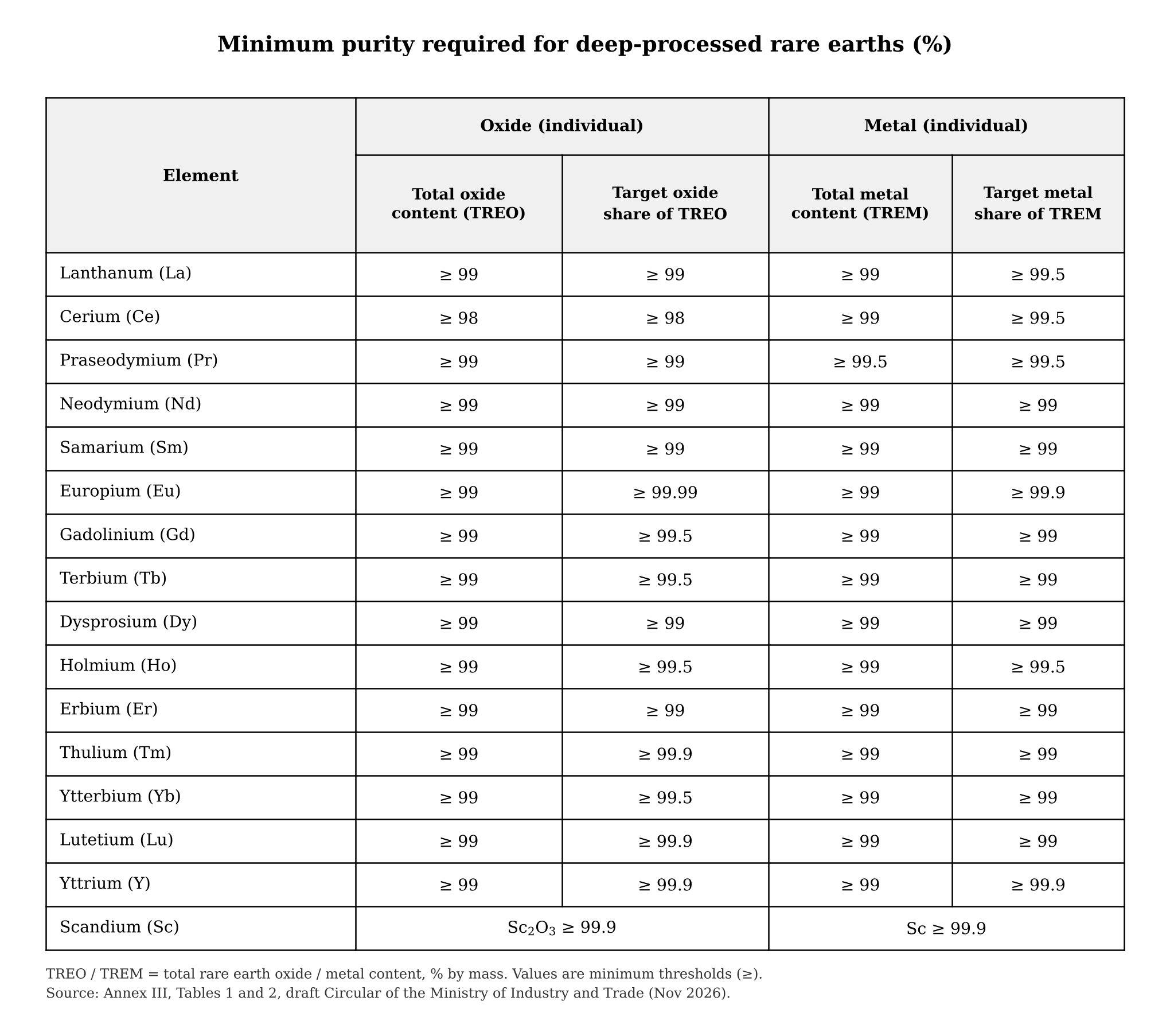
For separated oxides, the draft requires total rare earth oxide content of at least 99 percent for nearly every product, with cerium oxide lower at 98 percent.
The share of the oxide inside that total must also meet its own threshold. It is 99 percent for lanthanum, praseodymium, neodymium, samarium, dysprosium, and erbium oxides, and 99.5 percent for gadolinium, terbium, holmium, and ytterbium oxides.
Thulium, lutetium and yttrium oxides must reach 99.9 percent. Europium oxide is the strictest at 99.99 percent. Scandium oxide must be at least 99.9 percent by mass.
Individual rare earth metals face a similar requirement. Total metal content must be at least 99 percent, or 99.5 percent for praseodymium. The target metal’s share must be 99 to 99.9 percent depending on the element.
The annex also sets standards for alloys, alloy powders and permanent magnets. A neodymium-iron-boron alloy must contain at least 28 percent rare earth metal and 0.8 to 1.5 percent boron. A sintered neodymium-iron-boron magnet must have remanence of at least 1.08 tesla, intrinsic coercivity of at least 955 kilo-amperes per metre and a maximum energy product of at least 223 kilojoules per cubic metre.
Beyond the standard, a rare earth product can be exported only if it is also on the Prime Minister’s list of deeply processed products.
Vietnam’s rare earth resources are estimated in the ministry’s report at about 19.82 million tons of rare earth oxide, mainly in Lai Chau and Lao Cai provinces in the north.
Vietnam can ease rare earth export ban, seeks to export deep-processed products