

Google Threat Intelligence Group has documented what it describes as its first case of an artificial intelligence framework automating vulnerability discovery and exploitation without a human in the loop, alongside live use of agentic tools against organizations in Asia.
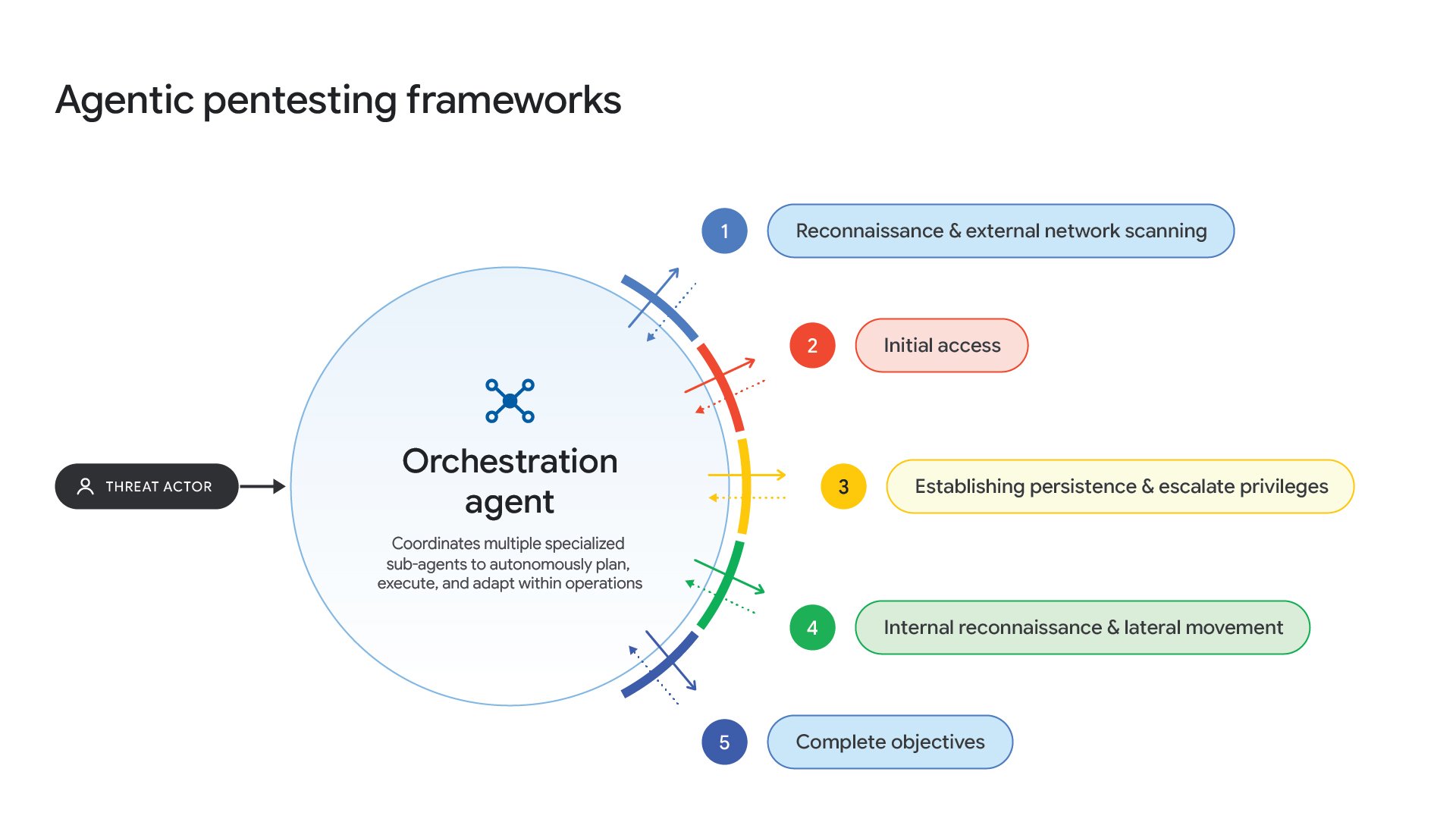
In a November 16 threat report, GTIG and Mandiant said attackers are moving from one-off prompting toward multi-agent systems that can handle reconnaissance, vulnerability analysis, exploitation and parts of post-compromise activity.
The findings are based on Google’s investigations and telemetry. They describe observed tools and activity, but do not establish that every user of the named open-source frameworks is malicious.
Framework compared code and generated exploits
GTIG said it found an exposed staging server running a multi-agent framework it calls exploit_agent. The system was configured to compare software code before and after security patches, identify possible vulnerabilities, draft exploits and execute them automatically.
Google said the server also contained scripts for internal reconnaissance, brute-force activity, installing web shells and removing other attackers’ web shells. The company described this as the first instance it had identified in which an LLM framework automated both vulnerability discovery and exploitation without ongoing human direction.
Between late August and early October, GTIG also tracked an actor using a customized version of the open-source PentAGI platform for systematic reconnaissance and vulnerability scanning against organizations across Asia. Google assessed that financially motivated and suspected espionage actors have experimented with PentAGI, CAIRN, CyberStrikeAI and other agentic testing tools.
Cloud abuse and state-linked activity
The report also describes LLMJacking incidents in which attackers stole credentials or compromised cloud environments to consume organizations’ AI and computing resources. Google said some incidents produced more than $100,000 in fraudulent usage in a day, with cumulative abuse reaching $1 million in the most severe cases it investigated.
GTIG additionally attributed AI-supported reconnaissance, stolen-data analysis and influence operations to several government-linked or suspected state-backed actors. Those attribution claims remain Google’s assessments and are not independently established by the report’s public evidence alone.
Google said autonomous offensive frameworks currently trade stealth for speed, producing traffic and code artifacts that defenders can detect. It has deployed behavioral detection rules and published hardening guidance through Mandiant.
Google says threat actors are shifting to agentic AI attacks