

A third of semiconductor companies plan to expand manufacturing into Asia-Pacific markets over the next three years as the AI boom drives chip demand, according to global courier Fedex.
Fedex released the figure in a statement on Thursday regarding its “From AI to EVs: How APAC semiconductors drive the global innovation map” report. FedEx also highlighted that said the surging demand for AI, high-performance computing, electric vehicles, and advanced communications is accelerating chip production and investment in the data centers behind the AI economy.
In the FedEx survey, conducted among attendees at the SEMICON Taiwan trade show, 35 percent expect to expand manufacturing into more Asia-Pacific markets within three years. As many as 25 percent plan to increase or diversify sourcing.
Nearly four in five pointed to Taiwan, Southeast Asia, Greater China, and Japan as the markets set for the biggest demand growth.
Resilience is becoming a priority over pure efficiency, FedEx said: 30 percent of respondents named geopolitical disruption as the biggest challenge to growth, ahead of costs and customs complexity, pushing firms toward geographic diversification and inventory buffers. Chip components now travel more than 25,000 miles and cross over 70 borders before completion, the report said, and more than 2,000 new data centres are expected worldwide between 2026 and 2035.
Global semiconductor market can reach $975 billion by 2026
The global semiconductor market is forecast to reach $975 billion by 2026, the report said, with Asia-Pacific accounting for roughly 58 percent of industry revenue. China alone makes up close to 29 percent of the global market.
AI accelerators and high-bandwidth memory chips have become the main growth drivers, at about a fifth of chip sales, the report said.
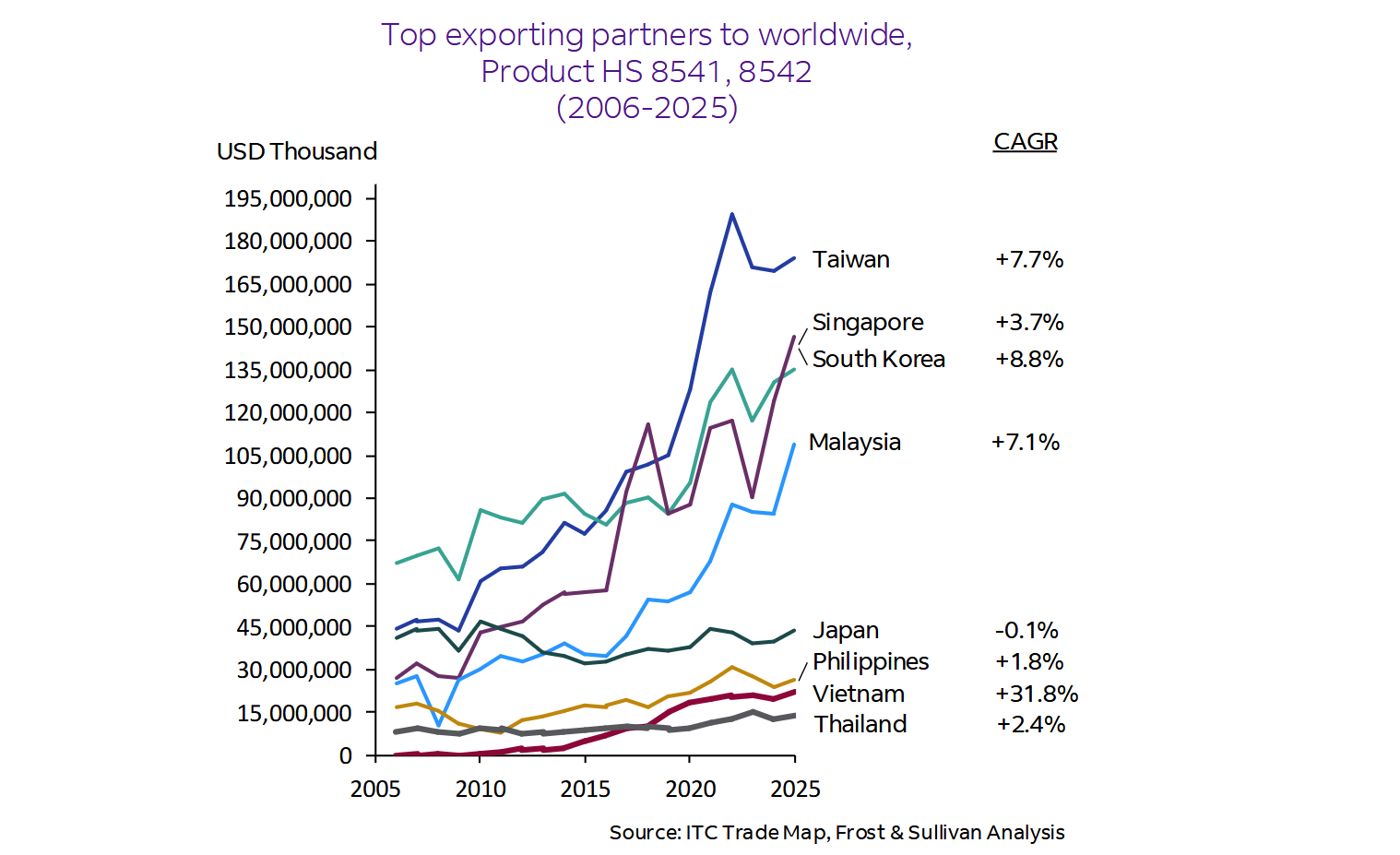
Singapore has become the world’s largest chip importer, topping $105 billion, as components move in and out for assembly and distribution.
Vietnam’s chip exports are growing fastest, with a compound annual growth rate (CAGR) of 32 percent since 2006, as integrated-circuit exports reached $32.4 billion in 2023, the report said.
Production is spread across specialized hubs as Taiwan leads advanced manufacturing with roughly 60 percent of global foundry output. South Korea dominates memory chips. Japan supplies equipment and materials and holds about 30 percent of the global equipment market.
China is a major materials supplier and growing fabrication base and Southeast Asia has become a hub for chip assembly, packaging, and testing.
Salil Chari, FedEx’s Asia-Pacific president, said the coming decade of innovation would depend on the resilience of the supply chains behind AI and digital infrastructure.
MBSB keeps tech sector neutral as talent crunch caps AI upside