

Fifteen-year-olds reporting they never or almost never used artificial intelligence (AI) for schoolwork outscored their AI-using peers in science on nearly every type of task, except for utilizing AI as a general study aid, according to the PISA result conducted by the OECD.
The Programme for International Student Assessment (PISA), run by the Paris-based Organisation for Economic Co-operation and Development (OECD), tests 15-year-olds every few years and is the world’s largest international education survey. Released Tuesday, the latest edition of PISA tested more than 760,000 students in 91 countries and economies in 2025, with science as the main focus.
For drafting writing assignments, summarizing texts, and conducting preliminary research, students not using AI posted the highest science scores of any group. The gap was widest for summarizing reading, with daily users scoring nearly 30 points below non-users.
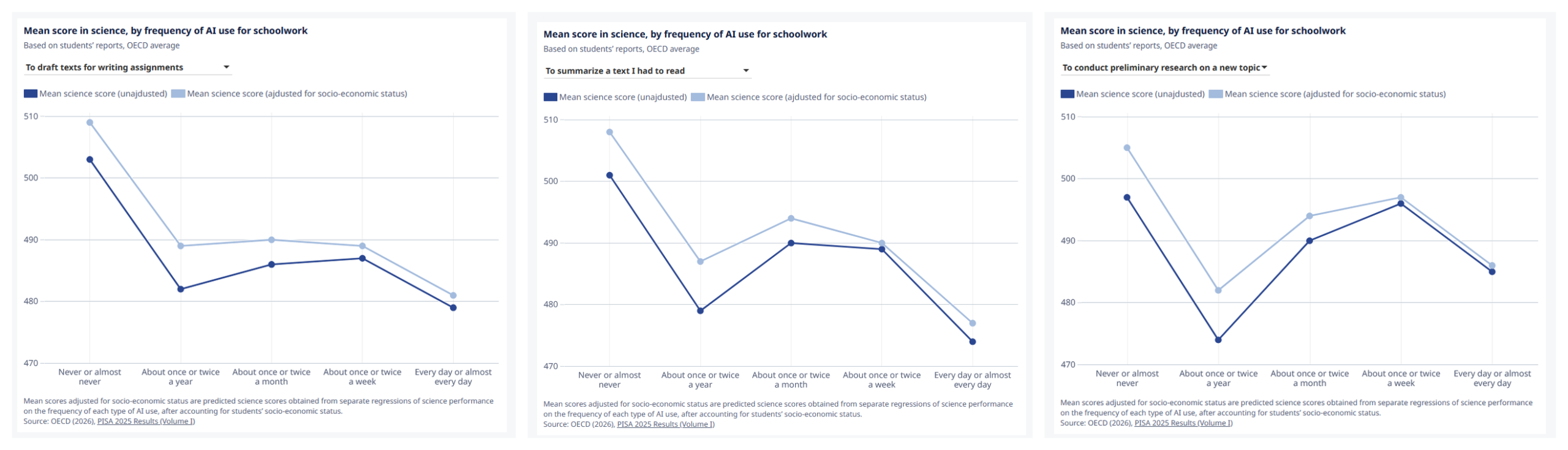
The one exception was using AI “to help me learn” as students using it about weekly scored highest, at around 500 points, and non-users came second, slightly below the top one.
The findings show an association rather than proof that AI use raises or lowers achievement. As many as 46 percent of OECD students said they used AI chatbots at least weekly. For specific schoolwork tasks, non-users outscored users by about 20 points in science on average, equivalent to roughly a year of schooling.
A recurring dip appeared among the most occasional users, with students turning to AI once or twice a year often scoring below both non-users and weekly users, pointing to regular, moderate use as the pattern tied to the best outcomes.
The AI findings came alongside a broader decline. Performance across OECD countries fell to its lowest on record in mathematics and reading, with one in five 15-year-olds now a low performer across science, mathematics and reading, up from 16 percent in 2022.
Reading recorded the steepest fall, down 28 points across OECD countries between 2015 and 2025, about one and a half years of learning, the OECD said. Mathematics fell 22 points. Science was broadly stable between 2022 and 2025, after declining over the previous decade.
The top-performing systems were again in Asia, led by Singapore and the Chinese jurisdictions of Beijing, Shanghai, Jiangsu and Zhejiang, with Estonia, Japan, Korea, Macao, Chinese Taipei, and the United Kingdom also among the top 10.
Secretary-General Mathias Cormann said technology and AI could strengthen learning only when used purposefully and not as a substitute for attention, effort, and understanding.