

The White House’s “The Great Transshipment Scam” report on illegal transshipment, released in August 2026, names nine of the ten ASEAN member states among the roughly 40 jurisdictions it identifies as part of a global “Shadow Transshipment Network.”
According to the report, this network lets Chinese-origin goods enter the U.S. market under new national identities, evading the tariffs they would face if shipped directly from China.
In Southeast Asia, only Brunei is left out. The report splits the other nine across its two lower risk tiers—four as high-volume “Scale Leaders” and five as smaller “opportunistic targets”—making Southeast Asia one of the most heavily represented regions in the document.
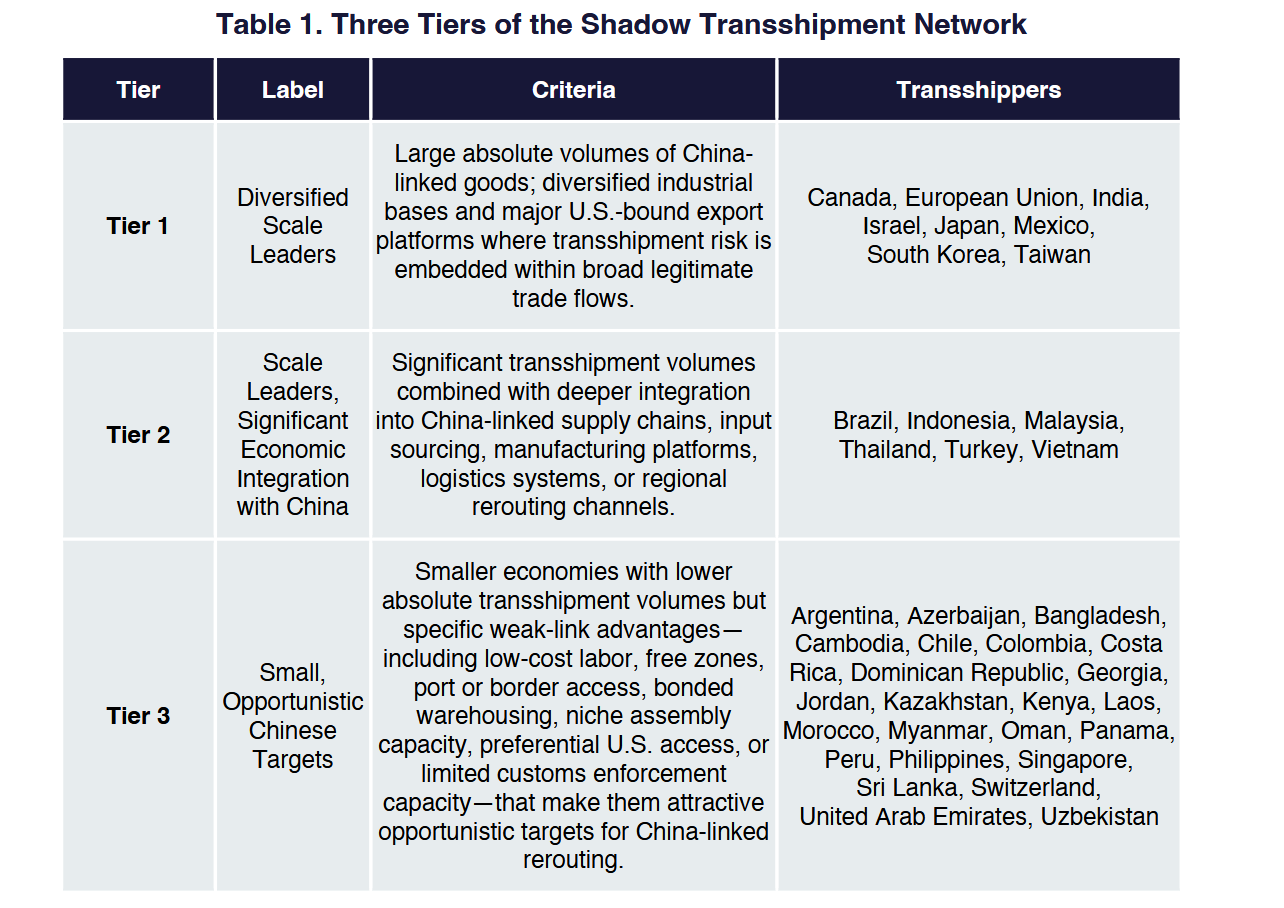
Tier-1, 2, 3 risks against the United States
The report sorts flagged jurisdictions into three tiers by the scale of their China-linked trade, the depth of their integration with China, and the presence of “weak-link” advantages. Southeast Asian countries fall into Tiers 2 and 3.
Tier 1, “Diversified Scale Leaders,” covers jurisdictions moving large absolute volumes of China-linked goods within diversified industrial bases and major U.S.-bound export platforms. Transshipment risk sits embedded in broad legitimate trade with many economies, namely Canada, the European Union, India, Israel, Japan, Mexico, South Korea, and Taiwan.
Tier 2, “Scale Leaders with Significant Economic Integration with China,” covers countries with significant transshipment volumes combined with deeper integration into China-linked supply chains, input sourcing, manufacturing platforms, or logistics systems. Vietnam, Thailand, Malaysia, and Indonesia is classified as Tier 2 risks.
The report describes them as closely integrated into China-adjacent manufacturing networks and as major platforms for electronics, machinery, plastics, footwear, apparel, and components incorporating China-origin inputs, with the industrial scale, port capacity, and logistics depth to move significant volumes of China-linked goods into U.S.-bound trade.
Tier 3, “Small, Opportunistic Chinese Targets,” covers smaller economies with lower absolute volumes but specific weak-link advantages—low-cost labor, free zones, port or border access, bonded warehousing, niche assembly capacity, preferential U.S. access, or limited customs enforcement capacity. Cambodia, Laos, Myanmar, the Philippines, and Singapore are Tier-3 risks.
9 ASEAN economies
The report of the Department of Commerce Commerce’s Office of Trade and Economic Analysis (OTEA) names Vietnam, Mexico, India as the three leading global hubs. The three together accounting for roughly $67 billion in transshipped goods in 2025 and an estimated $28 billion in lost tariff revenue. Its Ho Chi Minh City corridor is paired with circuit-protection and switching apparatus (HS 8536), set against Chicago, Milwaukee, and Rockford.
Malaysia carries two functional roles. The report places it in the Maritime Gateways cluster and singles it out as functioning as both a microhub and a maritime gateway, citing the Port Klang Free Zone. Its Penang–Kulim cluster is tied to plastic articles (HS 392690), set against Akron, Canton, and Upstate South Carolina.
Thailand’s Ayutthaya–Samut Prakan corridor is tied to thermostats (HS 903210), set against Minneapolis–St. Paul.
Indonesia’s*Bekasi–Batam corridor is tied to plastic boxes, cases, crates, and packing articles (HS 392310), set against Houston, Lake Charles, Beaumont, and Tulsa.
The report also names Vietnam, Thailand, Malaysia, and Cambodia together in its solar cell and module AD/CVD circumvention passage.
Among the Tier 3 members, the report says Cambodia offers low-cost labor and export-processing zones and uses it to illustrate the production-side microhub model, where China-origin inputs receive stitching, labeling, packaging, or final inspection before export under Cambodian documentation.
It describes Laos and Myanmar as China-adjacent border corridors with lower-capacity enforcement, where relatively small rerouting flows can be economically significant.
It places the Philippines in the Southeast Asian Microhubs cluster (light assembly, relabeling, re-export), and Singapore in the Developed Logistics Platforms cluster for its advanced customs, ports, trading houses, bonded warehouses, and re-export systems.
Overall impact
The report shows transshipment flows into broader economic losses, though the figures are global rather than Southeast Asia–specific. It calculated that roughly 6,000 jobs are displaced per $1 billion of added trade deficit, $1.5–2.0 billion of lost GDP per $1 billion, and lost federal revenue at 17 percent of lost GDP.
The report states these are model-based estimates rather than observed job counts, and that some of the shift away from China reflects legitimate changes in production, investment, and sourcing rather than fraud.
It states that the net effect of the administration’s tariff and anti-transshipment policies remains unresolved, that a rigorous assessment requires trade and customs data available only after a significant lag. The U.S. Customs and Border Protection (CBP) has not yet fully implemented several provisions of Executive Order 14411.
The report describes itself as establishing a framework for continuing assessment rather than reaching a final determination.
MBSB maintains positive stance on Malaysia’s renewable energy on structural policy tailwinds