

AI, energy and security are expected to drive the next wave of strategic investments and support global economic and corporate earnings growth, according to HSBC Private Bank.
Rising global competition and national security priorities are creating the urgency, funding and policy support needed to sustain capital market activities. The bank also expects an expanded role for private markets to supplement the investment funding gap.
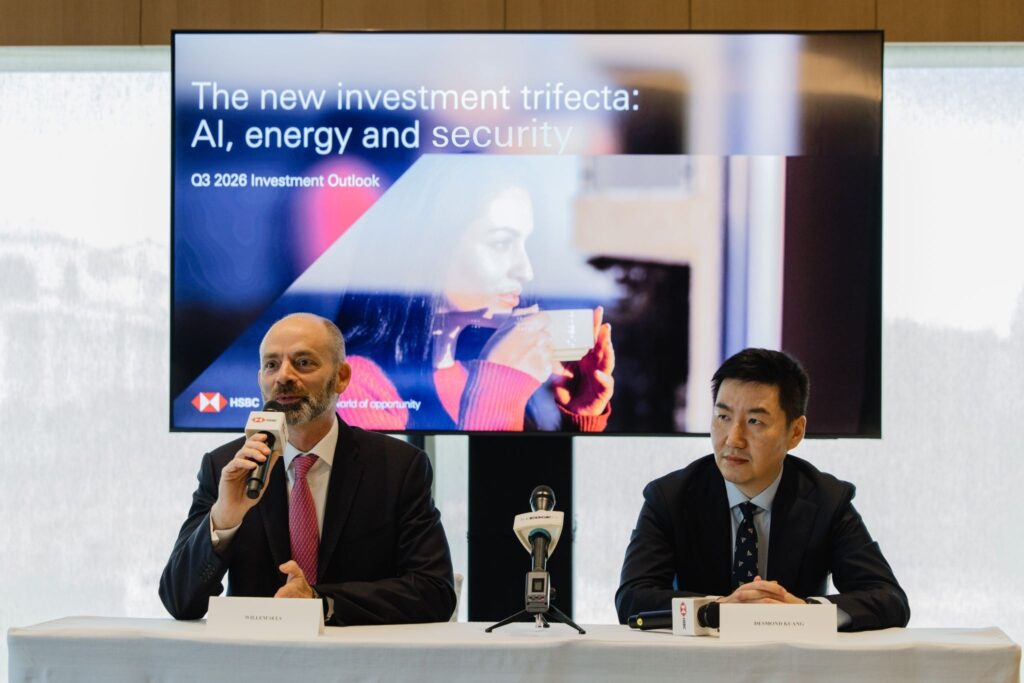
In its Q3 2026 Investment Outlook, HSBC Private Bank has remained optimistic about the resilience of the global economy and expects volatility to be manageable for now, the bank said in a statement on Wednesday, after holding its Q3 2026 Investment Outlook Media Briefing.
Drawing on lessons from the COVID-19 shock and shifting international trade dynamics, the bank cites that governments and businesses have been diversifying supply chains, trade relationships and energy sources to support economic growth.
“Volatility is here to stay as global markets react to fast-moving risks and headlines. The priority is to stay disciplined with resilient and diversified multi-asset portfolios that can withstand short-term uncertainty, while keeping sight of longer-term opportunities emerging from structural growth trends,” said Willem Sels, Global Chief Investment Officer, HSBC Private Bank and Premier Wealth.
Against this backdrop, the bank outlines a portfolio strategy focused on longer-term tailwinds relating to AI, energy independence and aerospace themes for its high net worth clients.
The approach highlights opportunities in technology, industrials, materials and utilities sectors, where investment in innovation remains strong and continues to favour growth-style over value companies.
This quarter’s outlook also expects the US Federal Reserve to keep policy rates on hold throughout 2026, reflecting the balance between inflation and growth risks.
HSBC Private Bank’s four priorities for Q3 2026:
• Invest in the AI-led future: Strong earnings surprises, easing monetisation concerns and attractive valuations after the software sell-off may present opportunities in semiconductors, data centers and AI adopters.
• Position for security and energy independence: Geopolitical shifts are accelerating efforts to diversify energy supply, expand electrification and increase grid investment.
• Build portfolio resilience with multi-asset strategies: Bonds, gold, alternatives and currency diversification remain core building blocks, complemented by infrastructure to provide stable, inflation-linked cashflows.
• Tap into Asia’s innovation and income opportunities: A barbell strategy can capture Asia’s innovation-led investment cycle while balancing with income opportunities, paired with a geographical overweight in mainland China, Hong Kong, Singapore and South Korea.
On the outlook for Asia, Desmond Kuang, Chief Investment Officer, Asia, HSBC Private Bank and Premier Wealth (appointment w.e.f July 6, 2026), said, “As investment in AI accelerates globally, Asia is well placed to benefit given its leadership in semiconductors and rapid progress in large language models. Beyond AI, investors can also find a broadening opportunity set through income potential in bonds, alongside continued improvements in corporate governance reforms across Japan, South Korea, mainland China and Singapore.”
Malaysia
As for the outlook for Malaysia, Kuang said, “Malaysia’s GDP expanded by 5.4 percent year-on- year in the first quarter, moderating from the above 6 percent pace recorded in the fourth quarter of 2025. We think this slowdown reflects normalisation following an exceptionally strong quarter rather than any significant loss of momentum. HSBC maintains its full-year 2026 GDP growth forecast at 4.5 percent. Domestic inflation has remained largely benign, with generous subsidies helping to keep petrol prices at bay.”
“On the external front, the ongoing Middle East conflict underscores the advantage of being a net energy exporter. While Malaysia remains a modest net importer of crude oil, it is a major net exporter of natural gas, positioning the country favourably in the current environment,” he said.
“Despite external volatility, resilient domestic GDP growth and steady corporate earnings are providing support for the Malaysian equity market. We see more balanced risk ahead and retain a neutral outlook,” he added.
The bank added that geopolitical developments are contributing to an uneven economic landscape, further stressing the importance of distinguishing potential winners and losers across issuers, sectors and regions.
HSBC, Google Cloud sign AI partnership, eyeing $100M return per use case