

Singapore has set concrete targets to support 10,000 small and medium enterprises (SMEs) and upskill 100,000 workers in artificial intelligence (AI) over the next three years, as part of the country’s Economic Strategy Review (ESR) blueprint released last week.
The ESR aims to reposition the country’s economy for a changing global landscape. The targets anchor the second out of eight strategic thrusts set out in the review.
Its eight thrusts respond to several structural shifts, including the rising geopolitical tension reshaping global trade, the rapid growth of AI, the transition to a low-carbon economy, and a domestic population ageing faster than its workforce is growing.
“The global environment that enabled Singapore’s growth over the past decades has changed fundamentally,” the ESR showed, noting that technological advances will keep driving productivity gains but “may not translate into the same level of job creation as before.”
Three imperatives, eight thrusts
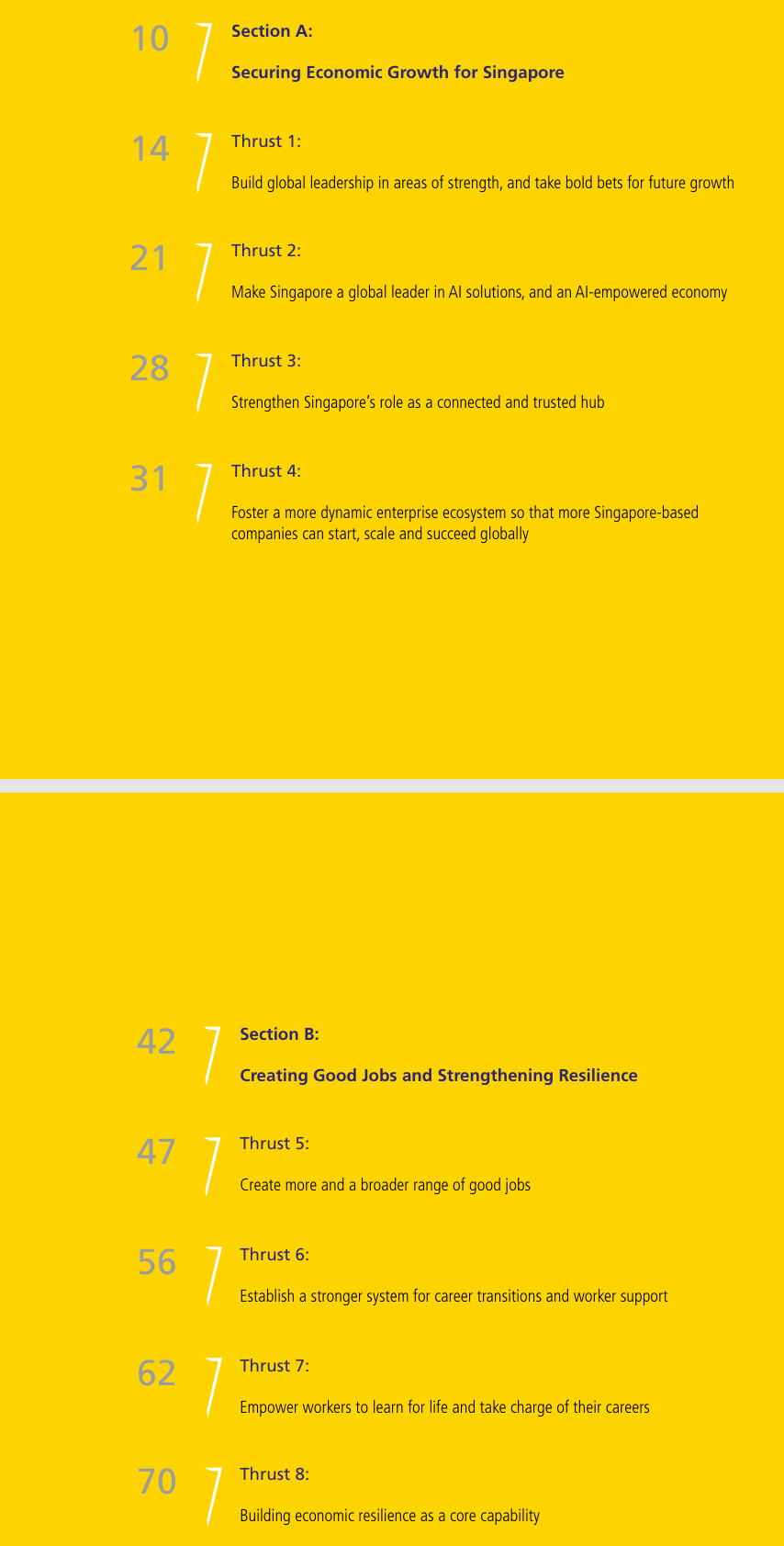
Three imperatives guide the recommendations: sharpen Singapore’s value proposition in a world where it cannot compete on raw scale; build greater agility and adaptability into firms, institutions and workers; and embed resilience alongside efficiency, given more frequent economic shocks.
These imperatives translate into eight thrusts spanning two broad areas, namely securing growth, and creating good jobs while strengthening resilience.
The first thrust builds global leadership in existing areas of strength, including semiconductors, pharmaceuticals and aerospace, while investing in emerging fields such as quantum technology, space, and decarbonization. The second thrust positions Singapore as a trusted base for developing and deploying artificial intelligence (AI), rather than competing to build the largest frontier models. The third deepens Singapore’s role as a global hub, moving beyond a waypoint through which goods, capital, data and energy pass, to a place where these flows are orchestrated, financed and governed. The fourth fosters a more dynamic enterprise ecosystem, helping companies start, scale, restructure and internationalize.
The fifth thrust creates more good jobs, including a broader range of them, given that AI and automation may no longer generate employment at the same rate as past growth. The sixth establishes a stronger system of “career bridges” and earlier intervention to help displaced workers transition into new roles. The seventh overhauls Singapore’s lifelong learning architecture so workers can keep pace with skills becoming obsolete more quickly. The eighth treats economic resilience as a core national capability, covering energy security, climate adaptation, supply chain vulnerabilities and trusted international partnerships.
A maturing startup ecosystem
Singapore ranks fourth globally on StartupBlink’s Global Startup Ecosystem Index 2026, behind the United States, United Kingdom and Israel, having climbed seventeen places since 2019. The ecosystem comprises more than 4,500 tech startups, supported by 220 incubators and accelerators and roughly 500 venture capital firms.
A funding gap persists for growth-stage companies. A pre-Budget 2026 survey by the Action Community for Entrepreneurship found that 73 per cent of respondents cited difficulty attracting capital amid a global funding contraction. The ESR showed that “venture funding by Singapore firms declining further in 2025” as investors shifted toward later-stage deals. Venture debt remains under 5 per cent of total startup funding in Singapore, compared with roughly 25 per cent in the United States, according to one committee member.
A S$1 billion ($780 million) top-up to the Startup SG Equity scheme now supports growth-stage deep tech startups, alongside a second S$1.5 billion tranche of the Anchor Fund, under which the government will act as a cornerstone investor in companies preparing to list domestically. A Growth Capital Workgroup is studying further measures to deepen these markets, including venture debt, private credit and secondaries.
The review also recommends mechanisms to help startups secure their first customers, deepen access to specialised talent, and build entrepreneurial mindsets from a young age.
Besides, the ESR aims to help startups attract specialized talent with improved tax schemes, particularly in deep tech fields where 78 per cent of polled startups offered such schemes in 2024, up from 59 per cent in 2021. The new AI and Tech Track under the Overseas Network and Expertise Pass, taking effect from 1 January 2027, will recognize non-cash components such as employee share options as part of its salary criterion.
Singapore’s total trade reached $1,083.5 billion in 2025, more than three times the size of its GDP. Foreign direct investment inflows hit $150 billion in 2024, led by the United States, United Kingdom, Japan, and China.
The economy has expanded at an average of roughly 3 per cent a year over the past decade, with outward-oriented services such as wholesale trade and finance accounting for about 54 per cent of nominal value added in 2025, manufacturing contributing a further 18 per cent, and domestically oriented sectors such as retail, food and beverage, and construction making up the remaining 27 per cent.
Singapore eyes global leader in AI solutions, AI-empowered economy