

Targeting the Energy Bottleneck of AI Data Centers: SANOC’s 100G EcoFiber Intelligent Optical Transceiver Wins the 2026 Taiwan Excellence Award
Driving AI Data Center Transformation with Sustainable High-Speed Optical Technology
NEW TAIPEI CITY, Dec. 16, 2025 /PRNewswire/ — As artificial intelligence (AI) and high-performance computing (HPC) continue to expand rapidly, the demand for high-speed, low-power, and highly reliable optical communication equipment in data centers is steadily rising. SANOC’s independently developed product, the EcoFiber100 – 100G Intelligent Optical Transceiver, has been awarded the 2026 Taiwan Excellence Award, demonstrating the company’s technological strength in high-speed optical communication, energy-efficient design, and sustainable innovation.
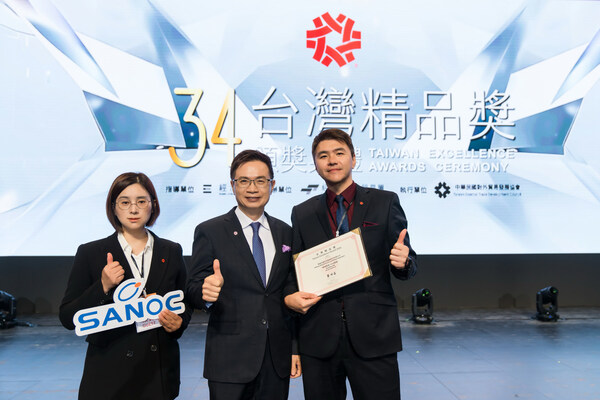
Dr. Sam Liao, CEO of SANOC, and Ms. Elise Lee, PR Manager, pose for a photo with Mr. James Huang, Chairman of TAITRA.
The Taiwan Excellence Award is regarded as one of Taiwan’s most important industrial honors. Evaluation criteria include R&D innovation, product design, quality management, marketing strategy, and domestic manufacturing capability. SANOC’s recognition this year not only underscores its deep technical expertise in high-speed optical communications, but also highlights its long-term commitment to energy-efficient and sustainable technologies.
Focusing on AI and Data Center Needs — Low Power as the Key Technological Indicator
Dr. Yu-Sheng Liao, General Manager of SANOC, stated:
“Winning the 2026 Taiwan Excellence Award with EcoFiber100 reflects the achievement of our team’s long-term dedication to high-speed optical communication and energy-saving technologies. As AI and cloud services accelerate, data centers increasingly require optical communication solutions that offer high efficiency, low power consumption, and maintainability. Moving forward, SANOC will continue to innovate and uphold sustainability as our core principles, helping customers achieve the best balance between performance and energy usage.”
Why are low-power optical modules considered the lifeline of next-generation AI data centers?
Dr. Liao explains: “If you have read NVIDIA, Meta, or Microsoft’s recent annual reports, you may have noticed a recurring concern — the energy ceiling. In AI computing, the true bottleneck is no longer pure computing power, but whether systems can cool down and whether data centers can afford the electricity. Traditional solutions rely on larger heatsinks, stronger fans, or more complex liquid-cooling systems. These not only increase server costs but also make rack expansion significantly more difficult. The bottleneck of AI isn’t that we can’t build it, but that we can’t stack it anymore. This is why low-power optical modules have become essential to sustaining AI infrastructure.”
From the perspectives of power consumption, thermal control, density, and serviceability, low-power optical modules have evolved from being mere communication components to becoming strategic units in the global AI energy race.
Three Key Technical Advantages Designed for High-Density Compute Environments
To address the increasingly demanding compute environments in AI and HPC scenarios, EcoFiber100 integrates several critical technologies to enhance stability under high-heat and high-load operation. Key features include:
- Stable Operation Under High Thermal Load
High-efficiency packaging and precise optoelectronic management significantly improve thermal stability during prolonged high-load operations. - Low-Power Architecture Enabling High-Density Deployment
Power consumption is reduced to approximately 60% of comparable products, enabling higher server density while lowering total energy usage. - Intelligent Monitoring to Reduce Operational Risks
Integrated DDM smart diagnostics provide real-time telemetry on temperature, voltage, and module lifespan, enabling administrators to detect anomalies early.
Additionally, EcoFiber100 can be paired with SANOC’s self-developed Optical Module Intelligent Monitoring Platform, enabling comprehensive module-level oversight. According to internal estimates, this can improve operational efficiency by over 30% and reduce maintenance risks.
Responding to Global Net-Zero Trends: Low-Carbon Design for Sustainable Data Centers
In the global pursuit of net-zero emissions—and as AI accelerates energy demand—EcoFiber100 supports sustainable data center transformation through its product design and manufacturing approach:
- Power consumption reduced to approximately 60% of industry-equivalent modules
- High-density deployment can reduce cooling energy usage by around 40%
- Compliant with RoHS and halogen-free standards
- Incorporation of recyclable materials and lead-free manufacturing processes
Future Outlook: Advancing Innovation, Expanding Global Reach, and Fulfilling Sustainability Goals
SANOC will continue leveraging its expertise in high-speed optical technology to advance three major development directions:
- Technological Innovation and Product Expansion
Accelerating development of 400G, 800G, and 1.6T optical transceivers to deepen product capabilities. - Global Market and Service Infrastructure Enhancement
Expanding service hubs across five continents to provide strengthened technical support and delivery capabilities. - Sustainable Manufacturing and Supply Chain Development
Promoting green processes, enhancing carbon-management transparency, and fulfilling long-term sustainability goals.
Dr. Liao further emphasized:
“Taiwan possesses exceptional engineering capabilities and talent, yet has long been constrained by capital environments, regulatory structures, and international supply chain systems. But the true force driving technological progress has never been capital nor regulation — it is humanity’s desire and determination to build a better world. The closer technology aligns with real-world needs, the greater its power to change the world.”
“With world-class R&D and manufacturing capabilities, Taiwan can play a pivotal role in the green transformation of global data centers. Through high-speed optical communication and sustainable manufacturing, SANOC is not only responding to the decarbonization challenge, but also empowering Made in Taiwan to become a key force in global data-center sustainability. This is what we are committed to — and the way we believe we can change the world.”