

Vietnam and Japan have signed a memorandum of understanding on artificial intelligence (AI) research and development and a bilateral agreement to speed up patent examination, during the official visit to Japan by General Secretary-State President To Lam.
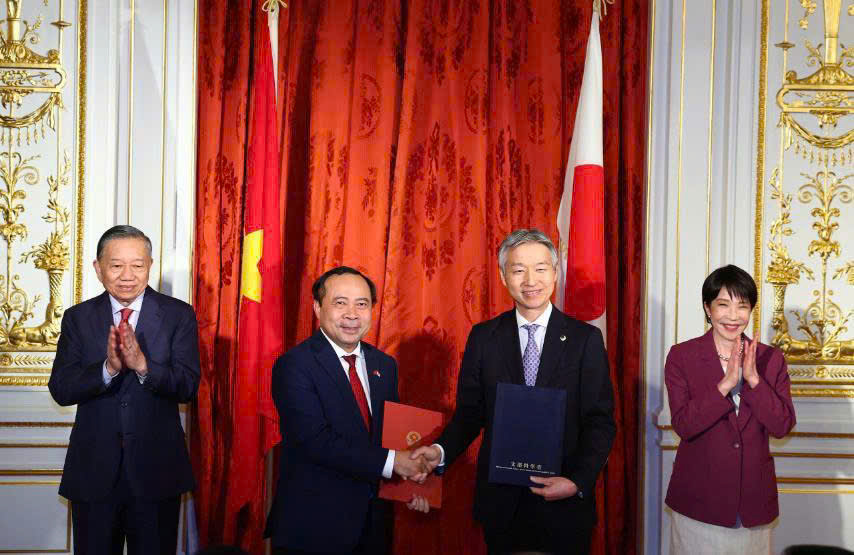
Vu Hai Quan, Vietnam’s Minister of Science and Technology, and Yasuyoshi Kakita, Deputy Minister for Policy Coordination at Japan’s Ministry of Education, Culture, Sports, Science and Technology (MEXT), signed the AI memorandum, the Vietnamese ministry said on Monday.
It sets out three areas of cooperation: joint research and development on AI and AI for science and related technologies; exchanges of researchers and experts, with workshops and joint research activities; and the sharing of research results and the practical application of AI.
The two sides said they will expand cooperation through the NEXUS program, a Vietnam–Japan framework focusing on semiconductors and high-tech workforce development, to cover AI. They also plan to collaborate to support training of 100 AI doctoral candidates.
Besides, Vietnam’s Intellectual Property Office and Japan’s Patent Office (JPO) signed a bilateral agreement on the Patent Prosecution Highway Navigator, which aims to speed up patent examination. Under it, Vietnam will regularly provide a list of patent applications that request fast-track examination through the PPH program. The JPO will provide reasons for the grant of corresponding Japanese patents to support examination in Vietnam.
The aim is to cut the average time to the first substantive examination result to eight months from the date a fast-track request is received. The ministry said the scheme should help businesses, research institutions, and universities reduce time and fees, speed up the establishment of intellectual property rights, and help move research results into commercial use.
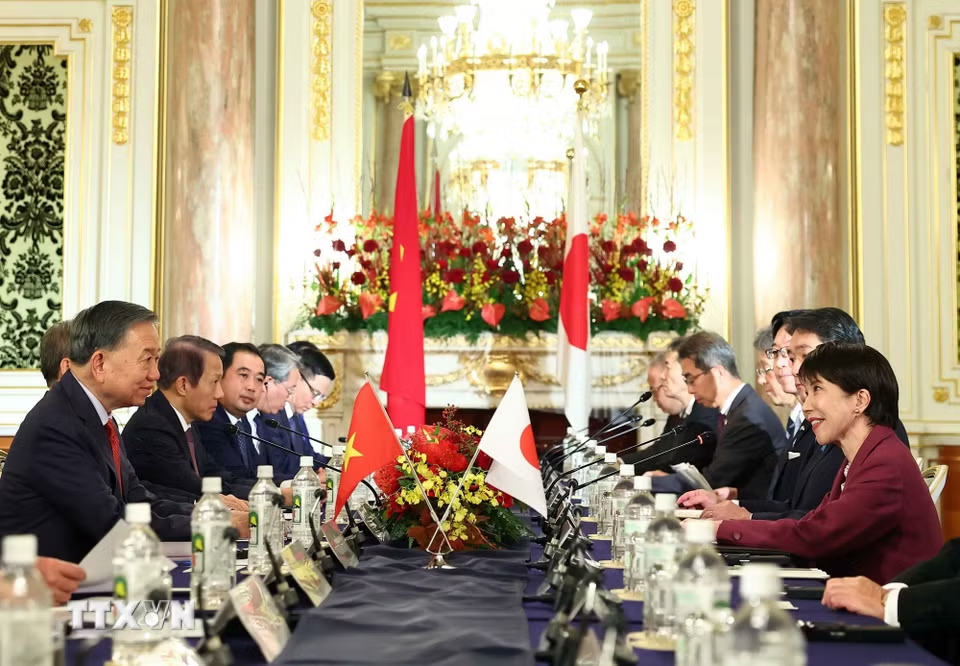
Additionally, at their talks in Tokyo on November 9, Vietnamese General Secretary- State President To Lam and Japanese Prime Minister Sanae Takaichi agreed that technology cooperation should move from transfer to joint research, joint investment, and shared markets.
On technology, the two leaders agreed to expand cooperation in AI, semiconductors, quantum technology, robotics, energy technology, biotechnology, high-speed rail, and space. They also agreed to promote AI cooperation within the Japan–ASEAN AI co-creation initiative and to link university and research institutes in both countries.
For digital infrastructure, the two leaders named submarine cables, Open RAN, AI-RAN, 5G and 6G, satellite communications, and all-optical networks as priorities.
The joint statement from the visit also records 14 joint crediting mechanism projects and 15 Vietnam–Japan energy projects under the Asia Zero Emission Community, which includes LNG-fired power plants backed by Japanese investors.
Japan’s Sojitz to buy 5% of Vietnam’s Masan High-Tech Materials, after $125M deal of US’ Elmet