

The AI trend can help drive up the economic growth of Southeast Asia and Vietnam can top the region’s GDP growth in 2026 with 7.4 percent, followed by Indonesia with 5.2 percent and Malaysia with 5.1 percent.
The World Bank (WB) released the figures in the October 2026 edition of its “East Asia & Pacific Economic Update” report, with a focus on “Riding the AI Wave.” It clarifies AI value chain as production related to semiconductors (chips), computation (data centers), large language models (LLMs), and others.
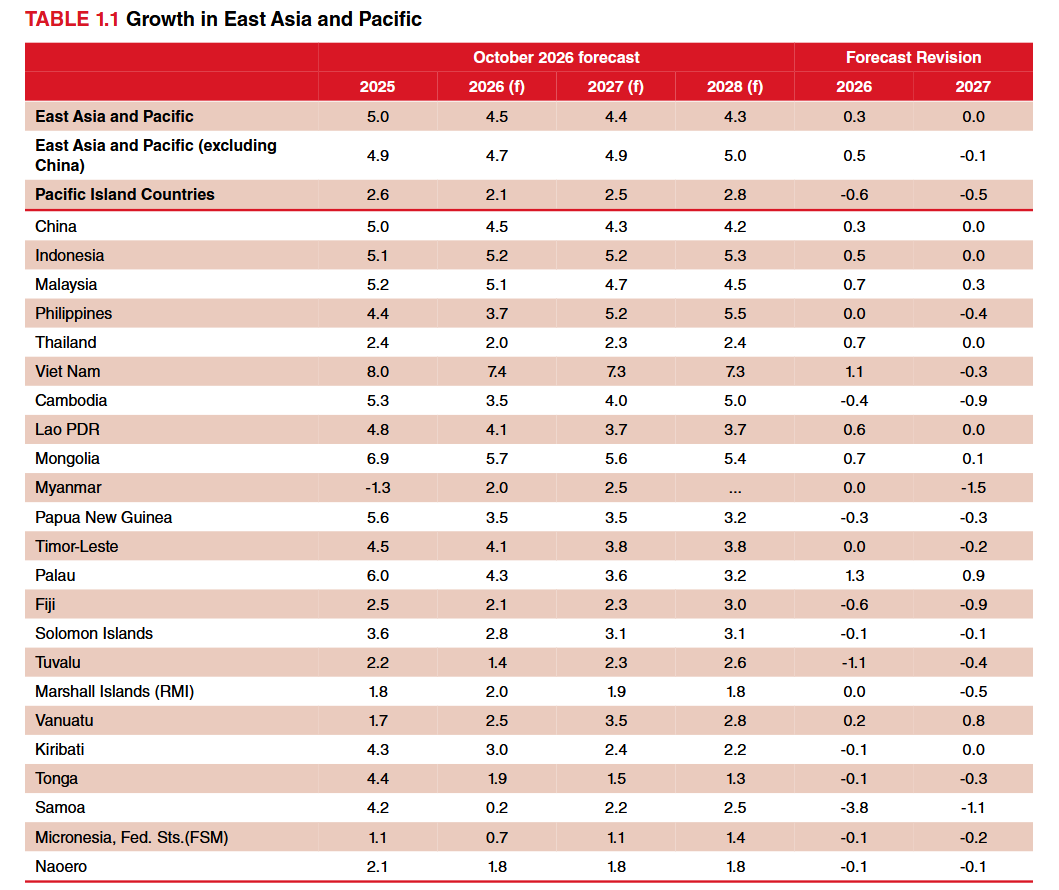
The report pointed out Vietnam’s GDP growth reached 8 percent in 2025 and can reach 7.4 percent in 2026, 7.3 percent in 2027, and 7.3 percent in 2028, the highest rates in the region. The WB’s projection does not include advanced economies, such as Singapore, South Korea, and Japan.
For 2026, the WB also expects high growth from Mongolia at 5.7 percent, Indonesia at 5.2 percent, Malaysia at 5.1 percent, and China at 4.5 percent.
The WB emphasized global investment in AI-related assets has risen sharply on the expectation of significant profits and productivity gains. This spending has become an important driver of global activity.
A slowdown concentrated in AI would be material for East Asia because of the region’s prominence in the AI supply chain. China, Indonesia, Malaysia, the Philippines, Thailand, and Vietnam exported $1.4 trillion of AI-related goods to the world in the twelve months to April 2026.
Much of this went to the United States, which imported $739 billion of AI-related goods in the 12 months to April 2026, one third of it from East Asia and Pacific.
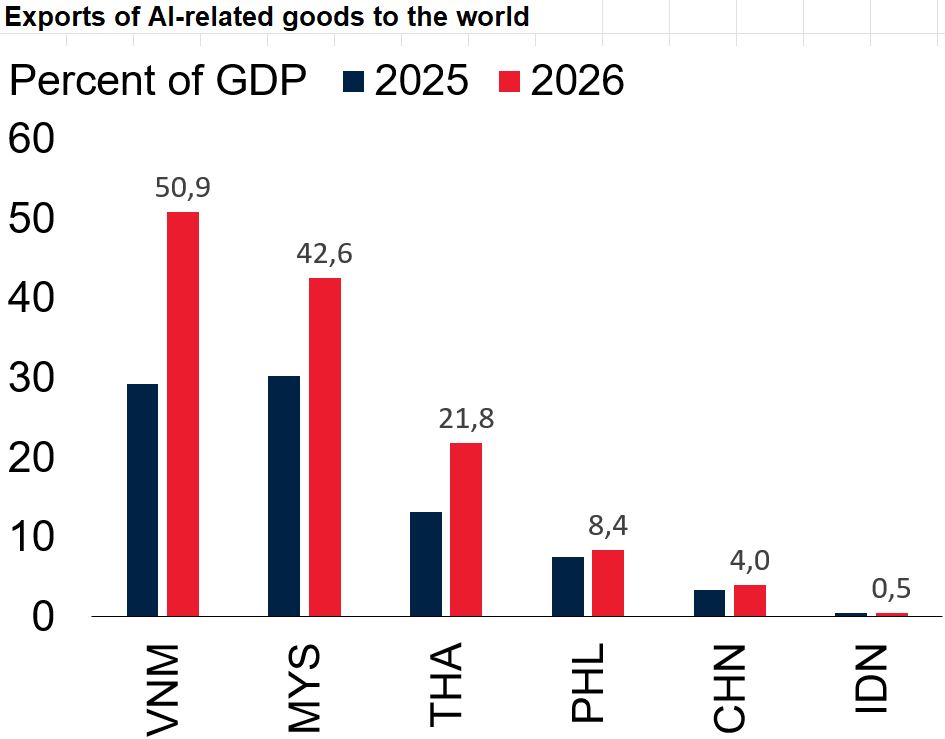
China, the largest supplier at $785 billion, mostly exports intermediate inputs, which account for nearly three-quarters of the country’s AI-related exports, to other ASEAN countries.
Assembled equipment such as computers, servers, and routers accounts for 69 percent of Thailand’s AI-related exports and 60 percent of Vietnam’s, with a larger share directed to final demand in the United States.
Exports of AI-related goods have at least doubled relative to their 2020–22
averages in Vietnam and Malaysia, the WB added.
AI has yet to significantly impact automatable jobs, but it is already reshaping skills demand, the WB stressed. Firms increasingly seek AI expertise alongside analytical abilities and social skills.
AI is most effective at supporting jobs that require complex thinking and judgment, yet only 13 percent of jobs in the region fall into this category, compared to 39 percent in advanced economies.
Granite Asia, Google AI fund to co-invest up to $2M per Asian AI startup