

Software developers across Southeast Asia and India are handing more work to autonomous AI “agents,” yet 86 percent still have to review or validate the AI’s output most of the time
Singapore-based digital travel platform Agoda, part of Booking Holdings, released the figure in its “Agoda AI Developer Report 2026.” The report, released on Friday, showed that 79 percent of AI tasks require human approval before code reaches production.
The Agoda AI Developer Report 2026, based on responses from more than 800 developers and engineering leaders across seven markets, found that 53 percent now use AI agents in selected production workflows or broadly across their organisations. This is a shift from earlier assistant-style use.
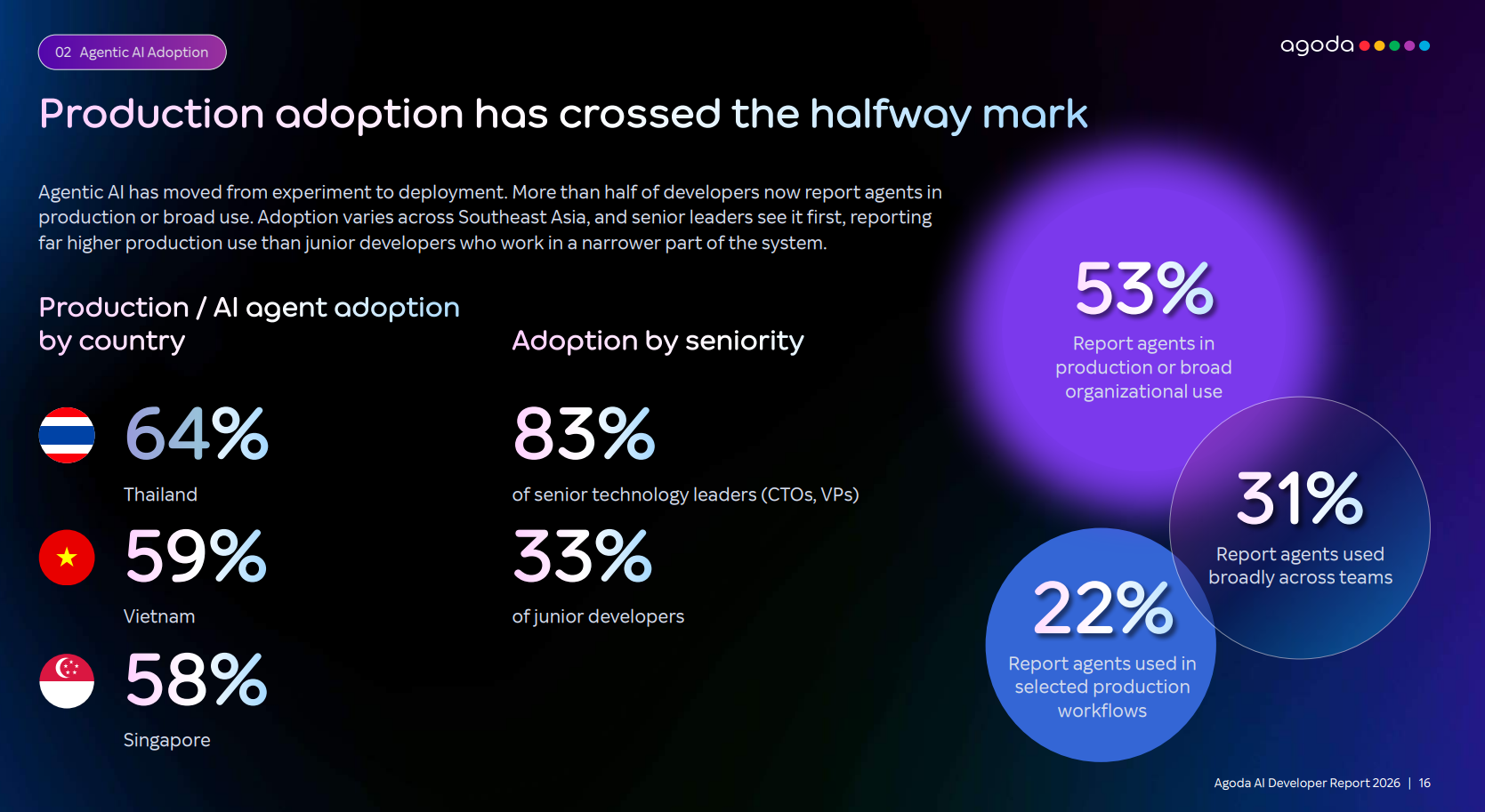
Adoption was highest in Thailand at 64 percent, followed by Vietnam at 59 percent, and Singapore at 58 percent. Only 38 percent considered their codebase ready for full autonomy, meaning some teams are deploying agents into code they do not yet regard as ready.
Productivity gains have risen sharply. The share of developers saving at least seven hours a week tripled to 55 percent from 18 percent in 2025, the report said. The figure varied, such as Thailand at 70 percent, Vietnam at 63 percent and the Philippines at 57 percent. About 62 percent said AI-generated code was usable often or almost always without major changes.
Cost has become a leading obstacle to wider use, cited by 28 percent as the top barrier, narrowly ahead of integration complexity at 24 percent and weak governance at 19 percent. The report said AI costs extend beyond model usage to the work of designing, integrating and validating agents, and that four in five developers operate under some limit such as token quotas or budget caps.
The demand for oversight tightens closer to production, with the human sign-off requirement rising to 84 percent in both Vietnam and Thailand. Even so, 71 percent expect AI agents to handle most development work within three years.
Idan Zalzberg, Agoda’s chief technology officer, said AI was moving from speeding up individual tasks to reshaping software development more broadly, but that the real cost lay in making AI trustworthy in production.
The survey was conducted online between June and August 2026 with Macramé Consulting, covering India, Indonesia, Malaysia, the Philippines, Singapore, Thailand and Vietnam.