

The Asian Development Bank (ADB) raised its 2026 economic growth forecast for developing Southeast Asia to 4.7 percent, crediting the global technology and artificial-intelligence (AI) investment cycle and resilient electronics exports.
The ADB released its forecast in the September 2026 edition of its Asian Development Outlook (ADO), released on Wednesday. The figure is higher than the 4.6 percent projected in the July edition. Besides, the ADB said gains remain uneven across the region.
For 2027, the bank lifted the sub-regional forecast to 4.9 percent from 4.8 percent. It pointed to three forces behind a widening divergence: the technology and AI investment cycle favoring economies tied into electronics and digital supply chains; differences in public investment and policy support; and varying domestic demand, tourism, and economic structure.
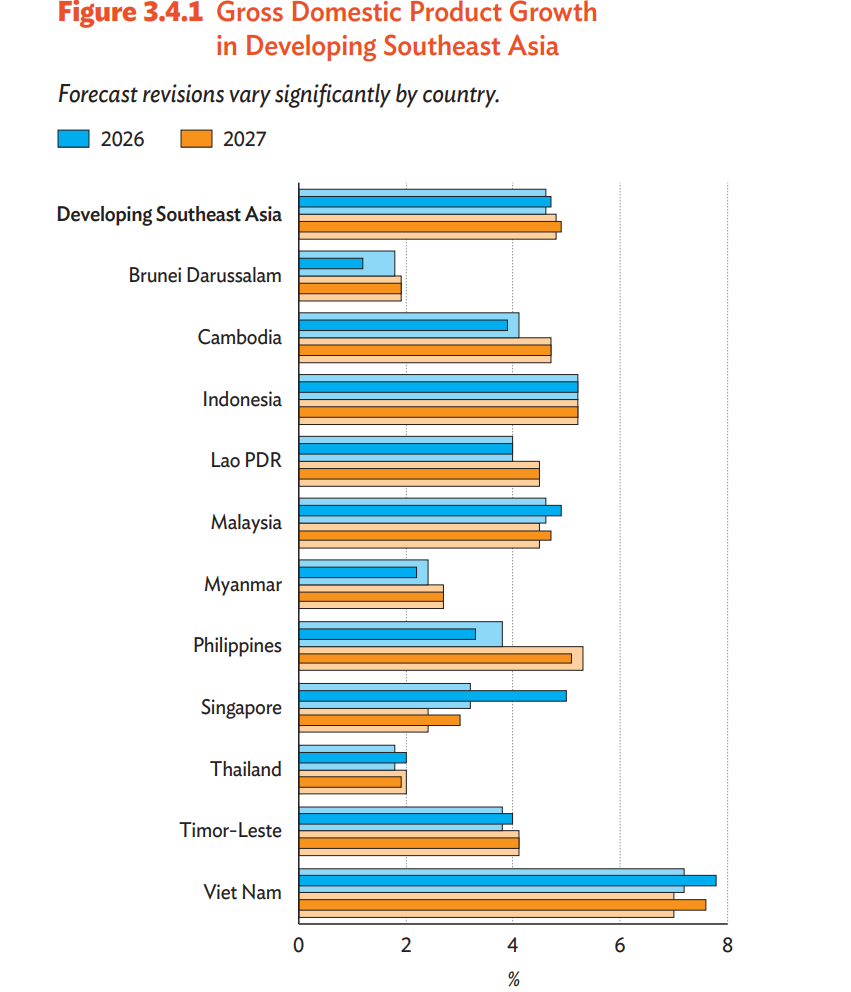
Vietnam drew the largest upgrade. The bank raised its 2026 forecast to 7.8 percent, from 7.2 percent, and its 2027 forecast to 7.6 percent, from 7.0 percent, citing rapid manufacturing expansion, strong foreign direct investment, resilient services and accelerated infrastructure spending.
Malaysia’s 2026 forecast rose to 4.9 percent from 4.6 percent, and its 2027 figure to 4.7 percent, helped by a semiconductor upcycle, data-center investment, and public infrastructure programs.
Thailand’s 2026 forecast increased to 2.0 percent from 1.8 percent on electronics exports and technology investment, before easing to 1.9 percent in 2027 as export momentum normalizes.
The Philippines was downgraded for 2026, to 3.3 percent from 3.8 percent, on weak public investment, softer consumption and higher food and fuel prices, with a rebound to 5.1 percent expected in 2027 on electronics exports.
Indonesia’s outlook was unchanged at 5.2 percent in both years, supported by consumption, services, and supportive fiscal and credit conditions.
Timor-Leste’s 2026 forecast rose to 4.0 percent from 3.8 percent, and to 4.1 percent for 2027, on stronger government spending, credit growth and improved investor confidence after its accession to the ASEAN bloc.
Cambodia’s 2026 forecast was cut to 3.9 percent from 4.1 percent as tourism stayed below pre-pandemic levels and border disruptions persisted, with a recovery to 4.7 percent seen in 2027.
Myanmar’s 2026 forecast fell to 2.2 percent from 2.4 percent, held back by instability, supply constraints and import curbs, and was kept at 2.7 percent for 2027.
Brunei Darussalam’s 2026 forecast was reduced to 1.2 percent from 1.8 percent as stronger hydrocarbon output failed to offset weakness in its non-oil economy, before 1.9 percent in 2027. The forecast for Laos was left unchanged.
Singapore, featuring as an “advanced” Asian economy, drew one of the sharpest upgrades. The bank raised its 2026 forecast to 5.0 percent from 3.2 percent, citing a first-half performance above expectations and continued global AI investment, and lifted its 2027 figure to 3.0 percent from 2.4 percent.
Across developing Asia and the Pacific, the Manila-based bank lifted its 2026 growth forecast by 0.1 percentage point, to 5.0 percent, and held its 2027 projection at 5.1 percent.
Singapore exports surge 46.2% in August on AI-linked electronics demand