

Asia Pacific small and medium-sized enterprises remain optimistic about growth, but many are placing greater emphasis on predictability as the number of digital tools and payment methods they manage increases, according to Mastercard’s new Dreamonomics research.
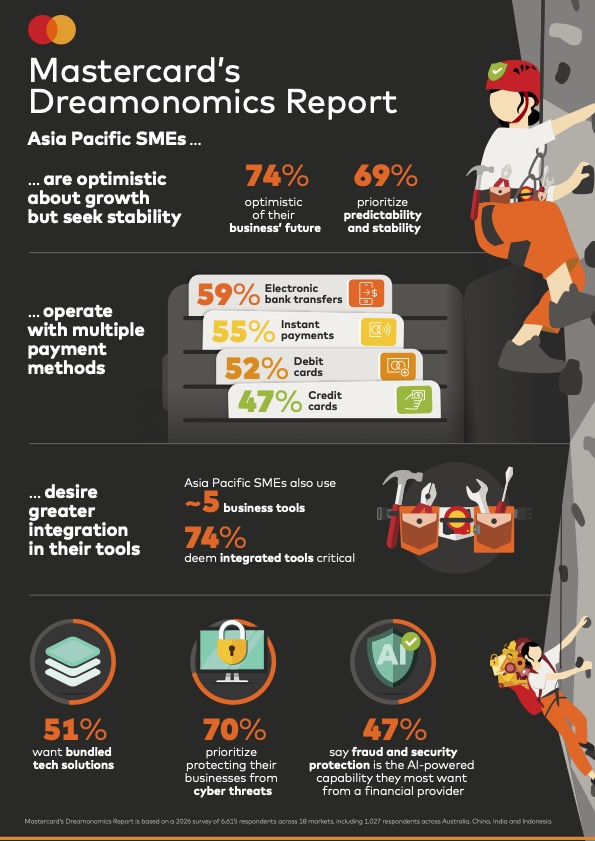
The regional findings show 74 percent of surveyed APAC SMEs are optimistic about the future of their business and 61 percent frequently experiment with new ideas. At the same time, 69 percent say predictability and stability are priorities. Mastercard said the inaugural study covered more than 6,000 SMEs across 18 countries, including more than 1,000 respondents in Australia, China, India and Indonesia.
The results point to a practical challenge for smaller businesses that have already digitized much of their operations. Access to technology is increasingly being followed by a need to make separate tools, accounts and payment methods work together with less administrative overhead.
More tools create more operational friction
APAC SMEs use five business tools on average, according to the survey, while 94 percent are interested in adopting at least one tool they do not currently use. Three in four, or 74 percent, say integrated tools are critical.
That combination suggests the next phase of SME digitization will depend partly on consolidation and interoperability. Adding another application can solve a specific problem, but it can also introduce another place to reconcile data, permissions and workflows.
“Businesses don’t think in terms of payment rails or funding sources. They think about paying suppliers, managing cash flow and keeping operations moving,” said Anouska Ladds, executive vice president for Commercial and New Payment Flows, Asia Pacific at Mastercard.
Mastercard has previously highlighted similar issues in cross-border payments for Asia Pacific SMEs, where fragmented systems and limited visibility can add friction as businesses expand internationally.
Payments add another layer of complexity
The Dreamonomics findings show APAC SMEs use four payment methods on average for business expenses. Electronic bank transfers are used by 59 percent of respondents, instant payments by 55 percent, debit cards by 52 percent and credit cards by 47 percent.
Having multiple payment options gives businesses flexibility, but Mastercard argues that it can also create delays in reconciliation and reduce cash-flow visibility when accounts and funding sources are managed separately.
The company is using the research to support a broader push toward integrated commercial-payment products. In India, Mastercard and City Union Bank are piloting Mastercard One Credential, which can link multiple eligible consumer and commercial payment relationships to a primary card. Transactions can then be routed according to preset preferences such as transaction amount or merchant category.
Mastercard described the pilot as India’s first experience of this type. That is a company claim, and the announcement does not establish how widely the pilot is available or how many SMEs are participating.
India shows demand for payment flexibility
The India responses show stronger interest in some payment options than the APAC average. Mastercard said 63 percent of Indian SMEs are interested in real-time payments, compared with 51 percent regionally. Forty-five percent are open to flexible digital payment solutions, while 39 percent expressed interest in a combined credit and debit business card with controls.
The pilot is intended to let eligible SMEs separate personal and business expenses while retaining flexibility over how transactions are funded. Its practical value will depend on how the controls work in daily use and how well participating banks can integrate the underlying accounts and payment relationships.
Cybersecurity adoption still trails concern
Security is another area where the survey found a gap between stated priority and current adoption. Seventy percent of APAC SMEs say protecting their business from cyber threats is a high priority, but only 39 percent currently use cybersecurity tools.
AI interest is also high. Seventy-four percent of regional respondents said they are excited about AI’s potential, while fraud and security protection was the AI-powered capability they most wanted from a financial provider, cited by 47 percent.
Mastercard Simplifies Cross-Border Payments for Asia Pacific SMEs