

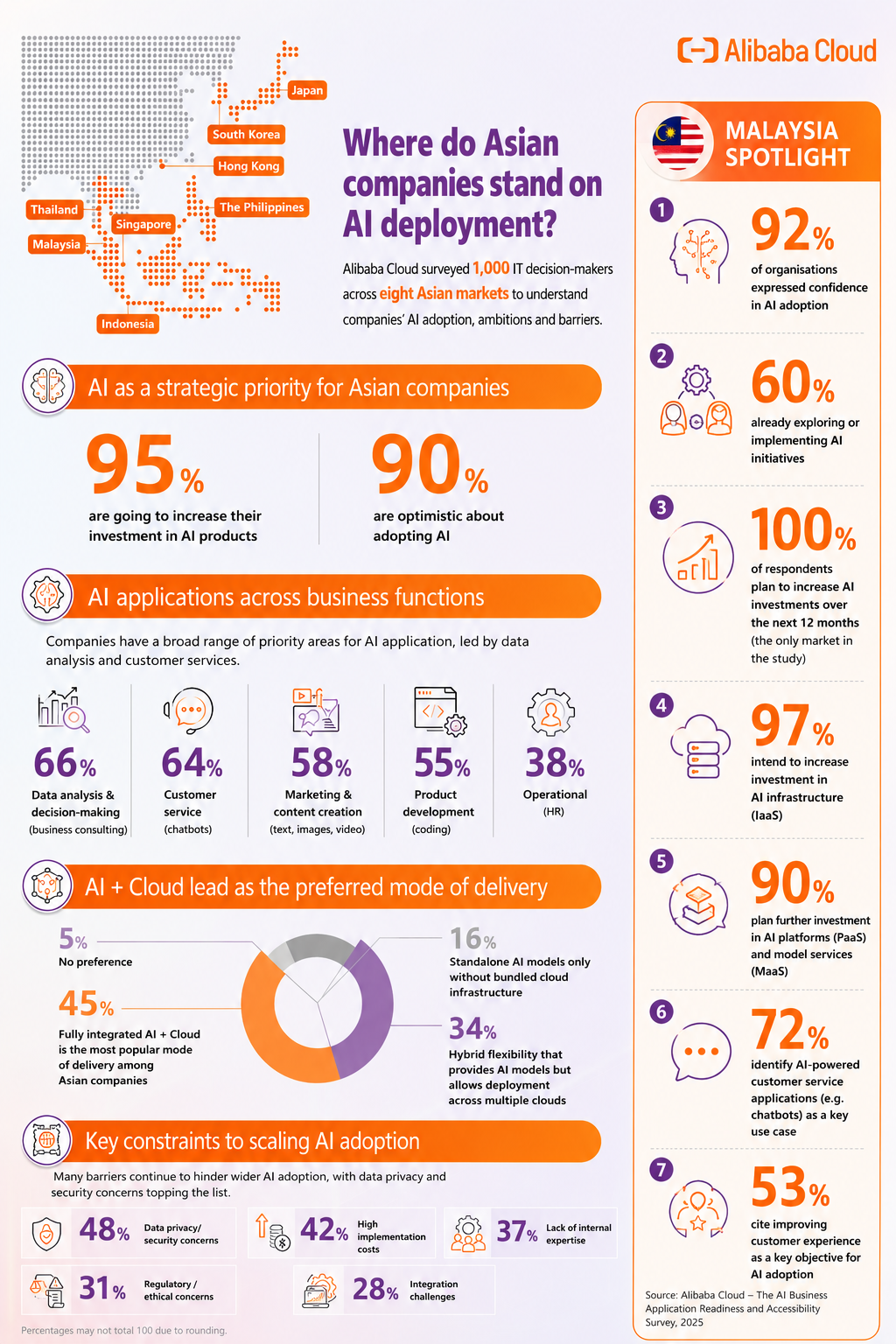
Malaysia is the only market among eight surveyed in Asia where 100 percent of respondents plan to increase AI investment, according to a survey of 1,000 IT decision-makers commissioned by China’s Alibaba Cloud and conducted by NielsenIQ.
In a recent statement related to the survey, Alibaba Cloud said 97 percent of respondents in Malaysia plan to raise spending on AI infrastructure (Iaas). More than 90 percent plan further investment in AI platforms (PaaS) and model services (MaaS), Alibaba Cloud added.
Across the eight markets, 99 percent of respondents say AI is a priority and 75 percent say AI has become indispensable to their business operations. Around 90 percent have started adopting AI development tools and models, while only 1 percent say AI is not a priority.
The top strategic objectives for AI adoption globally are driving innovation and new business opportunities at 64 percent, followed by achieving cost savings and efficiency at 63 percent, unlocking revenue growth potential at 48 percent, gaining competitive advantage at 45 percent, and improving customer experience at 43 percent.
The most common functional use cases are data analysis and decision-making at 66 percent, customer service tools such as chatbots at 64 percent, marketing and content creation at 58 percent, product development including coding at 55 percent, and HR operations at 38 percent. In Malaysia, 72 percent identify AI-powered customer service as a key use case and 53 percent cite improving customer experience as a top objective.
On solution preferences, 45 percent of respondents prefer fully integrated AI and cloud offerings from a single provider, compared with 34 percent who favor hybrid flexibility with models deployable across multiple clouds, and 16 percent who prefer standalone AI models without bundled cloud infrastructure.
Despite strong enthusiasm, data privacy and security concerns are the top barrier to broader adoption, cited by 48 percent of respondents. High implementation costs follow at 42 percent, while 37 percent point to a lack of internal expertise. Regulatory and ethical concerns are cited by 31 percent overall, rising in financial services, education, and the public sector.
Further barriers include integration challenges at 28 percent, limited solution accessibility at 23 percent, unclear return on investment at 22 percent, a lack of obvious business cases at 19 percent, and management resistance at 18 percent.
On support needs, 54 percent call for more customized AI solutions tailored to industry use cases, 49 percent for better availability of talent and skills, and 45 percent for more accessible and affordable offerings.
Language support also emerged as a critical factor, with only around half of respondents selecting English as their primary language for AI solutions, and enterprises in Japan, South Korea, Indonesia, and Thailand citing a scarcity of high-quality local-language models as a constraint on development.
Dr. Feifei Li, Chief Technology Officer and President of International Business at Alibaba Cloud Intelligence Group, said the findings reinforce the company’s belief that AI delivered on scalable, secure cloud infrastructure will be the defining technology platform for the next decade. The focus is shifting from producing efficient tokens to enabling actionable outcomes, the executive added.
AI demand powers Malaysia tech outlook despite risks – analysts