

Singapore has formally designated artificial intelligence (AI) as a national growth strategy, allocating 0.6 percent of GDP to the National Research Fund for AI capabilities and research in the FY2026 budget, the International Monetary Fund (IMF) said.
In its newly-released “Singapore: 2026 Article IV Consultation” report, the IMF highlighted the 0.6 percent figure is six times higher than the allocation of 0.1 percent of GDP for support package in response to the Middle East energy shock.
At the institutional level, the government is establishing a National AI Council chaired by the Prime Minister, with a mandate to set national AI strategy, commission priority AI deployments, and remove regulatory and resource bottlenecks. The four sectors identified for initial deployment plans are advanced manufacturing, connectivity, finance, and healthcare.
Private sector measures include expansion of the Enterprise Innovation Scheme to allow qualifying AI expenditures to receive tax deductions. The move can broaden the Productivity Solutions Grant to cover a wider range of digital and AI-enabled solutions, a new “Champions of AI” program to select successful AI adopters as sectoral benchmarks. Another scheme is to establish a new AI Park to concentrate startups, researchers, and industry partners in a single hub.
The IMF noted Singapore’s advantages, including its rank as first globally on the IMF’s AI Preparedness Index.
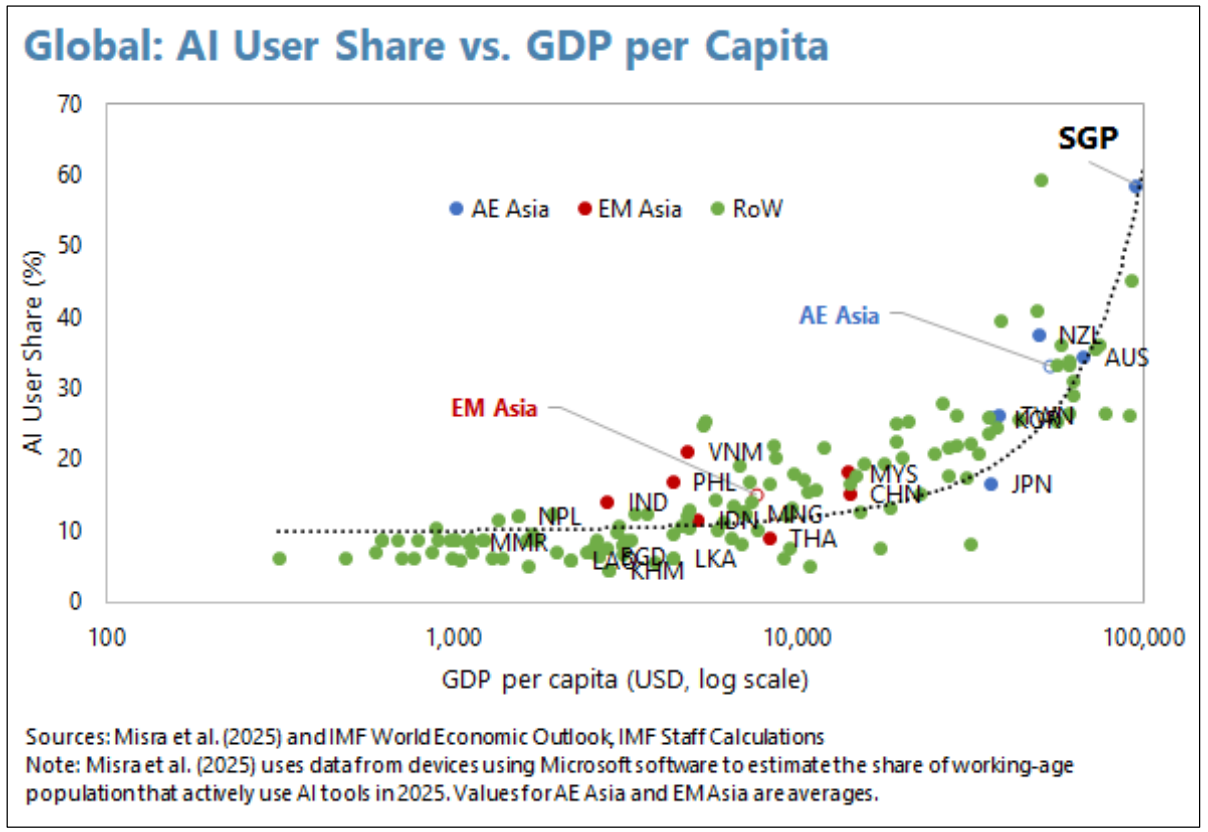
The economy grew at 5 percent in 2025, driven by AI-related electronics manufacturing and exports, the IMF added. The IMF’s 2026 growth forecast for Singapore was revised upward by 2.2 percentage points above the October 2025 edition of its World Economic Outlook baseline, driven largely by the strengthening AI technology cycle.
The IMF baseline projection is 3.5 percent growth in 2026 and 2.7 percent in 2027. Under an upside scenario in which AI demand continues to accelerate, growth can reach 4.4 percent in 2026.
Under a severe downside scenario involving a global re-evaluation of AI’s productivity potential, growth can slow to 2.6 percent in 2026 and 1.5 percent in 2027.
Regarding labor, the IMF identifies Singapore’s workforce as highly exposed to AI disruption, with women and younger workers facing the highest degree of exposure. Approximately half of the jobs most exposed to AI also carry high complementarity with the technology, indicating potential productivity gains alongside displacement risk.
Singapore also faces a measurable skills imbalance in which the number of jobs demanding new IT capabilities exceeds the number of graduates who have acquired them.
The government’s labor response includes free access to premium AI tools for Singaporeans enrolled in selected AI courses, expansion of tech-focused upskilling programs into non-tech professions, enhancements to the Workfare Skills Support and Progressive Wage Credit Scheme, and others.
AI demand drives Singapore’s manufacturing to 12.2% growth as economy expands 5.7% in Q2/2026