

US investor Balaji Srinivasan has requested a meeting with the office of Malaysia Prime Minister Anwar Ibrahim, days after immigration officers raided his startup school in Forest City, a sprawling $100-billion development on reclaimed land in Malaysia’s Johor state.
The Network School, a startup society he started, is willing to sign a memorandum of understanding with the Malaysian government committing to following local laws and respecting the country’s sovereignty, Srinivasan wrote in a post on X on Thursday.
Earlier this week, an immigration probe was launched into people associated with the startup school, saying that individuals may have flouted immigration rules.
Srinivasan said the accusations were false and that authorities had checked “hundreds of passports” and confirmed that “all travel documents were in order”.
In his post ”Should the global tech community continue investing in Malaysia” on X, he said at this point, all further investment they were planning to make in Malaysia is “on hold” until they get sufficient assurance that such issues won’t recur.
“So are the investment plans of many of our friends, including the execs and investors at global tech firms that we brought to Forest City. Because to put it very plainly: we have invested MYR100 million+ in Malaysia, while creating jobs for dozens of Malaysians, and our faces and names are known. Our Malaysian executives and employees deserve the benefit of the doubt over anonymous internet trolls,” he wrote.
“There are two paths forward. In the first case, if Malaysia still wants continued global tech investment, if it wants to be a top 20 tech hub, if it wants us to revitalize Forest City, then we request an audience with the Prime Minister’s office to discuss the terms of a memorandum of understanding between Network School and the Malaysian government, similar to the document recently signed between the Solana Foundation and the Kazakhstan government,” he wrote in the post.
“Specifics can of course be discussed, but we would publicly commit to abiding by all Malaysian laws (we already do) and respecting Malaysia’s sovereignty (never in question),” he added.
“We aren’t asking for any money — just a meeting, to help restore confidence in Malaysia as an investable jurisdiction. Alternatively, if you don’t want our investment, or those of our colleagues at billion dollar funds and trillion dollar companies, we will of course respect your wishes, and reallocate our capital to other countries instead,” he wrote in the post.
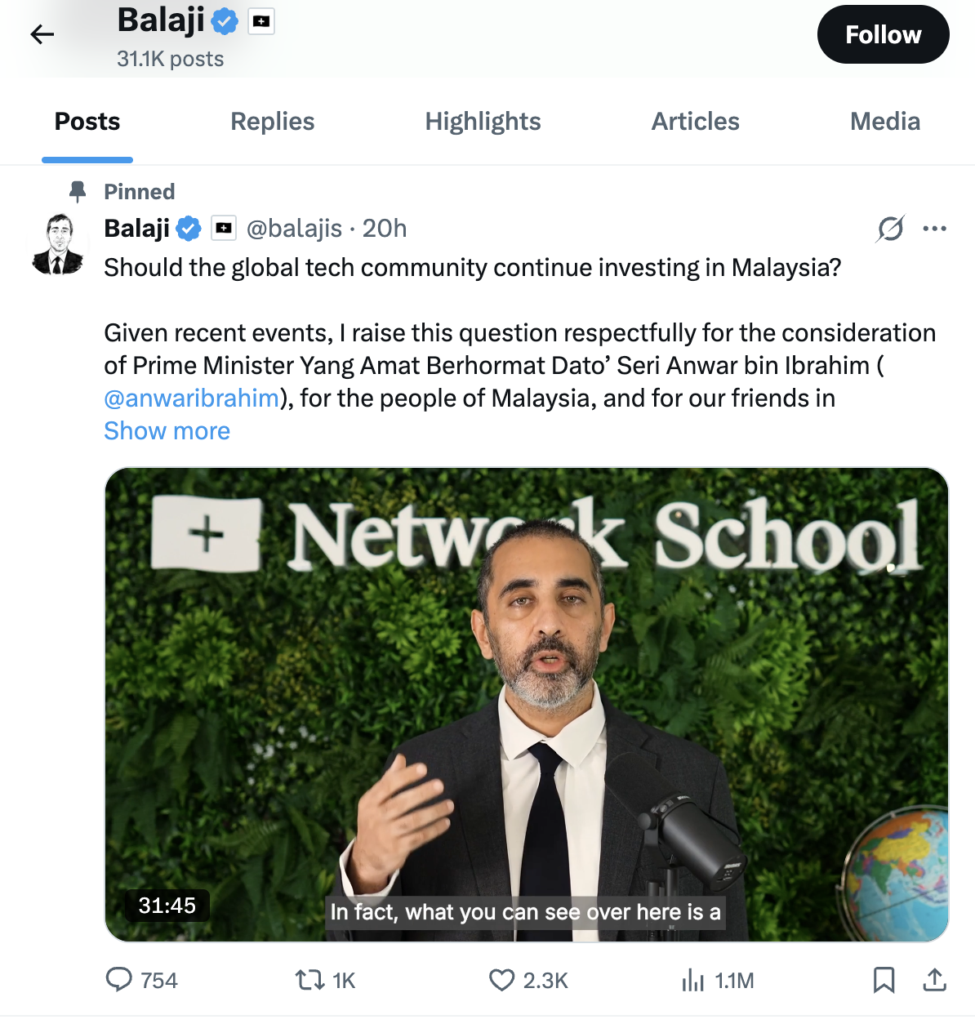
In his post on X, Srinivasan said he is the former CTO of Coinbase and former General Partner at Andreessen Horowitz (a16z) is a venture capital firm in Silicon Valley, California. In October 2024, he opened a startup society called Network School in Malaysia, because “he felt he had been invited in by the government’s pro-tech policies”.
“Specifically, the KL20 initiative set out Malaysia’s ambition of becoming a top 20 global tech hub. Their MDEC digital nomad visas and Malaysia My Second Home (MM2H) investor visas were created to facilitate an influx of global talent and capital. And the Johor-Singapore Special Economic Zone was announced to facilitate the flow of capital and talent between Malaysia and Singapore, where I live,” he wrote.
“When taken in combination with Malaysia’s datacenter buildout and its policy of welcoming visa-free visits for 98 percent of the world, it seemed like Malaysia might be a great place to build a global tech hub that was simultaneously inexpensive and easy to visit (especially for non-Westerners),” he added.
Reuters reported on Wednesday that Malaysia’s Immigration Department said that members of a “digital nomad” community run by Srinivasan had valid travel documents, a day after authorities announced a probe into claims that Israelis were among them in violation of local laws.
The investigation came after some social media users alleged that The Network School included participants from Israel who had entered Malaysia with passports of other countries.
Muslim-majority Malaysia, a staunch supporter of the Palestinian cause, bars entry of Israeli passport holders as the countries do not have diplomatic relations. However, it does not have specific laws barring Israelis from traveling on second-country passports, according to the report.
The immigration department said it had inspected 266 foreigners from 40 countries and found they had valid documents, though further checks were ongoing to ensure compliance with all other entry requirements and related laws, Reuters reported on Wednesday.
Tighter digital rules could cut Malaysian startup VC funding by 26%: Oxford Economics