

As many as 87 percent of investors in Asia Pacific expect greater market volatility over the next year, with only 5 percent planning to maintain their existing strategic allocations, according to Schroders’ Global Investor Insights Survey 2026.
In a statement on Wednesday, Schroders said the survey collected responses from more than 1,000 institutional investors and wealth managers globally with combined assets under management of $72 trillion.
The survey, conducted following the outbreak of war in Iran in early 2026, found geopolitical risks weigh more heavily on Asia Pacific investors than on their global peers. Armed conflict in the Middle East was the leading concern at 76 percent, compared to 69 percent globally, followed by uncertainty over US foreign policy and global leadership at 70 percent versus 67 percent globally, and energy security at 62 percent versus 60 percent globally.
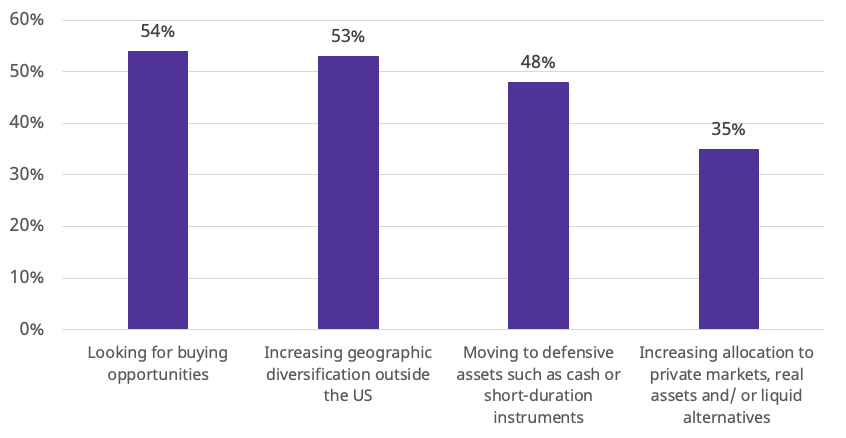
Downside protection and diversification emerged as the top portfolio priorities for Asia Pacific investors, at 83 percent and 82 percent respectively. Some 54 percent are looking for buying opportunities, 53 percent are increasing geographic diversification outside the United States, and 48 percent are moving to defensive assets such as cash and short-duration instruments.
Concentration risk has emerged as a key concern, with only 4 percent of Asia Pacific investors saying they are unconcerned about index concentration, and 37 percent rotating into active management specifically to address it. If diversifying away from technology, investors in the region identified energy at 50 percent, infrastructure at 39 percent, and value-focused strategies at 36 percent as the most likely sources of returns.
Conviction in active management remains strong, with 86 percent of Asia Pacific investors confident it can help achieve investment objectives over the next 12 to 18 months. Global equities topped the list of asset classes where investors see the greatest benefit from active management at 40 percent, followed by small and mid-cap equities at 30 percent.
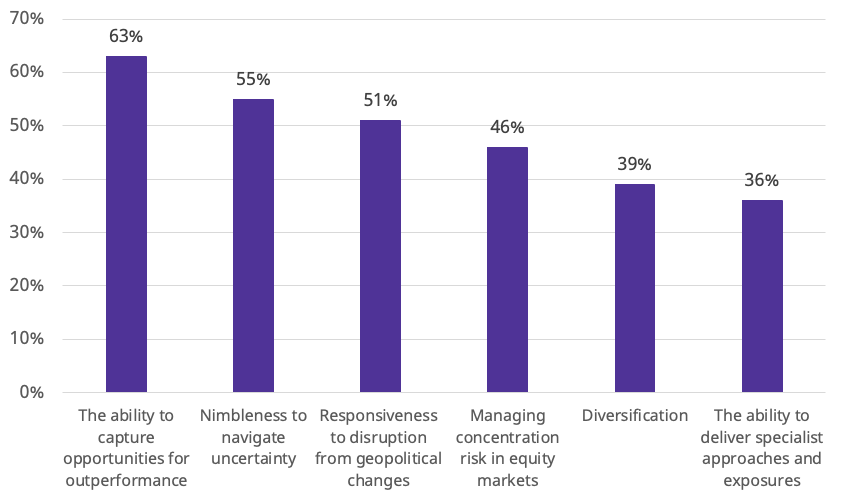
Conviction in active management remains strong, with 86 percent of Asia Pacific investors confident it can help achieve investment objectives over the next 12 to 18 months. Among the characteristics driving this confidence, 63 percent cited the ability to capture opportunities for outperformance, 55 percent cited nimbleness to navigate uncertainty, and 51 percent cited responsiveness to disruption from geopolitical changes.
Johanna Kyrklund, Group Chief Investment Officer at Schroders, said investors are reshaping portfolios to prioritise diversification and resilience while navigating geopolitical risk, and that the ability to be selective and respond dynamically to fast-moving market conditions is the active management edge in current conditions.
The survey also found investors taking a more holistic approach across public and private markets, with more than half evaluating opportunities holistically rather than through separate allocation frameworks: 53 percent for equities, 54 percent for credit, and 57 percent for income. Private credit adoption in the region is accelerating, with the zero-allocation group dropping from 23 percent to 15 percent.
Gopi Mirchandani, Head of Client Group for Asia at Schroders, said investors across the region want asset managers who can be nimble, provide access to specialist exposures, and work across both public and private markets, reflecting a structural shift in how portfolios are being built.
AI agents are joining the workforce; Inclusion must be part of the job description